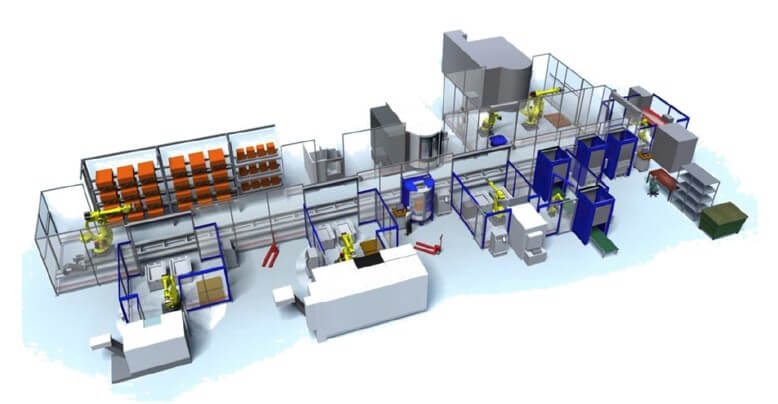
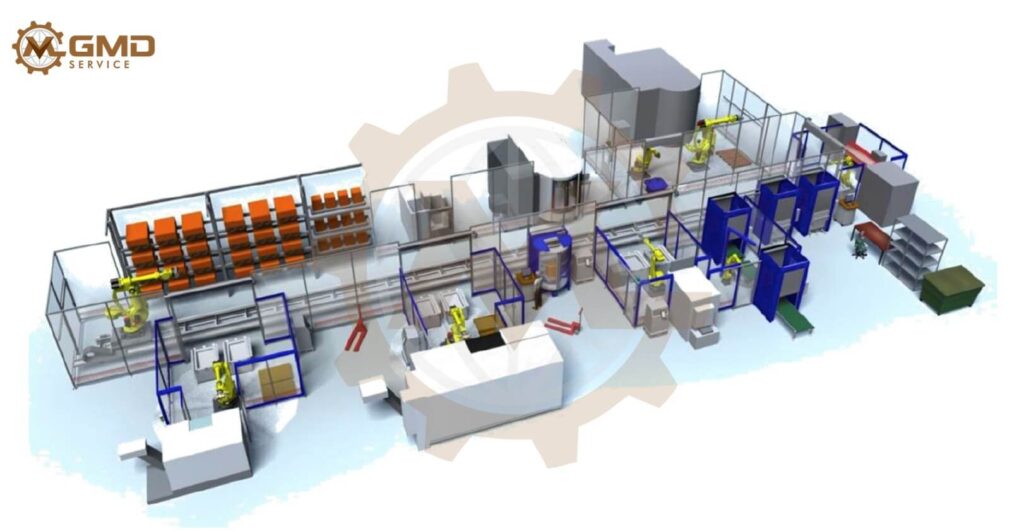
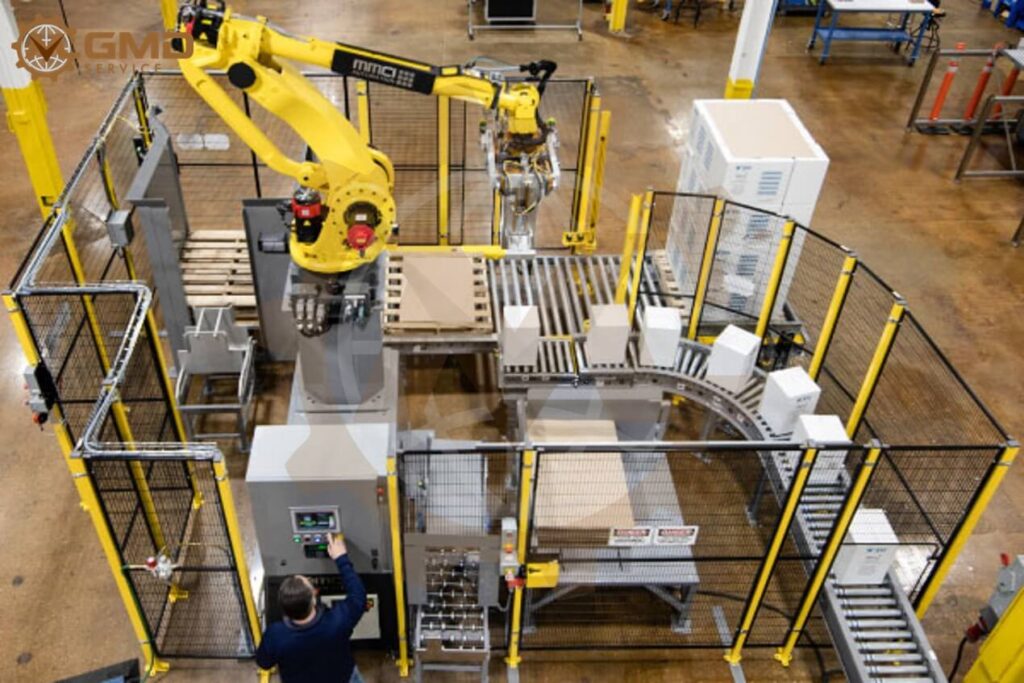
Robotic cells designed around your process, workspace and production targets.
GMD Services develops robotic cell layouts and mechanical designs that bring together robot reach, tooling, fixtures, material flow and operator access. We provide 3D CAD models and manufacturing drawings to support fabrication and system integration.
Industrial automation is no longer limited to installing a robot arm. A successful robotic automation project requires a well-engineered robotic cell that combines robot motion, tooling, fixtures, safety systems, conveyors, sensors, and operator interaction into one reliable production system.
At Global Machine Design Services (GMD), we provide professional robotic cell design services for manufacturers, automation companies, machine builders, and system integrators worldwide. Our engineering team develops complete robot work cells optimized for productivity, safety, maintenance, and future scalability.
Whether you need a robotic welding cell, machine tending robot cell, robotic palletizing cell, or a fully customized robotic automation system, we transform your concept into a production-ready engineering package.
Robotic Cell Design is the engineering process of creating a complete automated workstation where one or more industrial robots perform manufacturing tasks safely, efficiently, and consistently. Unlike simply selecting a robot arm, robotic cell design focuses on developing the entire production environment that enables the robot to operate as part of an integrated manufacturing system. This includes the structural frame, fixtures, conveyors, end-of-arm tooling (EOAT), safety guarding, sensors, operator stations, maintenance access, and equipment layout—all working together to achieve a specific production objective. A well-designed robotic cell combines mechanical engineering, manufacturing expertise, automation principles, and production planning into a single solution. Every component must be carefully engineered to ensure reliable operation, minimize downtime, simplify maintenance, and maximize productivity throughout the equipment’s service life. Whether the application involves robotic welding, palletizing, machine tending, assembly, packaging, inspection, or material handling, the success of the automation project depends heavily on the quality of the robotic cell design rather than the robot itself. Many manufacturers assume that purchasing an industrial robot is the most important step in an automation project. In reality, the robot is only one component within a much larger system. The surrounding mechanical equipment determines how efficiently the robot receives parts, performs its task, transfers finished products, and interacts with operators or other machines. Poor cell design can create bottlenecks, increase cycle time, complicate maintenance, and reduce the return on investment—even when using a high-performance robot. A complete robot work cell typically consists of multiple integrated systems, including:
Industrial robot or collaborative robot (cobot)
Structural steel frame and robot base
Custom fixtures and workholding devices
End-of-arm tooling (EOAT)
Conveyor systems or material transfer equipment
Safety fencing and machine guarding
Safety doors, light curtains, and laser scanners
Vision inspection systems
Sensors and pneumatic components
Electrical cabinets and PLC control systems
Operator loading and unloading stations
Cable management and utility routing
Maintenance access platforms and service areas
Each of these elements influences the overall performance of the robotic automation system. For example, an optimized fixture can reduce loading time, while an efficient conveyor layout minimizes unnecessary robot movement. Similarly, properly designed safety guarding protects operators without restricting accessibility during maintenance or product changeovers. These engineering decisions have a direct impact on production efficiency, equipment reliability, and long-term operating costs. Another essential aspect of robotic cell engineering is layout optimization. Engineers must determine the ideal position of every machine, conveyor, fixture, and robot to maximize workspace utilization while maintaining safe operator access and efficient material flow. Factors such as robot reach, payload capacity, collision avoidance, maintenance clearance, forklift access, cable routing, and future expansion must all be considered before manufacturing begins. Solving these challenges during the design phase significantly reduces installation risks, commissioning delays, and costly modifications later in the project. Modern robotic cells are also expected to be flexible enough to accommodate future production changes. Manufacturers increasingly require automation systems that can support new product variants, increased production volumes, or additional process stations without requiring a complete redesign. As a result, robotic cell design has evolved beyond creating a single-purpose workstation into developing modular, scalable automation platforms that can adapt as manufacturing requirements change. At Global Machine Design Services (GMD), we approach every robotic cell as a complete engineering project rather than simply a robot installation. Our engineers evaluate the entire manufacturing process—from raw material input to finished product output—to develop robotic work cells that improve productivity, simplify maintenance, enhance operator safety, and support long-term manufacturing growth. By combining practical mechanical engineering experience with advanced 3D CAD design and automation expertise, we deliver production-ready robotic cell designs that help manufacturers reduce engineering risks and accelerate project implementation.
Our Robotic Cell Design Services
At Global Machine Design Services (GMD), we provide complete Robotic Cell Design Services that cover every stage of mechanical engineering, from initial concept development to production-ready manufacturing documentation. Our goal is to help manufacturers, machine builders, and automation integrators develop reliable robotic work cells that improve productivity, reduce engineering risks, and accelerate project implementation.
Rather than designing individual components in isolation, we engineer the entire robotic cell as an integrated manufacturing system. Every project is optimized for production efficiency, operator safety, maintenance accessibility, equipment reliability, and future scalability.
Custom Robotic Cell Design
Every manufacturing process has unique requirements. Product dimensions, production rates, available floor space, robot payload, and process flow all influence how a robotic cell should be designed.
Our engineers develop custom robotic cells based on your specific application instead of relying on standard layouts. During the design phase, we evaluate material flow, operator interaction, equipment positioning, maintenance access, and future expansion to create a solution that fits your production environment.
Whether the project involves a single industrial robot or a fully automated production line with multiple robotic stations, every robotic cell is designed to maximize efficiency while minimizing unnecessary complexity.
Custom Robotic Cell Design
Robot Cell Layout Design
An efficient layout is the foundation of every successful robotic automation project.
We carefully determine the optimal position of robots, conveyors, fixtures, safety equipment, operator stations, electrical cabinets, and maintenance areas to achieve smooth production flow while making the best use of available factory space.
Our layout design considers:
Robot working envelope
Material flow
Operator ergonomics
Maintenance clearance
Forklift accessibility
Future equipment expansion
Cable and utility routing
Production line integration
By resolving layout challenges during the engineering stage, manufacturers can significantly reduce installation time and avoid costly modifications after fabrication.
Robot Cell Layout Design
Structural Frame and Robot Base Design
Industrial robots generate dynamic loads during acceleration, deceleration, and continuous operation. A poorly designed support structure can reduce positioning accuracy, create excessive vibration, and shorten equipment life.
Our team designs robust structural frames, robot pedestals, equipment bases, maintenance platforms, and supporting structures that provide the rigidity required for long-term industrial operation.
Every structural design is developed with manufacturability, transportation, installation, and maintenance in mind while maintaining compatibility with the selected robot manufacturer.
Structural Frame and Robot Base Design
Fixture Design and Workholding Solutions
A robot can only perform consistently when every workpiece is accurately positioned.
We design custom fixtures and workholding systems that ensure repeatable positioning, fast loading, and reliable production quality.
Depending on the application, fixtures may include:
Pneumatic clamping systems
Manual fixtures
Quick-change fixtures
Welding fixtures
Machining fixtures
Assembly nests
Inspection fixtures
Modular tooling
Our fixture designs focus on reducing setup time while maintaining repeatable positioning throughout high-volume production.
Fixture Design and Workholding Solutions
End-of-Arm Tooling (EOAT) Design
The end-of-arm tool is one of the most critical components of any robotic automation system. It directly affects gripping performance, cycle time, payload utilization, and overall production reliability.
GMD designs custom EOAT solutions for a wide range of manufacturing applications, including vacuum grippers, mechanical grippers, magnetic tooling, welding tools, assembly tools, and specialized handling devices.
Every design considers product geometry, gripping force, weight distribution, robot payload limitations, and maintenance requirements to ensure reliable operation throughout the production cycle.
End-of-Arm Tooling (EOAT) Design
Conveyor and Material Handling Integration
Most robotic cells rely on efficient material handling systems to achieve continuous production.
Our engineering team integrates robotic cells with conveyor systems, transfer mechanisms, indexing tables, lift units, and automated handling equipment to create a seamless production process.
Typical conveyor solutions include:
Belt conveyors
Roller conveyors
Chain conveyors
Pallet transfer systems
Indexing conveyors
Vertical lifting systems
Accumulation conveyors
By integrating robot motion with material handling equipment, we help reduce idle time and improve overall production throughput.
Conveyor and Material Handling Integration
Robot Cell Safety and Guarding
Safety is an essential consideration in every robotic cell we design.
Our engineers incorporate protective systems that comply with modern industrial automation practices while maintaining convenient operator access and maintenance efficiency.
Safety solutions may include:
Robot cell fencing
Machine guarding
Safety doors
Interlock systems
Light curtains
Area laser scanners
Emergency stop locations
Maintenance access gates
We carefully balance operator protection with production efficiency, ensuring that safety systems support—not hinder—the manufacturing process.
Robot Cell Safety and Guarding
Manufacturing Documentation
A robotic cell design is only valuable when it can be manufactured efficiently.
Every project is supported by comprehensive engineering documentation that enables fabrication teams to build and assemble the equipment with confidence.
Typical deliverables include:
Complete 3D CAD assemblies
Detailed part models
Manufacturing drawings
Assembly drawings
General arrangement (GA) drawings
Bill of Materials (BOM)
Purchased parts lists
Fabrication documentation
Installation drawings
PDF engineering packages
These deliverables reduce manufacturing errors, simplify procurement, and support faster project execution.
Engineering Collaboration
Many automation projects involve multiple engineering disciplines working simultaneously. Our mechanical engineers collaborate closely with electrical engineers, PLC programmers, robot integrators, and machine builders to ensure every subsystem fits together as a complete automation solution.
This collaborative approach minimizes interface issues during installation and helps shorten commissioning time while improving overall project quality.
Whether you require a robotic welding workstation, a machine tending cell, a palletizing system, or a fully customized robotic automation solution, GMD provides the engineering expertise needed to transform your concept into a production-ready robotic cell that is practical to manufacture, easy to maintain, and built for long-term industrial performance.
Mechanical Design Scope for Robotic Welding Projects
GMD’s primary role is to develop the mechanical engineering package required to fabricate and integrate the robotic welding cell. Depending on the agreed scope, this may include cell layouts, robot bases, welding fixtures, positioner support structures, loading stations, guarding structures, pneumatic clamping arrangements, manufacturing drawings, and BOMs.
Mechanical design reviews can include geometric reach and clearance checks using the robot and equipment data available for the project. Detailed robot path simulation, offline programming, and validated cycle-time studies are separate activities and are included only when expressly agreed.
Robot programming, PLC and electrical design, welding procedure development, safety control validation, equipment installation, and commissioning are coordinated with the client’s appointed specialists unless included separately in the project scope.
We define responsibilities and equipment interfaces at the start of the project so that the mechanical design aligns with the welding process, automation system, and manufacturing requirements.
Types of Robotic Cells We Design
Every manufacturing process presents unique production challenges, which is why there is no universal robotic cell that fits every application. Factors such as product size, cycle time, payload, accuracy, factory layout, and production volume all influence how a robotic work cell should be engineered. At Global Machine Design Services (GMD), we design custom robotic cells tailored to your manufacturing process, ensuring every system delivers reliable performance, efficient material flow, and long-term operational value.
Below are the most common types of robotic cells our engineering team designs.
Robotic Welding Cells
Robotic welding is one of the most widely adopted automation solutions in modern manufacturing. A properly engineered robotic welding cell improves weld consistency, increases production speed, and reduces operator exposure to hazardous environments.
Our robotic welding cell design services include:
Robot positioning and reach analysis
Welding fixture design
Positioners and rotary tables
Structural frame design
Welding booth layout
Safety guarding and fencing
Fume extraction integration
Cable and hose management
Maintenance access planning
Every welding cell is designed to minimize robot travel, maximize weld accessibility, and simplify fixture loading while supporting future product variations.
Robotic Welding Cells
Robotic Welding Station Configurations
GMD develops mechanical layouts for robotic welding stations based on product geometry, required weld access, loading methods, available floor space, and target production capacity. Depending on project requirements, configurations may include:
Single-station welding cells: A dedicated fixture station with operator loading and unloading, suitable for a defined product family.
Dual-station welding cells: Separate loading and welding positions, allowing operators to prepare the next workpiece while the robot welds at the other station, subject to the agreed safety and control concept.
Rotary indexing-table cells: Fixtures mounted on an indexing table to transfer workpieces between loading and welding positions.
Welding positioner cells: Rotary or tilting mechanisms that orient the workpiece to improve access to weld joints.
Flexible welding stations: Interchangeable fixtures and adjustable locating elements designed to accommodate agreed product variants.
During concept development, we compare fixture accessibility, loading time, equipment footprint, changeover requirements, and maintenance access. This helps establish a practical mechanical configuration before detailed design begins.
Welding Fixture Design and Clamping Systems
Welding fixture design is a central part of robotic welding cell engineering. The fixture must locate and hold the components consistently while providing sufficient clearance for the welding torch, robot arm, and workpiece movement.
Our mechanical design scope may include:
Locating pins, support surfaces, stops, and product reference datums.
Manual or pneumatic clamping mechanisms.
Clamp arrangements and sequences coordinated with the loading and welding process.
Torch access clearances around weld joints.
Clearance for removing the finished welded assembly.
Replaceable locating elements and wear components.
Quick-change fixture interfaces for agreed product variants.
Protection of exposed mechanisms from welding spatter.
Access for fixture cleaning, adjustment, and maintenance.
We review fixture arrangements with the client’s welding engineer or robot integrator to address expected thermal movement, weld sequence, torch approach, and workpiece release. Welding procedures, process parameters, and final weld quality remain subject to process validation and commissioning.
Welding-Specific Design Inputs
In addition to the general robotic cell requirements, a welding project typically requires:
Product CAD and drawings: Individual components, welded assemblies, dimensions, tolerances, and product variants.
Weld information: Joint locations, weld symbols, required weld lengths, and any specified welding sequence.
Material information: Material grades, thicknesses, component weights, and relevant surface conditions.
Production requirements: Target output, batch sizes, changeover frequency, and loading and unloading methods.
Robot and welding equipment: Selected robot model, welding torch, power source, and positioner details where available.
Quality requirements: Critical dimensions after welding, inspection methods, and acceptance criteria.
Site interfaces: Available floor space, utility connections, extraction equipment, and installation constraints.
If some inputs are still being developed, we can support the mechanical concept stage using documented assumptions. These assumptions are reviewed with the client and relevant integration partners before the design is released.
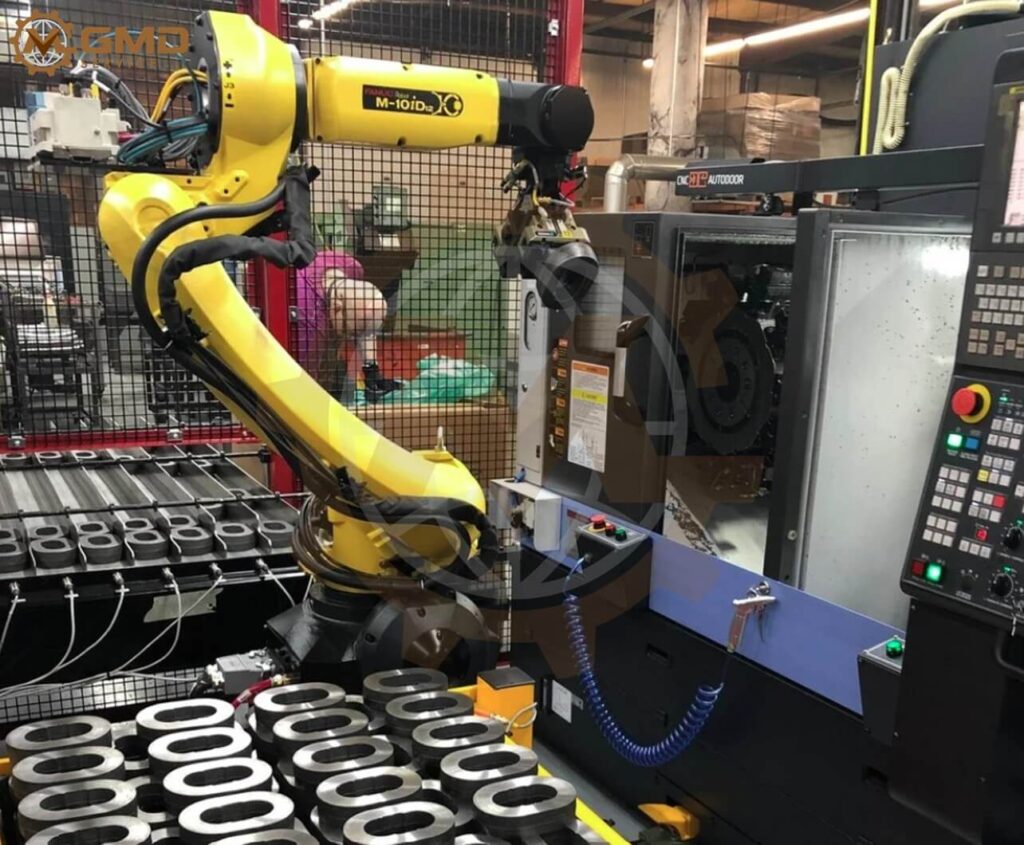
Machine tending remains one of the highest-return automation investments for manufacturers operating CNC machines, lathes, machining centers, and injection molding equipment.
Instead of relying on manual loading and unloading, a robot automatically transfers parts between the machine and downstream processes, allowing production to continue with greater consistency and reduced labor requirements.
The result is a robotic cell capable of improving machine utilization while reducing idle time and operator intervention.
Machine Tending Robot Cells
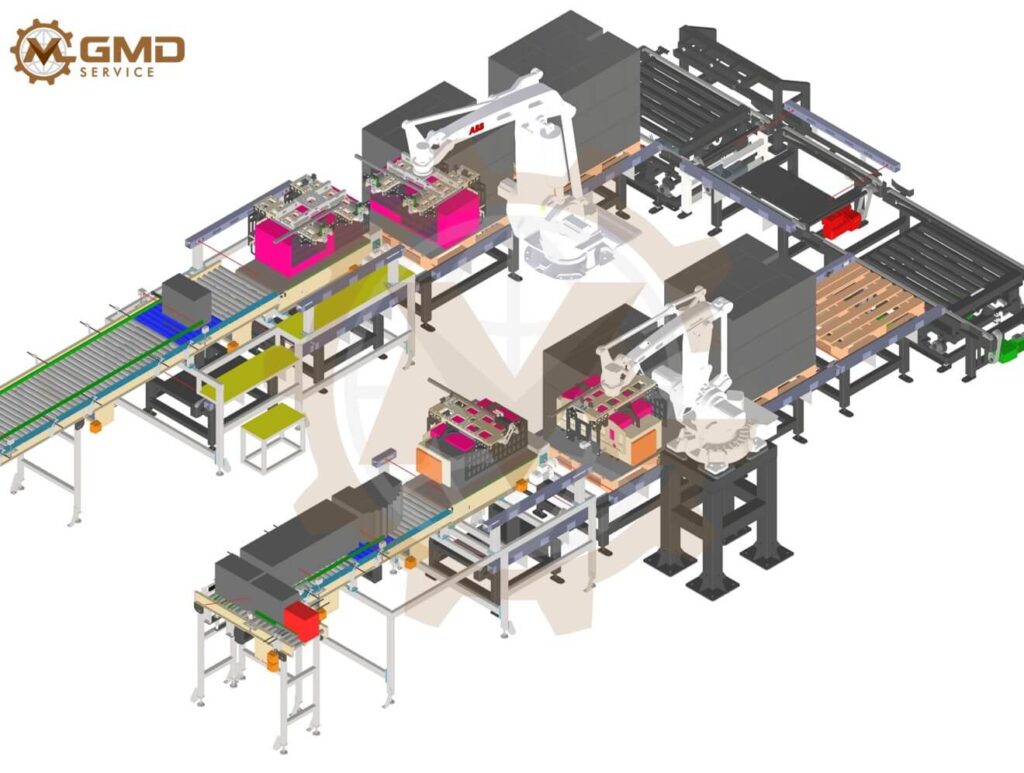
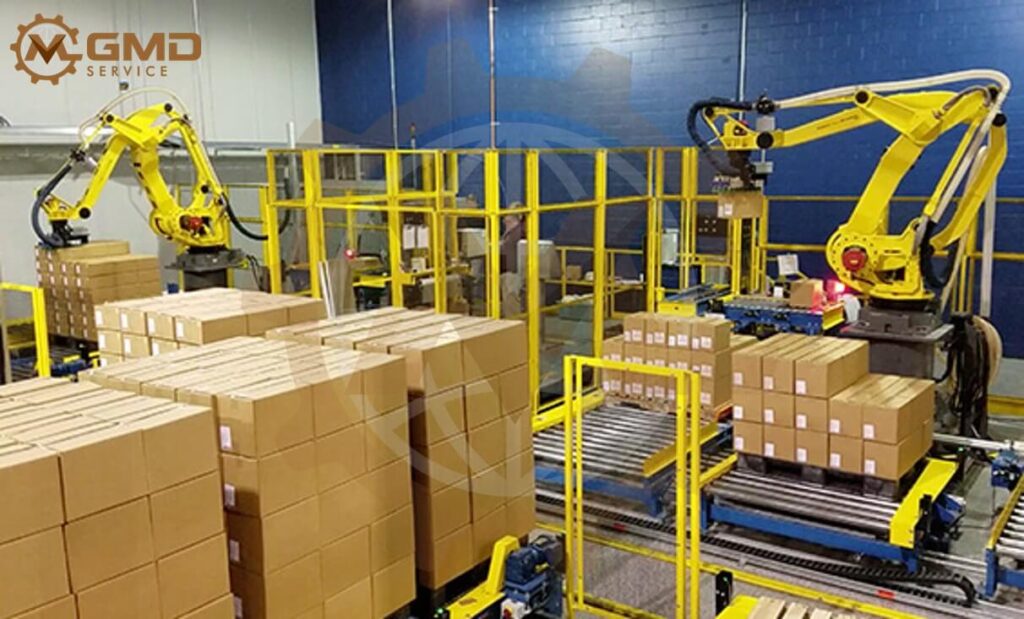
Robotic Palletizing Cells
End-of-line palletizing is an ideal application for industrial robots due to its repetitive motion, heavy lifting, and continuous production requirements.
We design robotic palletizing cells that automate stacking operations while maintaining stable pallet patterns and efficient product flow.
Typical system components include:
Product conveyors
Pallet conveyors
Pallet dispensers
Slip sheet handling
Stretch wrapping interfaces
Safety guarding
Forklift access zones
Operator stations
Every layout is optimized to minimize robot movement while maintaining safe and efficient pallet exchange.
Robotic Palletizing Cells
Pick and Place Robot Cells
Pick-and-place applications require high positioning accuracy, reliable gripping, and optimized cycle times.
Our engineers design robotic cells capable of handling products with varying shapes, sizes, and materials using custom end-of-arm tooling developed specifically for the application.
These systems are commonly used for:
Product sorting
Packaging
Assembly preparation
Conveyor transfers
Vision-guided picking
High-speed material handling
By combining optimized robot paths with efficient fixture and conveyor layouts, we help reduce cycle time while maintaining consistent product handling.
Pick and Place Robot Cells
Robotic Assembly Cells
Assembly automation requires precise coordination between robots, fixtures, sensors, and feeding systems.
Our robotic assembly cells are engineered to perform repetitive assembly tasks with high repeatability while maintaining product quality throughout long production runs.
Typical applications include:
Component insertion
Fastener installation
Press-fit assembly
Adhesive dispensing
Product handling
Multi-station assembly processes
Every assembly cell is designed to provide easy maintenance access, efficient operator interaction, and the flexibility to support future product revisions.
Robotic Assembly Cells
Robotic Inspection Cells
Quality control has become an increasingly important part of automated manufacturing. Modern robotic inspection cells combine industrial robots with cameras, sensors, laser scanners, and measurement equipment to inspect products quickly and consistently.
Our inspection cell designs support:
Vision inspection
Dimensional verification
Surface inspection
Barcode and label verification
Presence detection
Pass/fail sorting
These systems reduce manual inspection effort while improving product traceability and production consistency.
Robotic Inspection Cells
Material Handling Robot Cells
Many automation projects focus primarily on moving products safely and efficiently between manufacturing processes.
We design robotic material handling cells that integrate seamlessly with conveyors, lifting systems, storage equipment, and automated production lines.
Applications include:
Part transfer
Bin picking
Tray handling
Component loading
Machine-to-machine transfer
Warehouse automation support
Each system is optimized to reduce unnecessary robot travel while maintaining continuous production flow.
Material Handling Robot Cells
Collaborative Robot (Cobot) Work Cells
Not every automation project requires a traditional industrial robot. In applications where robots and operators work in close proximity, collaborative robots provide an effective alternative.
We design cobot work cells that combine automation with operator flexibility for light assembly, testing, packaging, inspection, and machine tending operations.
Our engineering scope includes:
Cobot workstation layouts
Ergonomic workstations
Tooling and fixtures
Safety risk assessment support
Mobile workstation concepts
Modular equipment design
Collaborative cells are particularly suitable for manufacturers seeking flexible automation with lower implementation costs.
Collaborative Robot (Cobot) Work Cells
Multi-Robot Automation Cells
High-volume production often requires multiple robots working together within the same automation cell.
These systems demand careful engineering to synchronize robot movements, eliminate collision risks, and maintain balanced production flow.
Our engineers design multi-robot cells featuring:
Coordinated robot work zones
Shared fixture systems
Conveyor synchronization
Maintenance access planning
Safety zoning
Expandable production layouts
By considering robot interaction during the design phase, we help manufacturers reduce commissioning time while maximizing production capacity.
Multi-Robot Automation Cells
Fully Custom Robotic Automation Cells
Many industrial processes cannot be solved using standard automation solutions. In these cases, we develop fully customized robotic cells engineered specifically around your production objectives.
Starting from your product specifications and manufacturing requirements, our engineering team creates a complete robotic automation solution that integrates mechanical structures, tooling, conveyors, fixtures, safety systems, and robot positioning into one production-ready design.
Whether your project involves welding, assembly, inspection, palletizing, packaging, material handling, or a completely new manufacturing process, our goal remains the same: to deliver a robotic cell that is reliable, efficient, safe, and practical to manufacture.
Every robotic cell we design is built with scalability in mind, allowing future equipment upgrades, additional process stations, or increased production capacity without requiring a complete system redesign. This long-term engineering approach helps manufacturers maximize their investment while ensuring the robotic automation system continues to support evolving production demands for years to come.
Fully Custom Robotic Automation Cells
Related Robotic Welding Design Project
Semi-Automatic Robotic Welding Station
Explore our semi-automatic robotic welding station case study for an example of mechanical design involving welding fixtures, pneumatic clamping, and rotary positioning equipment.
The project illustrates how fixture design and workstation layout can be developed together around product handling and welding access.
At Global Machine Design Services (GMD), every robotic cell is developed using a structured engineering process that minimizes technical risks, improves design quality, and accelerates project delivery. Rather than focusing solely on the robot itself, we evaluate the complete manufacturing process to ensure every component works together as an integrated automation system.
1. Requirement Analysis
Every project begins with a detailed review of your manufacturing objectives. Our engineers collect technical information such as product dimensions, payload, production capacity, cycle time, available factory space, operator interaction, and existing production equipment.
We also evaluate future expansion plans, maintenance requirements, and budget considerations to establish the most appropriate engineering approach before design work begins.
2. Concept Development
Based on the project requirements, we develop one or more robotic cell concepts that optimize material flow, robot accessibility, and overall production efficiency.
During this stage, we determine:
Robot location
Equipment arrangement
Material flow
Loading and unloading methods
Safety concept
Maintenance access
Utility routing
The objective is to identify the most efficient solution before investing time in detailed engineering.
3. 3D Mechanical Design
After the concept is approved, our engineers develop a complete 3D CAD model of the robotic cell.
The assembly typically includes:
Structural frame
Robot base
Fixtures
End-of-arm tooling (EOAT)
Conveyors
Safety guarding
Platforms
Access doors
Purchased components
Pneumatic equipment
Creating the entire system in 3D allows potential design conflicts to be identified early, reducing costly modifications during fabrication and installation.
4. Design Verification and Optimization
Before releasing manufacturing documentation, we perform detailed engineering reviews to verify that the robotic cell is practical, safe, and efficient.
Depending on project requirements, this stage may include:
Robot reach verification
Collision detection
Maintenance accessibility review
Structural evaluation
Ergonomic assessment
Manufacturing feasibility
Assembly sequence verification
Cycle time optimization
Identifying issues during the engineering phase significantly reduces commissioning delays and improves overall project reliability.
Once the design is finalized, we prepare complete engineering documentation for manufacturing and assembly.
Typical deliverables include:
Complete 3D CAD assemblies
Individual part models
Manufacturing drawings
Assembly drawings
General Arrangement (GA) drawings
Bill of Materials (BOM)
Purchased parts lists
Fabrication documentation
PDF drawing packages
Our documentation enables fabrication teams to manufacture the equipment accurately while simplifying procurement, assembly, and future maintenance.
Applications of Robotic Cell Design
Robotic automation has become an essential part of modern manufacturing across a wide range of industries. By combining industrial robots with purpose-built mechanical systems, manufacturers can improve production efficiency, reduce labor-intensive operations, and achieve consistent product quality.
At GMD, we design robotic cells for a broad range of industrial applications, including:
Welding Automation
Automated welding stations for MIG, TIG, spot welding, and arc welding applications where consistent weld quality, high throughput, and operator safety are critical.
CNC Machine Tending
Robotic loading and unloading systems for machining centers, CNC lathes, milling machines, and other machine tools, helping maximize spindle utilization and reduce idle time.
Palletizing and Depalletizing
High-speed robotic palletizing systems for cartons, bags, boxes, containers, and industrial products, designed to improve end-of-line efficiency and warehouse operations.
Assembly Automation
Robotic work cells for component assembly, fastening, adhesive dispensing, press-fit operations, and other repetitive assembly processes requiring precision and repeatability.
Packaging and Pick-and-Place
Automated systems for sorting, packaging, transferring, and handling products with high speed and accuracy across food, consumer goods, electronics, and industrial manufacturing.
Inspection and Quality Control
Vision-guided robotic cells that support dimensional inspection, product verification, barcode reading, defect detection, and automated quality assurance.
Material Handling
Robot cells designed for transferring products between conveyors, machines, storage systems, and production stations while maintaining smooth and continuous material flow.
Regardless of the application, our engineering philosophy remains the same: develop robotic cells that are safe, reliable, easy to manufacture, and optimized for long-term industrial performance. By combining practical mechanical engineering expertise with a deep understanding of automation systems, GMD delivers production-ready robotic cell designs that help manufacturers increase productivity, improve operational efficiency, and build scalable automation solutions for future growth.
Project Deliverables
Every robotic cell design project at Global Machine Design Services (GMD) is delivered with complete engineering documentation that enables manufacturers, machine builders, and automation integrators to move efficiently from design to fabrication, assembly, and commissioning. Depending on the project scope, our deliverables can be tailored to meet your internal engineering standards or manufacturing requirements.
A typical robotic cell design package includes:
3D CAD Models
Complete robotic cell assembly
Individual part models
Weldment assemblies
Robot base structures
Fixture assemblies
Conveyor assemblies
Safety guarding assemblies
Maintenance platforms
Our designs are primarily developed using Autodesk Inventor, with neutral CAD formats available upon request.
Each project includes a structured BOM containing:
Manufactured components
Purchased components
Standard hardware
Bearings
Pneumatic components
Sensors
Fasteners
Structural materials
The BOM helps streamline purchasing and production planning while reducing procurement errors.
Engineering Documentation
Depending on project requirements, additional documentation may include:
Assembly instructions
Exploded assembly views
Equipment layout drawings
Installation drawings
PDF drawing packages
STEP files
DXF files for laser cutting
Manufacturing documentation packages
Our objective is to deliver documentation that allows your production team to manufacture and assemble the robotic cell with confidence.
Frequently Asked Questions
1. What industries can benefit from robotic cell design?
Robotic cells are widely used across automotive, electronics, food and beverage, packaging, pharmaceutical, logistics, metal fabrication, aerospace, plastics, consumer goods, and heavy manufacturing industries. Any production process involving repetitive, hazardous, or high-precision operations can benefit from a custom robotic cell.
2. Can you design robotic cells for any robot brand?
Yes. Our engineering services are vendor-independent. We can design robotic cells compatible with leading industrial robot manufacturers, including ABB, FANUC, KUKA, Yaskawa Motoman, Universal Robots (UR), Mitsubishi Electric, Epson, Kawasaki, Omron, and other major robot platforms. This flexibility allows you to select the robot that best suits your production requirements.
3. Do you provide robot programming?
Our primary expertise is mechanical engineering and robotic cell design. We develop the complete mechanical system—including structures, fixtures, conveyors, guarding, and layouts—that supports robotic automation. We also collaborate closely with your robot programmers, PLC engineers, and automation integrators to ensure the mechanical design is fully prepared for system integration and commissioning.
4. Can you design custom robotic cells for unique manufacturing processes?
Absolutely. Every robotic cell we develop is engineered specifically around your production requirements. We evaluate product geometry, payload, cycle time, available floor space, process flow, operator interaction, and future expansion plans to create a solution tailored to your manufacturing environment rather than relying on standard layouts.
5. Do you perform robot reach studies and collision analysis?
Yes. During the engineering process, we verify robot reach, working envelopes, potential collision points, maintenance accessibility, and equipment clearances. This design verification helps identify issues before fabrication begins, reducing installation risks and minimizing costly modifications during commissioning.
6. What software do you use for robotic cell design?
Our primary mechanical design platform is Autodesk Inventor, allowing us to create detailed 3D assemblies, manufacturing drawings, BOMs, and engineering documentation. Depending on project requirements, we can also provide neutral CAD formats such as STEP, DWG, DXF, and PDF to ensure compatibility with your manufacturing and engineering workflows.
7. Can you integrate conveyors, lifting systems, and fixtures into the robotic cell?
Yes. We specialize in designing complete robotic work cells rather than standalone robot installations. Our engineering scope can include conveyor systems, lifting mechanisms, custom fixtures, robot bases, safety guarding, maintenance platforms, transfer systems, and other mechanical equipment required to create a fully integrated automation solution.
8. What information is required to start a robotic cell design project?
To begin a project, we typically request information such as:
Product dimensions and weight
Production capacity and target cycle time
Robot model (if already selected)
Factory layout or available floor space
Existing production equipment
Process description
Preferred safety requirements
Available utilities
Project timeline and technical specifications
If some of this information is not yet available, our engineering team can assist during the concept development phase to define the most suitable technical solution for your application.
9. Can you design robotic cells for both new production lines and existing factories?
Yes. We support both greenfield automation projects and retrofit applications. For new production lines, we design the robotic cell as part of the complete manufacturing layout. For existing factories, we optimize the new robotic cell to fit within the available floor space while minimizing disruption to current production. Our engineering team carefully considers equipment interfaces, material flow, utility connections, and maintenance accessibility to ensure smooth integration.
10. Can you optimize an existing robotic cell instead of designing a new one?
Absolutely. Many manufacturers already have robotic systems that are underperforming due to inefficient layouts, poor fixture design, or limited maintenance access. We can evaluate your existing robotic work cell and recommend improvements such as layout optimization, fixture redesign, structural modifications, conveyor integration, or safety upgrades to improve productivity and reduce cycle time without replacing the entire system.
11. Can you design welding fixtures for an existing robotic cell?
Yes. We can develop welding fixtures for an existing robotic cell based on the product geometry, robot model, torch arrangement, mounting interfaces, and available workspace. The mechanical review considers locating and clamping, loading access, torch clearances, and removal of the welded assembly. Final robot paths and welding performance are verified with the client’s robot integrator and welding team.
12. Can you design dual-station welding cells and positioner-based workstations?
Yes. Our mechanical design scope can include dual-station layouts, rotary indexing tables, and workstations incorporating welding positioners. We develop fixture mounting arrangements, support structures, operator loading areas, and equipment clearances around the selected configuration. Positioner selection, coordinated robot motion, and safety control requirements are reviewed with the relevant equipment suppliers and integration specialists.
13. Do you provide robot cell safety and guarding design?
Yes. Safety is incorporated from the earliest stages of every project. Our robotic cell designs include safety fencing, machine guarding, interlocked access doors, maintenance gates, light curtain locations, safety scanner integration, and emergency stop positions. We design the mechanical aspects of the safety system to support compliance with your project’s applicable machinery and industrial safety requirements while maintaining efficient production and easy maintenance access.
14. Can GMD work with our internal engineering or automation team?
Yes. We frequently collaborate with machine builders, system integrators, robot programmers, PLC engineers, electrical designers, and manufacturing teams. Our mechanical engineering deliverables are structured to integrate smoothly with multidisciplinary automation projects, allowing your internal team to continue with controls engineering, programming, procurement, fabrication, and commissioning.
15. What project sizes can you support?
We support projects ranging from single robotic workstations to large-scale automated production lines consisting of multiple robotic cells. Whether you require a standalone welding station, an automated palletizing system, or an integrated manufacturing line with conveyors, lifting equipment, and multiple robots, our engineering process scales to match the complexity of your project.
16. What are the advantages of outsourcing robotic cell design?
Outsourcing robotic cell design allows manufacturers and automation companies to access experienced mechanical engineering expertise without expanding their in-house engineering team. It can reduce development time, lower engineering costs, improve design quality, and accelerate project delivery. By working with GMD, you gain a dedicated engineering partner focused on delivering production-ready documentation while your internal resources remain focused on manufacturing, integration, and customer support.
17. Why choose Global Machine Design Services for robotic cell design?
GMD combines more than a decade of practical mechanical design experience with a strong understanding of industrial automation systems. Our engineering philosophy focuses on manufacturable, reliable, and cost-effective solutions rather than theoretical concepts. Every robotic cell is designed with production efficiency, operator safety, maintenance accessibility, and future scalability in mind, providing clients with engineering documentation that is ready for fabrication and real-world implementation.
Ready to Build Your Next Robotic Cell?
Whether you are planning a new automation project or improving an existing production line, choosing the right engineering partner is one of the most important decisions you can make. A well-designed robotic cell not only increases productivity but also reduces commissioning risks, simplifies maintenance, and supports future production growth.At Global Machine Design Services (GMD), we work closely with manufacturers, machine builders, and automation integrators to develop custom robotic cells that are practical to manufacture, efficient to operate, and engineered for long-term industrial performance. From the initial concept through detailed 3D CAD design and manufacturing documentation, our team is committed to delivering solutions that help you move from idea to production with confidence.Contact GMD today to discuss your robotic cell design requirements and discover how our engineering expertise can help bring your automation project to life.
Conclusion
Industrial robots have become an essential part of modern manufacturing, but the success of an automation project depends on much more than selecting the right robot. The overall performance of a robotic system is determined by how well every mechanical, structural, and safety component works together as a complete production solution.A professionally engineered robotic cell improves productivity, enhances product quality, increases workplace safety, and reduces long-term operating costs. From robot positioning and fixture design to conveyor integration, safety guarding, maintenance access, and manufacturing documentation, every engineering decision contributes to the efficiency and reliability of the final system.At Global Machine Design Services (GMD), we specialize in designing complete robotic work cells that are tailored to your manufacturing objectives. Whether your application involves robotic welding, machine tending, palletizing, assembly, inspection, packaging, or material handling, we provide production-ready engineering solutions that support successful automation projects from concept to implementation.
We use cookies to make our website work, analyse traffic and improve your experience. You can accept all cookies, deny non-essential cookies or manage your preferences. You can change your choice at any time. For more information, please see our Cookie Policy.
Functional
Always active
The technical storage or access is strictly necessary for the legitimate purpose of enabling the use of a specific service explicitly requested by the subscriber or user, or for the sole purpose of carrying out the transmission of a communication over an electronic communications network.
Preferences
The technical storage or access is necessary for the legitimate purpose of storing preferences that are not requested by the subscriber or user.
Statistics
The technical storage or access that is used exclusively for statistical purposes.The technical storage or access that is used exclusively for anonymous statistical purposes. Without a subpoena, voluntary compliance on the part of your Internet Service Provider, or additional records from a third party, information stored or retrieved for this purpose alone cannot usually be used to identify you.
Marketing
The technical storage or access is required to create user profiles to send advertising, or to track the user on a website or across several websites for similar marketing purposes.