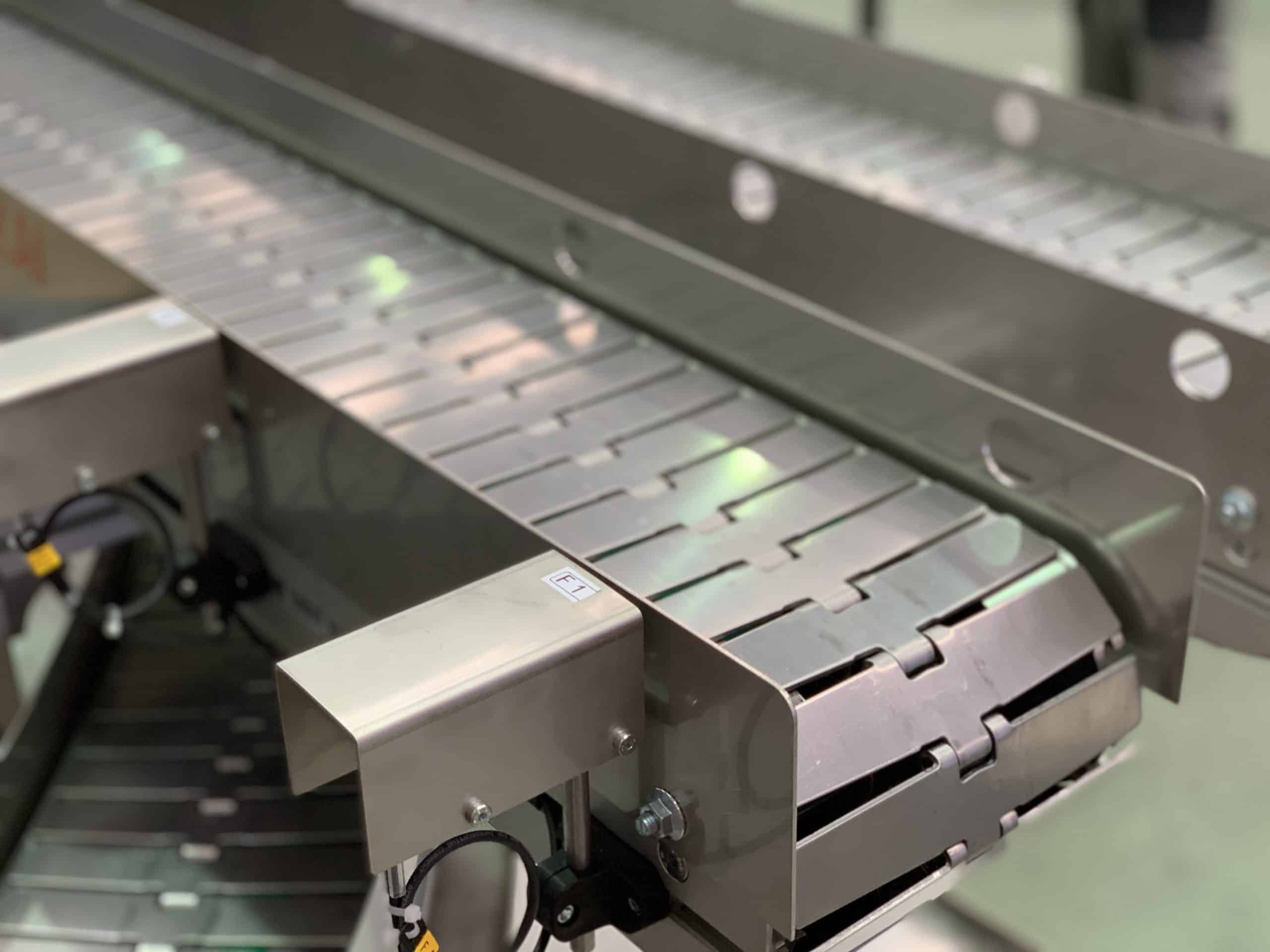
A reliable slat conveyor must coordinate the product support surface with the chain, sprockets, shafts, bearings, frame, guides, transfers, take-up, lubrication, guarding, and maintenance strategy. Our designs are developed around the real product weight, center of gravity, temperature, impact, contamination, cycle time, accumulation requirement, and available installation space—creating a practical conveyor system that can be manufactured, assembled, adjusted, and maintained efficiently.
Rigid-Surface Conveyor Engineering for Demanding Products
A slat conveyor uses individual plates or slats attached to one or more chains to form a moving carrying surface. Unlike a flexible belt, the slats can provide firm support for concentrated loads, resist heat and cutting damage, carry fixtures, and accept custom features such as stops, nests, cleats, side plates, or tooling interfaces.
GMD Services designs slat conveyor systems for OEMs, machine builders, automation integrators, and industrial end users. The engineering scope can include concept selection, product-support analysis, chain pull, drive sizing, slat and attachment design, shafts, sprockets, bearings, frame structure, product guides, transfers, sensors, guarding, 3D CAD, manufacturing drawings, BOMs, and design-review support.
What Is a Slat Conveyor?
A slat conveyor—sometimes called a slat chain conveyor or slat belt conveyor—uses parallel chains to pull a series of rigid slats along a defined track. Products rest directly on the slats or on fixtures mounted to them. The chain normally runs over sprockets at the drive and idler ends, while wear strips, rollers, or guide tracks support the loaded and return paths.
Slat conveyors are especially useful when a conventional belt could stretch, puncture, burn, absorb oil, deform under point loads, or provide insufficient positional stability. The correct configuration depends on the product geometry, load distribution, speed, process stations, accumulation, environment, transfer method, and maintenance philosophy.
Slat Conveyor Configurations We Design
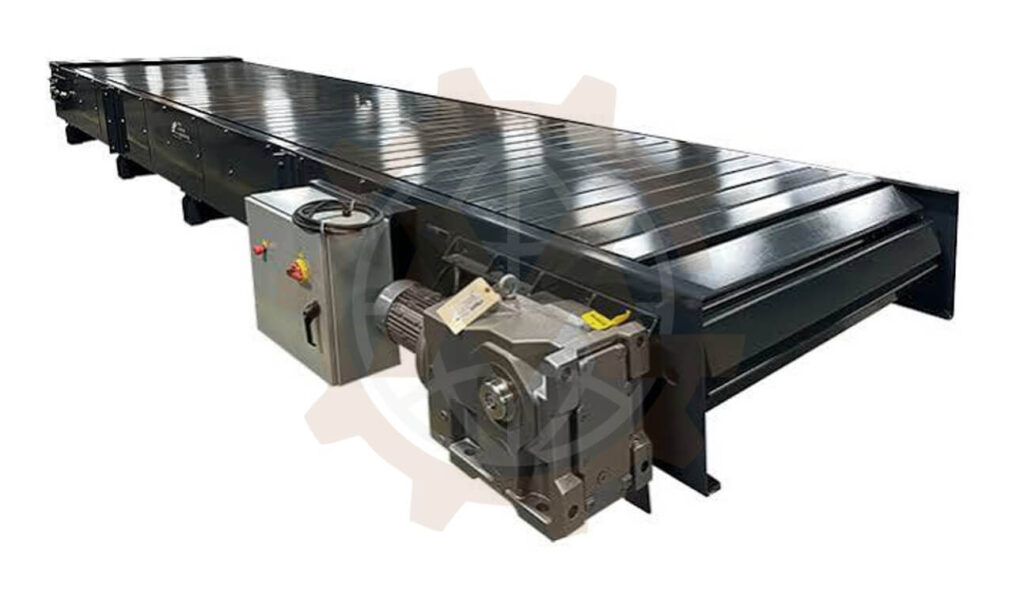
Steel Slat Conveyors
A steel slat conveyor provides a strong, wear-resistant carrying surface for heavy components, metal parts, castings, dies, fixtures, and hot products. Slat thickness, stiffening, support span, chain attachment, weld detail, flatness, and thermal behavior are checked against the real load and process conditions.
Steel Slat Conveyors
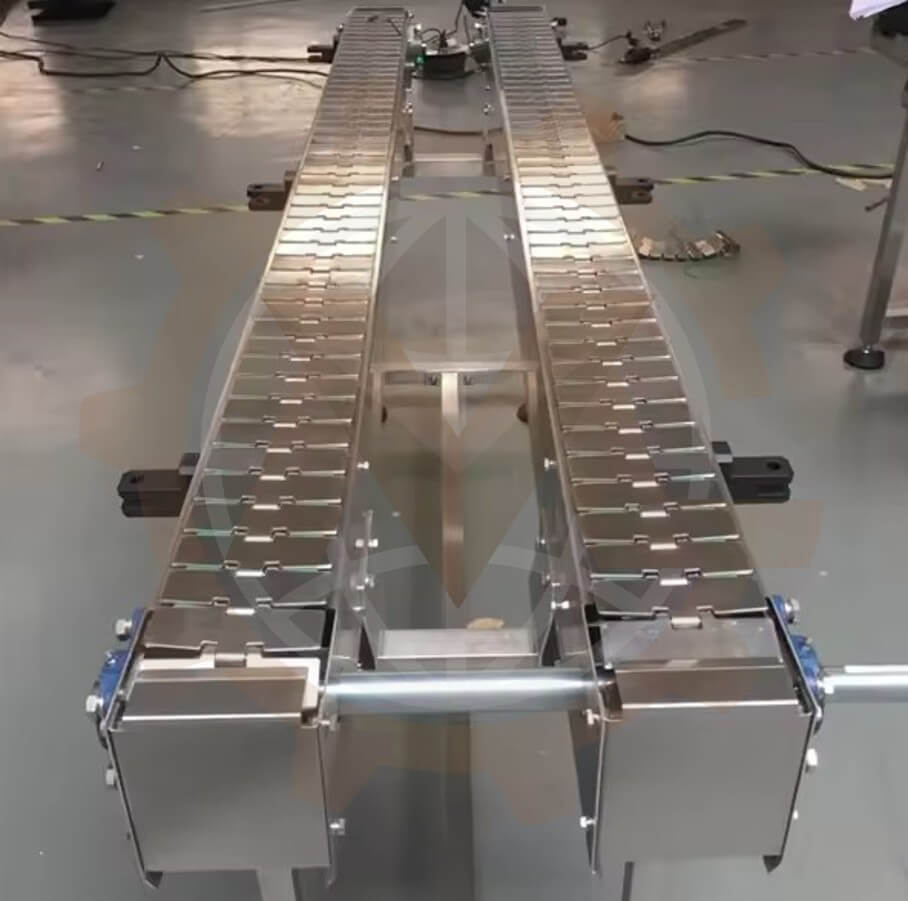
Stainless Steel Slat Conveyors
Stainless steel slat conveyors can support washdown, corrosive, food, beverage, chemical, or contamination-sensitive applications. Material grade, surface finish, drainage, weld quality, crevice control, cleaning access, and compatible wear-strip materials must be agreed for the operating environment.
Stainless Steel Slat Conveyors
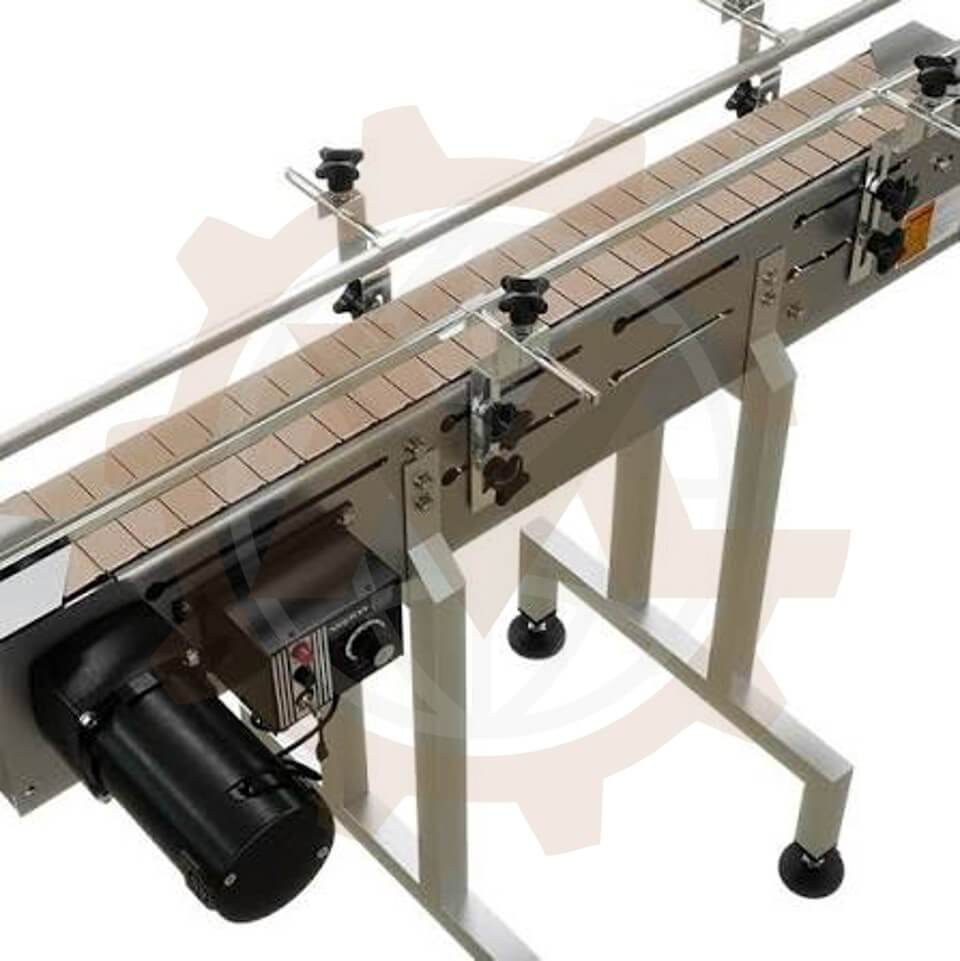
Plastic Slat Chain Conveyors
Plastic slat chains provide a lightweight, corrosion-resistant, and relatively low-friction surface for bottles, containers, packaged goods, and clean production environments. Chain selection considers load, speed, curves, temperature, chemical exposure, wear strips, product stability, and allowable chain pull.
Plastic Slat Chain Conveyors
Heavy-Duty Slat Conveyors
Heavy-duty slat conveyors transport large fabrications, automotive components, pallets, racks, engine parts, tooling, and other high-mass loads. Starting torque, shock, chain pull, sprocket and shaft loads, frame stiffness, anchoring, and safe maintenance access become primary design drivers.
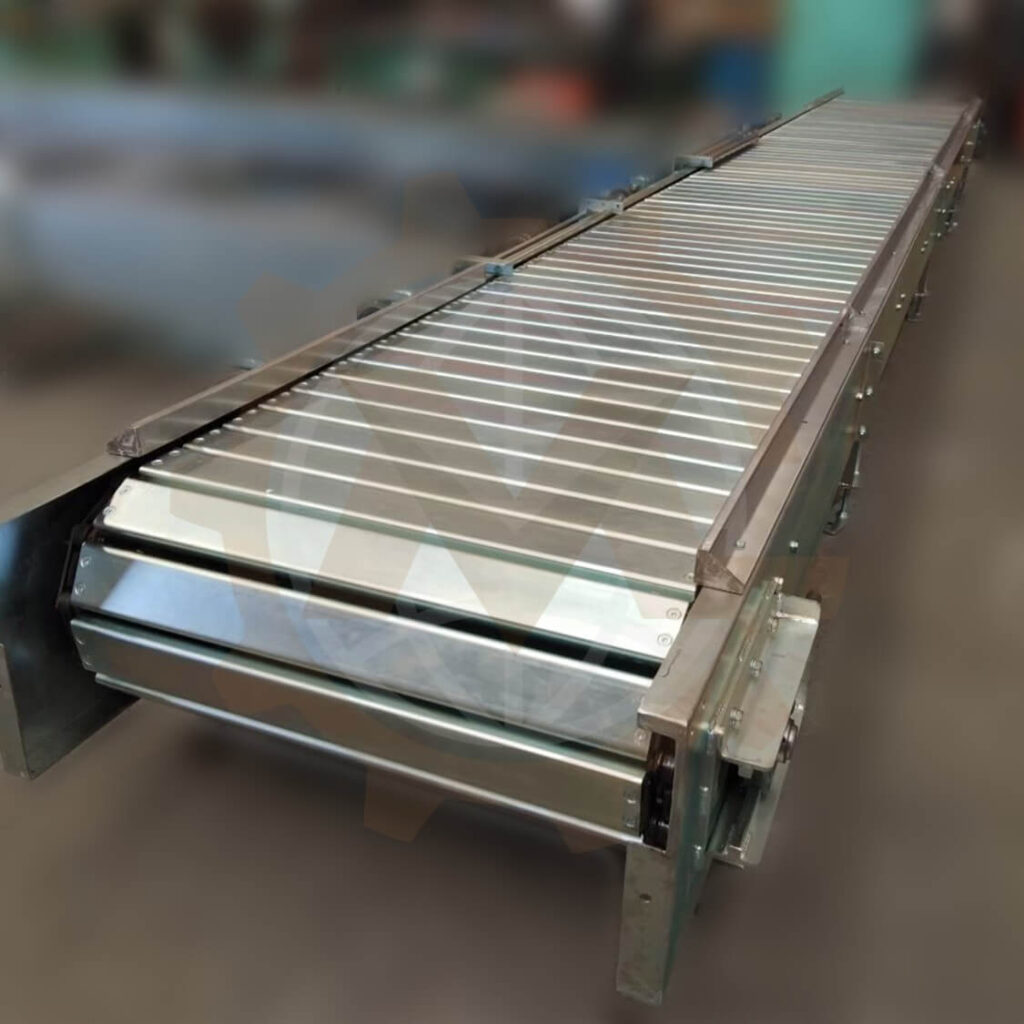
Heavy-Duty Slat Conveyors
Inclined Slat Conveyors
Inclined conveyors may use cleats, stops, nests, or textured slats to prevent product rollback or sliding. The design must evaluate incline force, product center of gravity, acceleration, chain tension, transfer geometry, retained-product behavior, and the consequences of power loss.
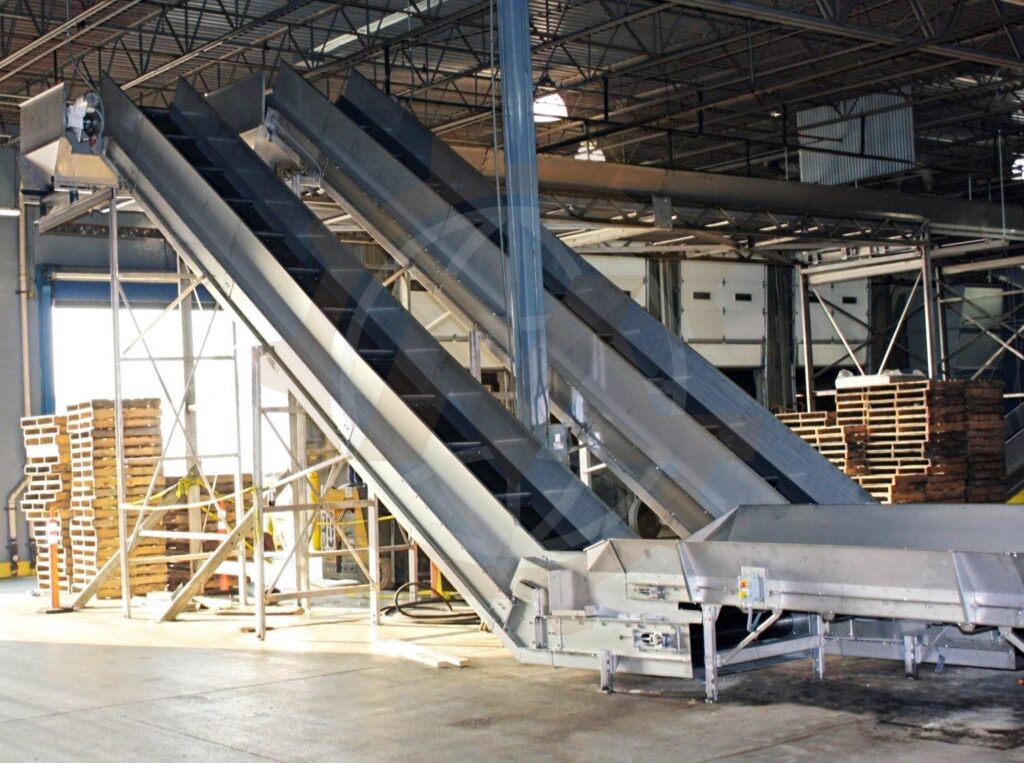
Inclined Slat Conveyors
Curved and Side-Flexing Slat Conveyors
Curved slat conveyors can route products around equipment and reduce transfer points. Side-flexing chains, guide rails, wear strips, curve radius, chain tension, product stability, and return-path geometry must be coordinated to prevent binding and excessive wear.
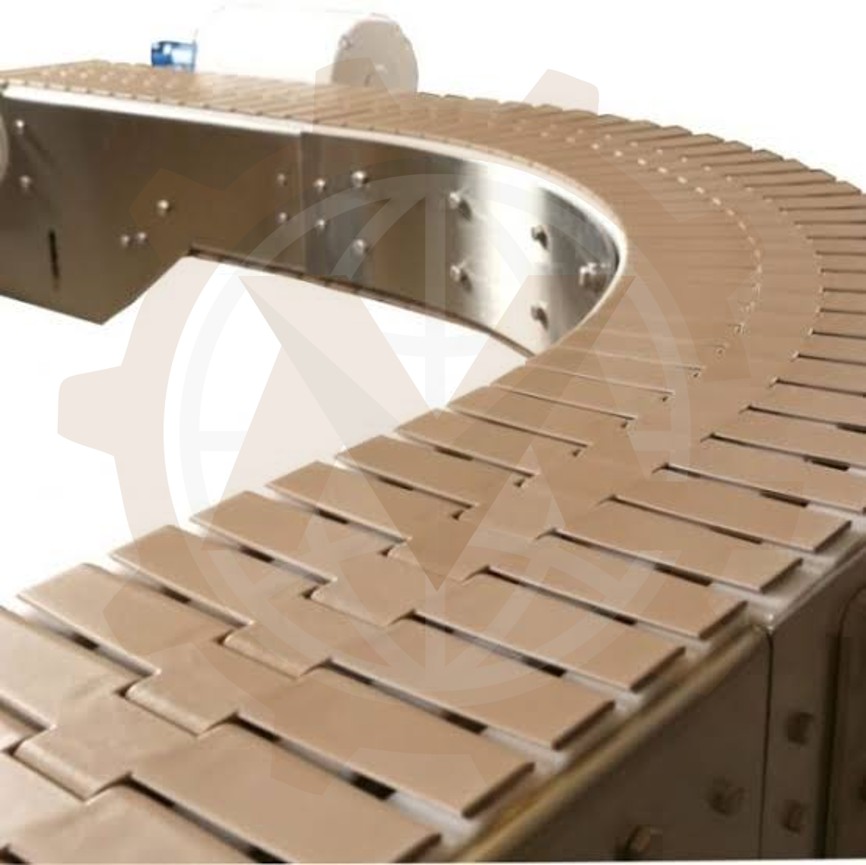
Curved and Side-Flexing Slat Conveyors
Drag Slat Conveyors
A drag slat conveyor uses flights or slats to pull bulk material through an enclosed or open trough. It is used in applications such as ash, chips, waste, aggregate, or asphalt handling. Material behavior, flight spacing, chain loading, trough wear, carryback, cleanout, and discharge control require a different design approach from unit-load slat conveyors.
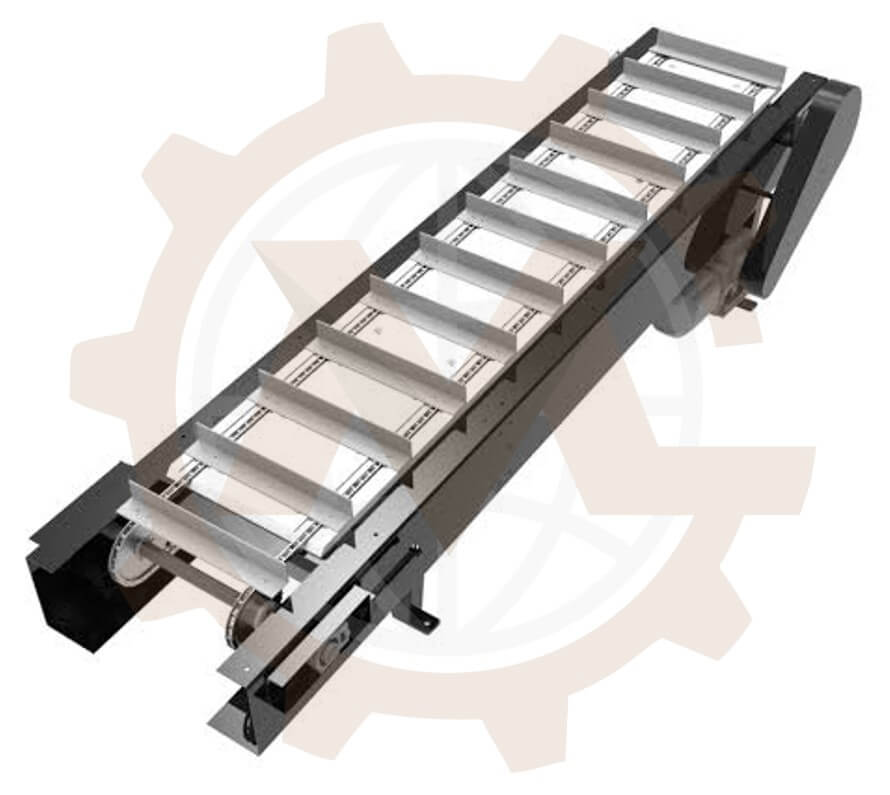
Drag Slat Conveyors
Indexing and Fixture Slat Conveyors
Slats can support dedicated nests, tooling plates, or fixtures for assembly, inspection, heating, cooling, coating, welding, and robotic operations. Positioning accuracy depends on the conveyor drive, chain stretch, stop mechanism, fixture datum, sensor strategy, and process-force isolation.
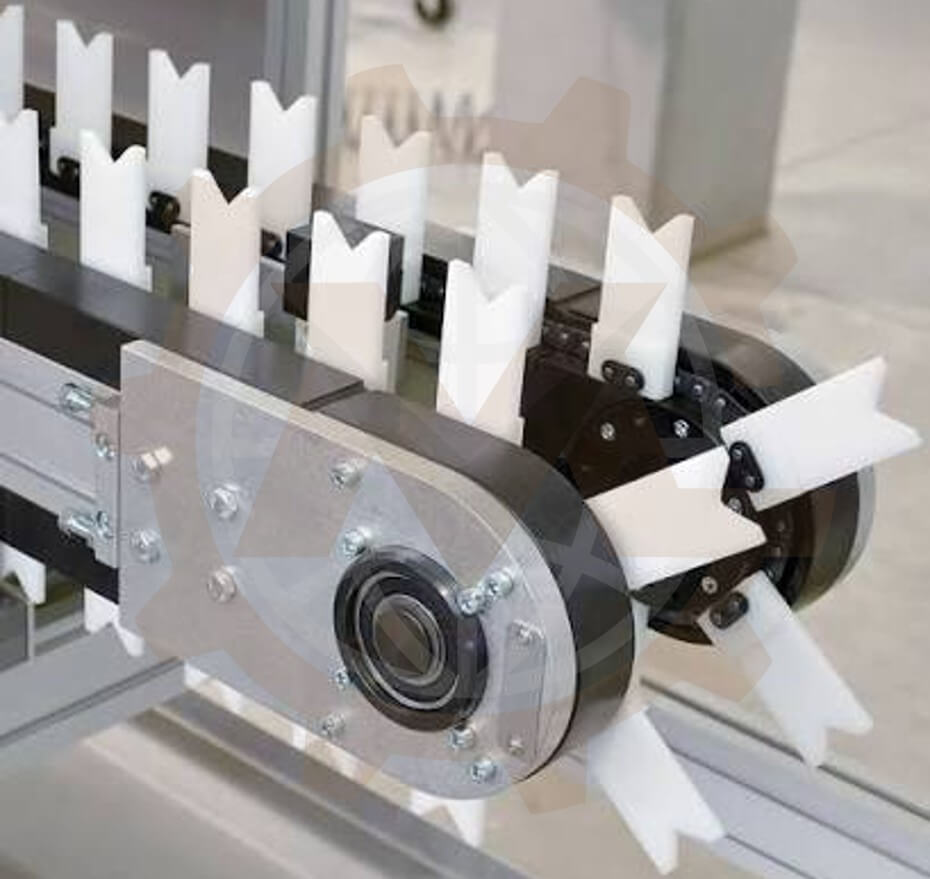
Indexing and Fixture Slat Conveyors
|
Configuration
|
Typical application
|
Primary design focus
|
|
Steel slat conveyor
|
Heavy parts, castings, hot products
|
Slat stiffness, chain pull, heat, impact and wear
|
|
Stainless steel slat conveyor
|
Washdown or corrosive environments
|
Material grade, cleanability, drainage and surface finish
|
|
Plastic slat chain conveyor
|
Containers and packaged products
|
Curve radius, chain pull, wear strips and product guides
|
|
Heavy-duty slat conveyor
|
Racks, dies, fixtures and fabrications
|
Starting torque, shafts, bearings, frame stiffness and anchors
|
|
Inclined slat conveyor
|
Elevation and process transitions
|
Cleats, rollback, center of gravity and power-loss behavior
|
|
Drag slat conveyor
|
Bulk solids, chips, ash and waste
|
Material resistance, flights, trough wear, carryback and cleanout
|
|
Indexing slat conveyor
|
Assembly and automated process cells
|
Positioning, fixtures, sensors, stops and process interfaces
|
Our Slat Conveyor Design Process
1. Product and Process Definition
We collect product dimensions, mass, center of gravity, support points, surface condition, temperature, throughput, speed, cycle time, accumulation, process forces, operating hours, environment, and upstream and downstream interfaces. Product variation and worst-case loading are clearly defined.
2. Conveyor Architecture and Layout
We determine the conveying route, working height, slat width, number of chains, drive position, take-up strategy, transfer points, process stations, support locations, maintenance clearances, and safety boundaries. Alternative concepts can be compared before detailed engineering begins.
3. Slat, Chain, and Support Selection
The slat material, thickness, profile, spacing, connection, chain pitch, attachment style, support method, wear strips, guide tracks, and return arrangement are selected together. The design must distribute the load without creating excessive slat deflection, attachment stress, chain wear, or noise.
4. Engineering Calculations
We calculate conveyor resistance, chain pull, starting force, acceleration, incline effects, process forces, motor power, gearbox torque, shaft loads, bearing reactions, slat strength, frame deflection, support reactions, and cycle time. Component ratings are checked against the actual duty and selected service factors.
5. Detailed 3D Mechanical Design
We model the slats, chains, attachments, sprockets, shafts, bearings, frame, wear strips, guides, drive, take-up, supports, guards, sensors, stops, transfers, fixtures, lubrication points, and connected-equipment interfaces. Assembly, adjustment, access, and component-removal paths are reviewed in the 3D model.
6. Fabrication Documentation
The deliverable package can include general arrangement drawings, fabricated-part drawings, machining drawings, slat and fixture details, assembly drawings, purchased-component specifications, BOMs, and neutral CAD exports.
7. Review and Integration Support
We review the design with the client, manufacturer, or system integrator, resolve agreed comments, and support interface clarification before release. Optional support can cover design changes, manufacturing questions, and as-built updates.
Conveyor Design Services: https://gmd.engineering/conveyor-design-services/
Key Engineering Calculations
- Product load distribution across one or more slats, including concentrated loads, impact, overhang, and center-of-gravity offset.
- Slat plate bending, local contact stress, stiffener loading, attachment forces, weld loading, and allowable deflection.
- Chain pull from product mass, chain and slat mass, guide friction, incline, acceleration, process loads, and accumulation.
- Motor power and gearbox torque for normal travel, loaded starting, stop-start duty, and credible jam or upset conditions.
- Sprocket tooth count, pitch diameter, engagement, chordal action, alignment, wear, and multi-strand synchronization.
- Drive and idler shaft strength under combined bending and torsion, including keys, locking elements, and fatigue effects.
- Bearing reactions, life, sealing, lubrication, alignment, mounting, temperature, and replacement access.
- Frame strength, cross-member deflection, support spacing, floor reactions, anchors, vibration, and process-station loading.
- Take-up travel for assembly tolerance, chain wear, thermal movement, adjustment, and equalization between chain strands.
- Cycle time, acceleration, dwell, indexing, transfer timing, buffer capacity, and sensor response.
Slat Design and Product Support
The slat is both a structural member and the product interface. A design that is strong enough may still be unsuitable if gaps catch the product, the surface marks finished parts, debris becomes trapped, or the slat cannot be replaced without dismantling the conveyor.
- Flat plate slats for simple product support.
- Formed or ribbed slats for greater stiffness at lower mass.
- Perforated or open slats for drainage, cooling, heating, or debris removal.
- Cleated, pocketed, or fixture-mounted slats for inclined transport and positive location.
- Overlapping or hinged slats where a more continuous surface is needed.
- Replaceable pads, wear plates, polymer inserts, or protective surfaces for finished products.
- Custom openings for sensors, tooling, process access, or liquid and chip drainage.
Slat width, thickness, gap, edge treatment, flatness, attachment location, replacement method, and thermal expansion are coordinated with the complete chain and frame design.
Chain Conveyor Design Services: https://gmd.engineering/chain-conveyor-design-services/
Chain, Sprocket, and Shaft Selection
The conveyor chain must carry both the transported load and the dead weight of the moving slats. Selection considers allowable working load, fatigue, shock, speed, pitch, attachments, lubrication, corrosion, temperature, articulation frequency, and environmental contamination. Catalog breaking load alone is not an acceptable design basis.
Sprocket tooth count affects polygonal action, speed variation, engagement, wear, and available package space. Multi-chain systems require accurate shaft geometry and sprocket alignment so the slats do not rack or bind. Shafts, keys, locking assemblies, bearings, and supports are designed for real torque and bending reactions.
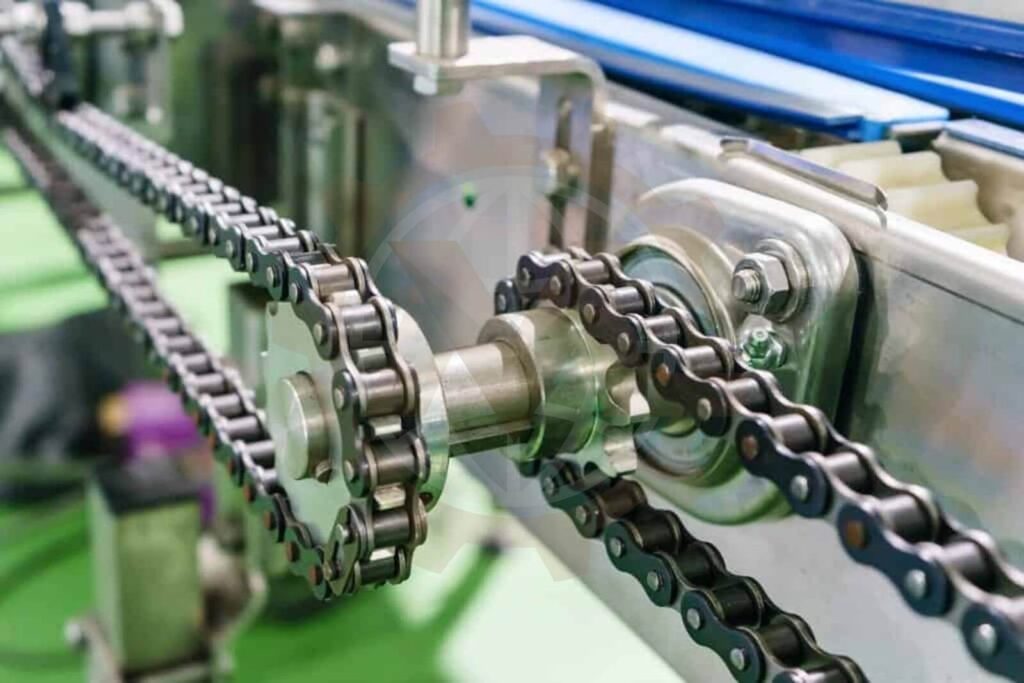
Chain, Sprocket, and Shaft Selection
Wear Strips, Guides, and Return Path
Wear strips and guide tracks control the chain path and support the loaded and return strands. Material selection depends on pressure, sliding speed, temperature, contamination, chemical exposure, noise, and lubrication. Joints, expansion allowance, mounting fasteners, and replacement access are planned to avoid steps that can catch the chain.
The return path may use wear strips, rollers, rails, or suspended chain support. It must prevent excessive sag, contact with guards or structure, accumulation of debris, and difficult maintenance. Drainage and cleanout are especially important in oily, wet, or chip-producing processes.
Pallet Conveyor Design Services: https://gmd.engineering/pallet-conveyor-design-services/
Transfers, Guides, Accumulation, and Indexing
Product Transfers
Transfer gaps must support the product without trapping edges, tipping unstable loads, or creating collisions. Dead plates, nose sections, powered transfers, side transfers, lift-and-transfer units, or synchronized adjacent conveyors may be used according to product geometry and process flow.
Side Guides and Product Control
Guide rails, funnels, centering devices, stops, and fixtures should control the product without excessive friction or jam risk. Adjustable guides may be appropriate for product families, but the adjustment range, locking method, and changeover reference must be clear.
Accumulation Strategy
Not every slat conveyor can accumulate products while the chain continues moving. Contact pressure, sliding friction, product damage, motor torque, heat generation, and operator safety must be evaluated. Zoned or stop-controlled arrangements can decouple processes when continuous-contact accumulation is unsuitable.
Indexing Accuracy
Accurate process positioning may require a mechanical stop, locating pin, lift-and-locate unit, servo drive, encoder, or fixture datum separate from the conveyor chain. This prevents chain wear and backlash from directly controlling process accuracy.
Screw Conveyor Design Services: https://gmd.engineering/screw-conveyor-design-services/
Materials and Operating Environments
- Carbon steel for general industrial and heavy-duty applications.
- Stainless steel for washdown, food, chemical, corrosive, or contamination-sensitive service.
- Aluminum where reduced moving mass and corrosion resistance are priorities.
- Engineered plastics for lightweight products, curves, low friction, and quieter operation.
- Heat-resistant alloys, insulated sections, or expansion provisions for ovens and hot-process conveyors.
- Wear-resistant plate, replaceable inserts, hardened surfaces, or special coatings for abrasive applications.
Material compatibility must be checked for temperature, cleaning chemicals, lubricants, product contact, corrosion, galvanic interaction, weldability, and the required service life.
Drive, Take-Up, and Lubrication Strategy
The drive may use a gearmotor, shaft-mounted reducer, chain drive, coupling, or servo system. Arrangement decisions include drive location, direction of pull, torque transmission, overhung load, braking, overload protection, back-driving, access, and removal clearance.
Take-up systems compensate for manufacturing tolerance, initial assembly, and progressive chain wear. Manual screw take-ups, spring-loaded devices, weighted systems, or controlled tensioners may be considered. Automatic lubrication can improve chain life in continuous-duty systems, but lubricant compatibility, application point, contamination, guarding, and collection must be addressed.
Automation and Sensor Integration
Slat conveyor systems may include photoelectric sensors, inductive sensors, encoders, RFID readers, motor-current monitoring, chain-motion detection, jam detection, stops, pneumatic or electric actuators, servo axes, and safety devices. Sensor brackets are positioned for reliable detection, adjustment, cleaning, and replacement.
The operating sequence should define normal flow, blocked and starved states, product release, accumulation limits, indexing, manual mode, restart logic, loss of position, jam recovery, and safe maintenance states. Mechanical, electrical, and PLC teams should work from the same interface and zone definitions.
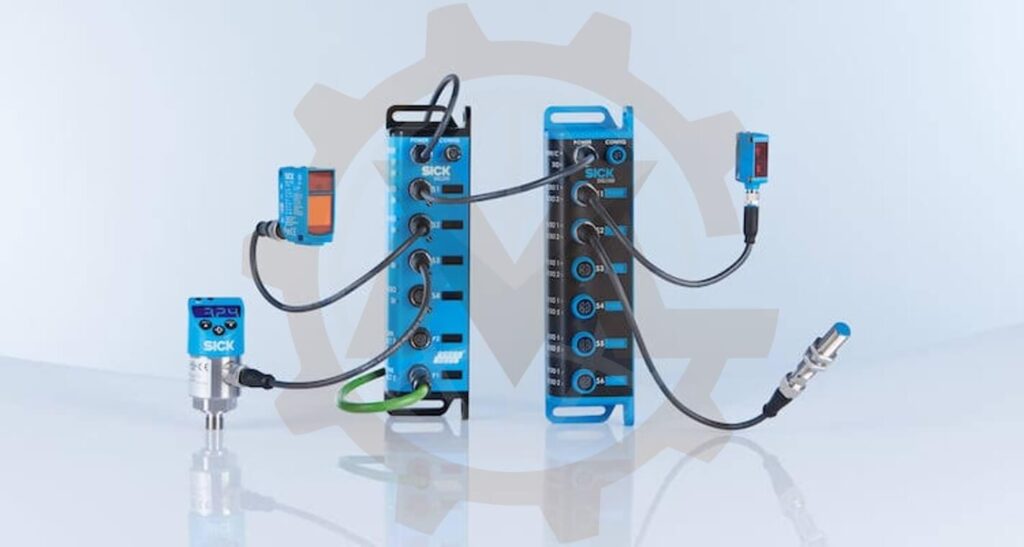
Automation and Sensor Integration
Safety and Maintainability
Slat conveyors contain chain and sprocket nip points, moving slat gaps, shear zones, rotating shafts, stored tension, and potential crush points at transfers or process stations. Safety requirements depend on the complete machine risk assessment, installation country, process, and customer standards.
- Guard chains, sprockets, couplings, shafts, take-ups, return paths, and accessible pinch or shear points.
- Coordinate emergency stops, safety gates, scanners, light curtains, and restart behavior with the complete line.
- Provide lockout and isolation for electrical, pneumatic, hydraulic, thermal, and stored mechanical energy.
- Prevent product rollback, falling, or uncontrolled movement after power loss on inclined or elevated systems.
- Provide removable guards and safe access to lubrication, bearings, sensors, take-ups, wear strips, and chain joints.
- Define practical removal routes and lifting points for motors, gearboxes, shafts, sprockets, chains, and slat sections.
- Control sharp edges, hot surfaces, chips, oil, wash water, and debris created by the process.
Industries and Applications
- Automotive assembly, engine, transmission, body, and component lines
- Steel fabrication, machining, welding, stamping, and foundry operations
- Packaging, bottling, container handling, and end-of-line systems
- Appliance, battery, electronics, and general industrial assembly
- Food, beverage, washdown, and process applications with suitable materials
- Heat-treatment, cooling, drying, coating, and oven conveyor systems
- Pallets, fixtures, racks, dies, castings, and heavy manufactured products
- Bulk-material drag conveying for chips, ash, waste, aggregate, and process residues
Engineering Deliverables
|
Deliverable
|
Typical content
|
|
Design basis
|
Product data, load cases, throughput, environment, assumptions and equipment interfaces
|
|
Concept and layout
|
Conveyor architecture, route, working height, transfers, drive, supports and maintenance zones
|
|
Engineering calculations
|
Slats, chains, sprockets, shafts, bearings, drive power, frame and cycle-time checks
|
|
3D CAD assembly
|
Complete conveyor, slats, chain, drive, guides, guards, sensors and surrounding interfaces
|
|
2D drawings
|
General arrangement, fabrication, machining, slat, fixture and assembly drawings
|
|
Bill of materials
|
Manufactured parts, chains, sprockets, motors, gearboxes, bearings, sensors and actuators
|
|
Exchange formats
|
Inventor files, STEP, SAT, DXF, PDF, Excel or other agreed formats
|
|
Review support
|
Design review, comment resolution, manufacturing clarification and controlled revisions
|
Why Choose GMD Services?
- More than 10 years of mechanical machine-design experience for conveyors, custom machines, and production equipment.
- Design decisions based on the actual product, load, process timing, environment, interfaces, and fabrication capability.
- Practical attention to manufacturing, welding, tolerances, assembly, adjustment, access, wear, cleaning, and component replacement.
- Autodesk Inventor as the primary design platform, with common neutral CAD and documentation formats available.
- Flexible engineering support for a complete slat conveyor or as an extension of an OEM or integrator design team.
- Clear definition of scope, assumptions, exclusions, responsibility boundaries, deliverables, and review stages.
- Remote collaboration for manufacturers and integrators serving international markets.
Information Needed to Start
- Product drawings, dimensions, mass, center of gravity, support points, surface condition, and allowable contact areas.
- Required throughput, conveyor speed, cycle time, indexing, accumulation, and operating hours.
- Route, length, width, elevation, incline, curve, transfer direction, process stations, and available layout.
- Temperature, impact, oil, chips, dust, moisture, washdown, chemicals, corrosion, and abrasive exposure.
- Upstream and downstream equipment, robot, operator, forklift, fixture, or process interfaces.
Preferred components, utilities, controls philosophy, safety requirements, design standards, CAD format, and schedule.
Industrial Automation Services: https://gmd.engineering/industrial-automation-services/
Frequently Asked Questions
What is a slat conveyor?
A slat conveyor uses rigid plates attached to one or more chains to form a moving product-support surface. It is commonly used for heavy, hot, sharp, oily, irregular, or unstable products that may not suit a conventional belt conveyor.
What is the difference between a slat conveyor and a belt conveyor?
A belt conveyor uses a continuous flexible belt and is often suitable for cartons, bags, and lighter products. A slat conveyor uses rigid plates and can better support concentrated loads, high temperatures, custom fixtures, cutting exposure, and demanding process operations.
How is slat conveyor chain pull calculated?
Chain pull includes the transported load, moving slat and chain mass, sliding or rolling friction, incline resistance, acceleration, process forces, accumulation effects, and selected service factors. Starting and upset conditions must also be checked.
Can slat conveyors handle hot products?
Yes, with suitable slat, chain, bearing, lubricant, guide, and frame materials. Thermal expansion, heat transfer to components, guarding, product stability, and maintenance access must be considered for the actual temperature range.
Can a slat conveyor be used for assembly or indexing?
Yes. Slats can carry fixtures, nests, tooling, or locating features. Accurate process positioning may require mechanical locating separate from the chain so chain wear and backlash do not control the final process datum.
Can you design steel and stainless steel slat conveyors?
Yes. The material and surface treatment are selected from strength, temperature, corrosion, hygiene, washdown, contamination, weldability, wear, and lifecycle requirements.
Do you provide calculations, CAD models, drawings, and BOMs?
Yes. Depending on the agreed scope, we can deliver engineering calculations, 3D CAD, general arrangements, fabrication and machining drawings, slat and fixture details, assembly drawings, BOMs, PDFs, and neutral CAD exports.
Can you redesign an existing slat conveyor?
Yes. Typical objectives include higher capacity, new products, reduced chain wear, improved tracking, stronger slats, better transfers, safer guarding, improved maintenance access, or replacement of obsolete components.
How long does a slat conveyor design project take?
Schedule depends on conveyor length, curves and transfers, load severity, custom slats or fixtures, calculation depth, documentation level, input quality, and review cycles. Complete product and interface data significantly reduce engineering lead time.
Develop a Slat Conveyor Around Your Product and Process
A durable slat conveyor is created by coordinating the product-support surface with chain loading, drive torque, shaft strength, frame stiffness, transfers, guides, wear protection, controls, guarding, and maintenance. GMD Services can provide the engineering capacity and documentation required to move from operating concept to fabrication.
Send us your product data, load information, conveyor route, cycle requirements, environment, connected-equipment details, and required deliverables. We will review the application and propose a practical scope for your Slat Conveyor Design Services project.