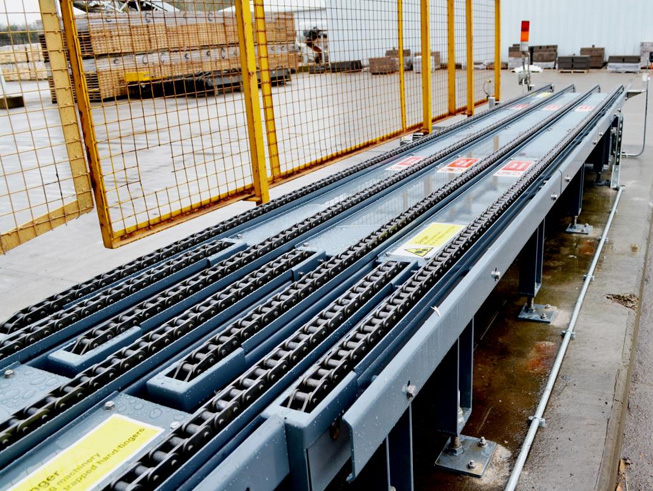
Custom Chain Conveyor Engineering for Demanding Material Handling
A chain conveyor must do more than move a load from point A to point B. It must start under load, maintain alignment, withstand repeated shock, integrate with upstream and downstream equipment, and remain serviceable throughout its operating life. GMD Services provides chain conveyor design services for manufacturers, system integrators, machine builders, and factories that need a practical, fabrication-ready solution rather than a generic conveyor layout.
We develop custom chain conveyor systems for pallets, fixtures, steel components, automotive assemblies, heavy products, bins, racks, and other unit loads. Our engineering scope can cover concept development, conveyor type selection, chain and sprocket sizing, drive calculations, structural design, guarding, sensor provisions, 3D CAD, 2D manufacturing drawings, bills of materials, and design documentation.
Whether you need a stand-alone conveyor, an indexing section, a chain transfer conveyor, or a complete automated handling line, the design is built around your product, process, duty cycle, plant constraints, and fabrication capabilities.
What Is a Chain Conveyor?
A chain conveyor uses one or more endless chains to pull, carry, support, or push a load along a defined path. Depending on the application, the product may sit directly on attachment chains, on slats or flights connected to the chains, on rollers driven by chains, or on a pallet supported by wear strips and guide rails.
Compared with a conventional belt conveyor, a chain conveyor is often the better choice when loads are heavy, the environment is harsh, positive engagement is required, or the product must be indexed accurately. The final configuration depends on load geometry, support points, transfer conditions, accumulation requirements, speed, temperature, contamination, noise limits, and maintenance strategy.
Chain Conveyor Systems We Design
The phrase “chain conveyor” covers several distinct machine architectures. Selecting the correct architecture early prevents oversizing, unstable transfers, excessive chain wear, and expensive changes after fabrication.
Pallet Chain Conveyors
A pallet chain conveyor commonly uses two or three parallel strands to transport wooden, plastic, or steel pallets. The chain spacing must support the pallet runners correctly, while guides and transfer interfaces must prevent skewing. We can design pallet conveyor sections for straight transport, stop stations, centering units, lifts, turntables, and 90-degree transfers.
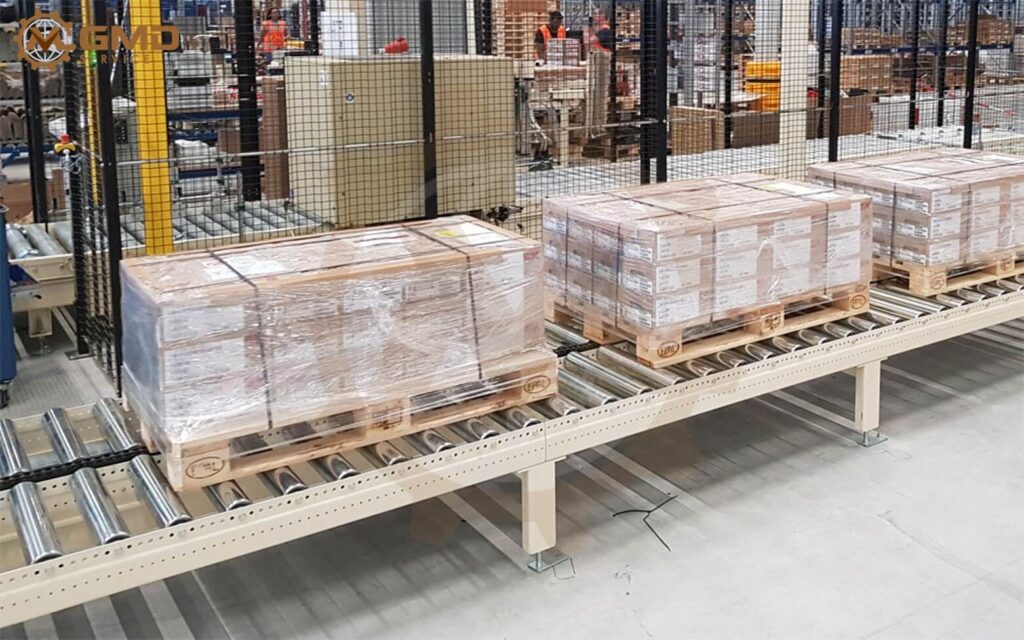
Pallet Chain Conveyors
Heavy-Duty Chain Conveyors
Heavy-duty chain conveyors are suitable for steel fabrications, dies, racks, engine components, and other loads that create high static and dynamic forces. The design process considers starting torque, impact loading, chain pull, frame deflection, shaft torsion, bearing reactions, fatigue-sensitive details, and safe maintenance access.
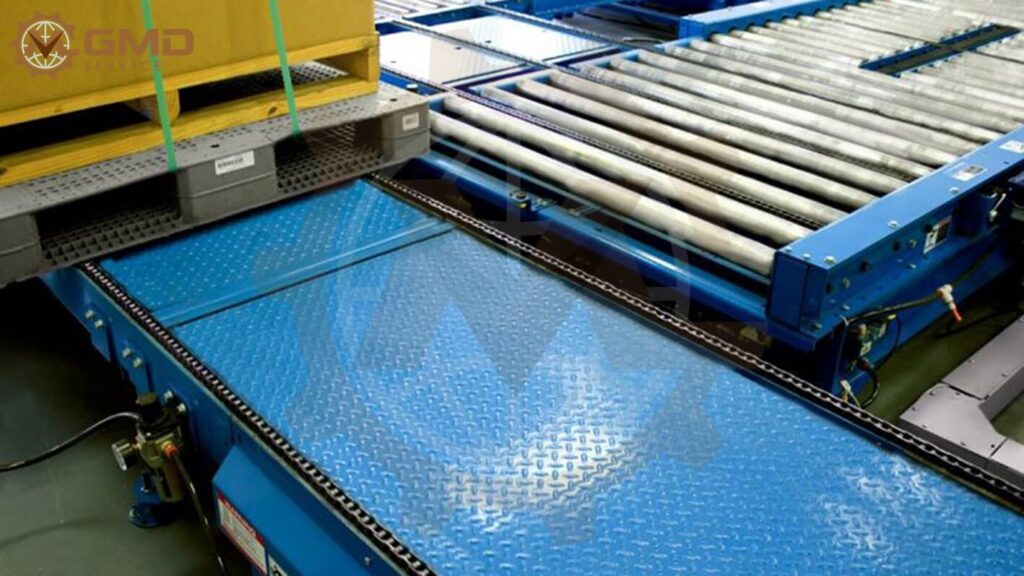
Heavy-Duty Chain Conveyors
Chain-Driven Roller Conveyors
A chain driven roller conveyor transfers torque from roller to roller through sprockets and chains. It is frequently used for pallets, containers, and rigid loads with a stable base. Roller pitch, roller diameter, chain arrangement, accumulation logic, and guarding must be coordinated to deliver reliable product flow without creating pinch-point or tracking problems.
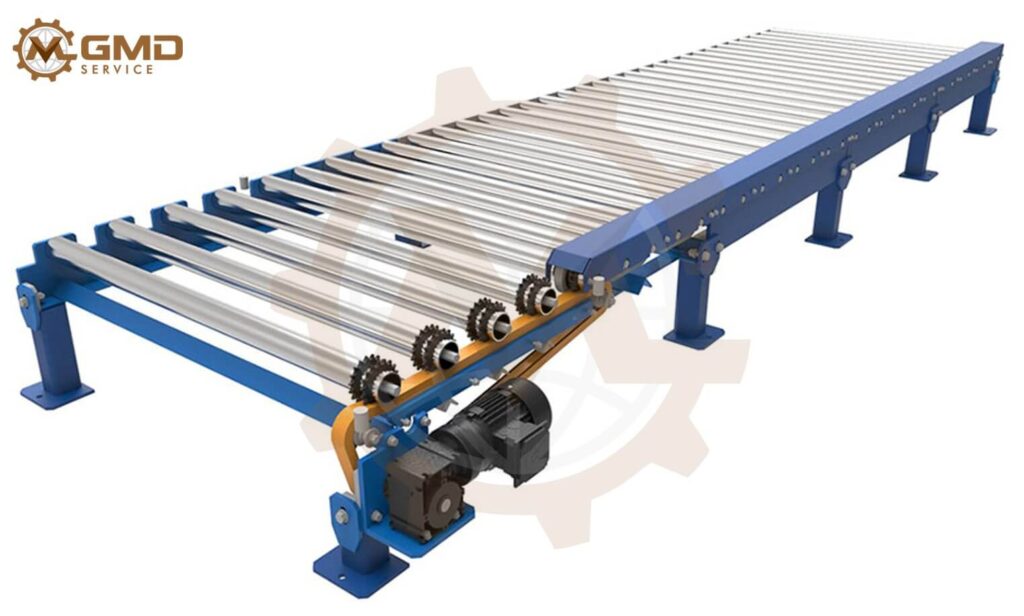
Chain-Driven Roller Conveyors
Slat, Flat-Top, and Table-Top Chain Conveyors
Slat chain conveyors and flat top chain conveyors create a continuous or semi-continuous carrying surface. Plastic chain conveyor systems are useful for bottles, packages, and products that need flexible layouts, while steel slats suit heavier loads and demanding environments. Curves, side-flexing chains, product guides, wear strips, and return-path support are engineered as one system.
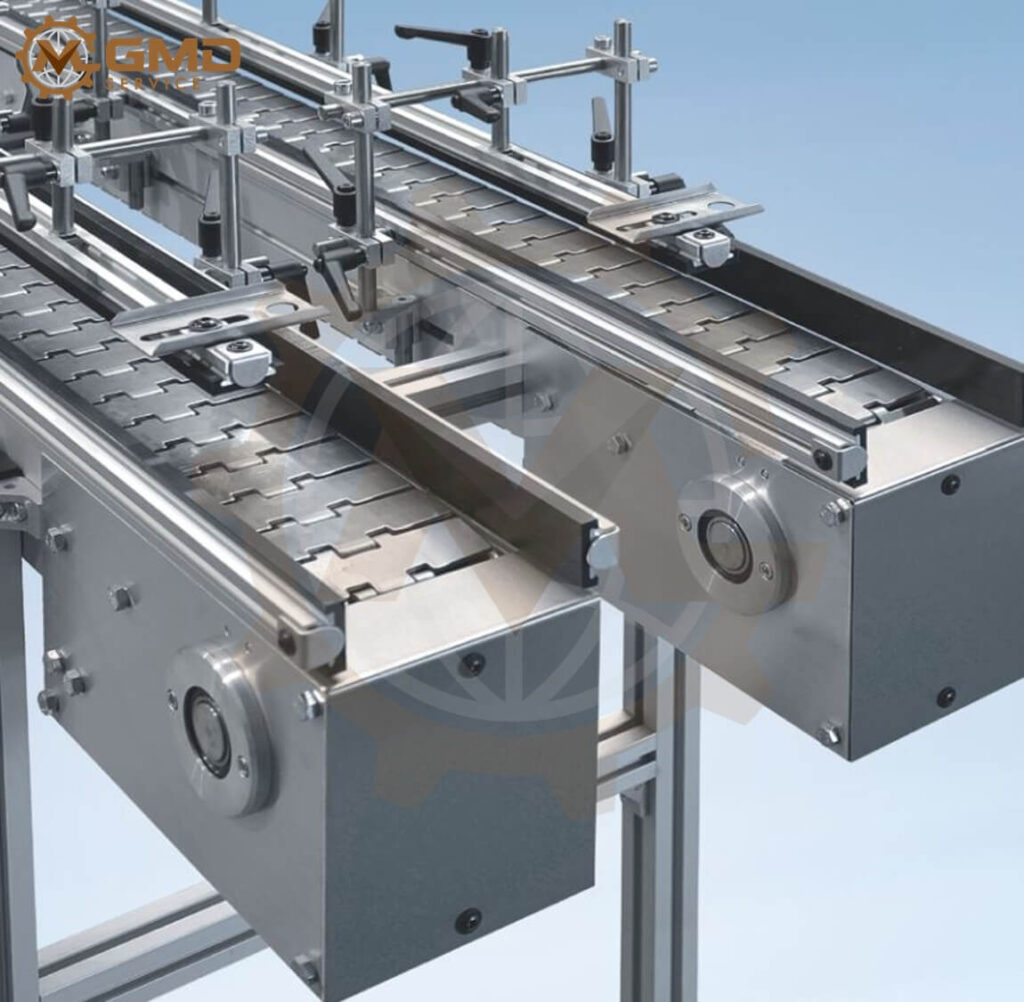
Slat, Flat-Top, and Table-Top Chain Conveyors
Drag and Flight Chain Conveyors
A drag chain conveyor uses flights or attachments to move bulk material or products through an enclosed or open trough. These systems require careful attention to material behavior, trough clearance, chain tension, return routing, cleanout access, and wear. Tubular drag chain conveyors are a specialized option for enclosed bulk transport; they should be evaluated separately from unit-load chain conveyors.
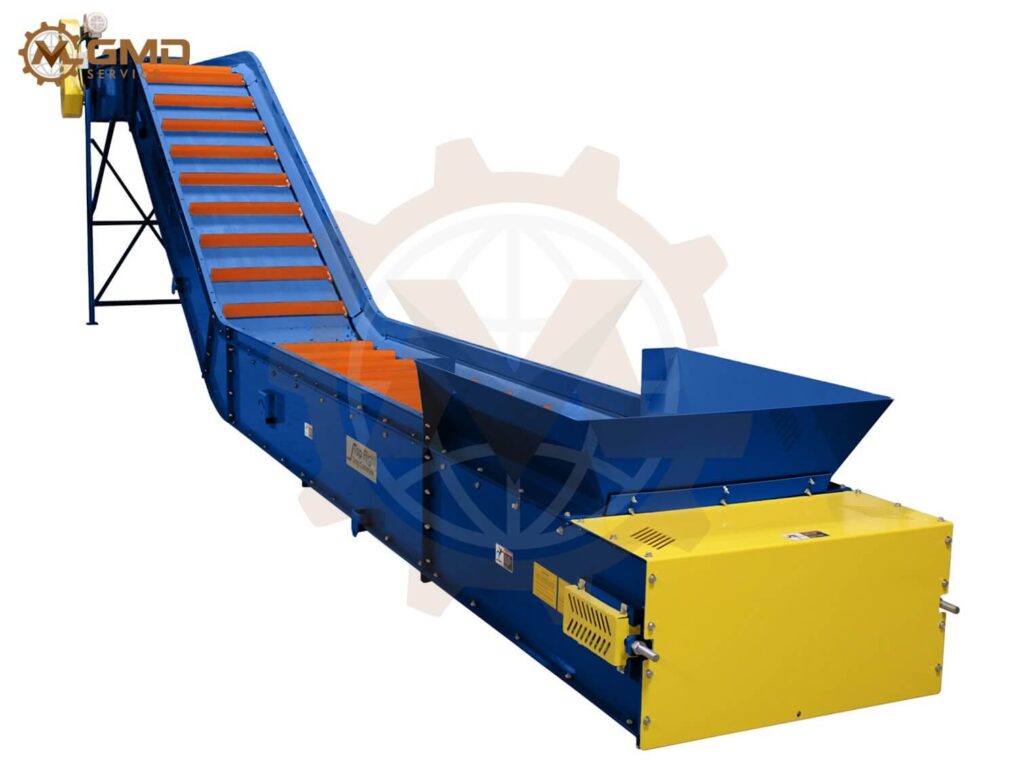
Drag and Flight Chain Conveyors
Overhead, Floor, Vertical, and Indexing Conveyors
Where floor space or process access is limited, overhead chain conveyors, in-floor conveyors, vertical chain conveyors, and indexing chain conveyors may be considered. These arrangements introduce additional requirements for load retention, anti-drop features, synchronization, positional control, and safe recovery after a fault or power loss.
| Conveyor type |
Best suited to |
Key design focus |
| Pallet chain conveyor |
Pallets, skids, fixtures |
Strand spacing, pallet support, transfers, centering |
| Heavy-duty chain conveyor |
Steel parts, racks, dies |
Chain pull, shock load, shaft and frame strength |
| Chain-driven live roller conveyor |
Rigid unit loads and pallets |
Roller pitch, accumulation, guarding, torque distribution |
| Slat / flat-top conveyor |
Packages, containers, components |
Surface continuity, curves, guides, wear strips |
| Drag / flight conveyor |
Bulk solids or enclosed transport |
Material behavior, flight spacing, trough wear, cleanout |
| Indexing / transfer conveyor |
Automated assembly and process cells |
Positioning, cycle time, sensor and actuator integration |
Our Chain Conveyor Design Process
1. Requirement Definition and Load Analysis
We begin with the product and process, not with a preferred catalog component. The input data normally includes load mass and dimensions, center of gravity, support surfaces, throughput, line speed, cycle time, start-stop frequency, accumulation, elevation changes, operating hours, environment, available utilities, footprint, interfaces, and applicable customer standards.
2. Concept and Conveyor Architecture
We compare practical concepts and define the number of chain strands, conveying surface, support method, drive location, take-up strategy, transfer geometry, maintenance zones, and interface heights. The concept stage is also where we identify risks such as unstable products, insufficient support, chain interference, inaccessible tensioners, and poor fault recovery.
3. Engineering Calculations and Component Selection
The selected arrangement is then checked for chain pull, effective tension, frictional resistance, acceleration force, incline force, service factors, sprocket engagement, shaft loads, bearing reactions, motor power, gearbox torque, and structural response. Components are selected using manufacturer ratings and the actual duty profile—not load mass alone.
4. 3D Mechanical Design and Integration
We create a detailed 3D CAD model of the conveyor, drive station, shafts, sprockets, frames, guides, supports, guards, sensors, stops, transfers, and interfaces. The model is checked for assembly access, adjustment ranges, lubrication access, removable wear parts, tool clearance, and collision risks.
Mechanical Design Services: https://gmd.engineering/mechanical-design-services/
5. Fabrication Documentation
The final engineering package can include general arrangement drawings, fabrication drawings, machining drawings, assembly drawings, purchased-part specifications, BOMs, and neutral CAD exports. Documentation is organized to support manufacturing, assembly, procurement, and design review.
6. Design Review and Revision Support
We review the system with your engineering or fabrication team, incorporate agreed comments, and help resolve integration questions before manufacturing. Optional support can include design updates, installation details, and as-built revisions.
Key Engineering Calculations
Reliable chain conveyor design requires a connected set of calculations. The following checks are typical; the exact scope depends on the system architecture and risk level.
- Chain pull and effective tension: resistance from load, chain mass, guides, friction, acceleration, incline, and process forces.
- Motor and gearbox sizing: steady-state power, starting torque, service factor, efficiency, speed range, and available overload capacity.
- Chain and sprocket selection: allowable working load, pitch, attachments, material, lubrication condition, tooth count, engagement, and wear life.
- Drive shaft design: combined torsion and bending, stress concentrations, key or locking-element connection, deflection, and fatigue.
- Bearing selection: radial and axial reactions, life target, sealing, alignment, mounting arrangement, and maintenance access.
- Frame and support design: global deflection, local plate bending, cross-member loading, floor reactions, anchor locations, and vibration.
- Take-up and tensioning: adjustment travel, thermal effects, chain wear allowance, equalization between strands, and inspection access.
- Throughput and cycle-time verification: acceleration, indexing dwell, sensor response, transfer timing, and buffer capacity.
For critical structures or unusually heavy loads, finite element analysis can be added to evaluate stress, deflection, local stiffness, and load paths. FEA supports—but does not replace—sound load definition, hand calculations, and engineering judgment.
Important Design Decisions That Affect Reliability
Chain Selection
The correct conveyor chain is selected from working load, speed, articulation frequency, shock, contamination, corrosion, temperature, and attachment geometry. A chain with a high catalog breaking load can still perform poorly if lubrication, sprocket size, alignment, or dynamic loading is ignored.
Sprockets and Shaft Arrangement
Sprocket tooth count influences chordal action, speed fluctuation, wear, and package size. Multi-strand systems also require controlled alignment and an appropriate method of torque transmission. Drive and idler shaft layouts must allow practical assembly and replacement.
Wear Strips, Chain Guides, and Return Support
Conveyor chain guides and wear strips control the chain path, reduce metal-to-metal contact, and support the loaded and return strands. Their material, mounting, joints, thermal expansion, and replacement method must suit the environment and load pressure.
Lubrication and Contamination Control
A conveyor chain lubrication system may be manual, drip-fed, brush-applied, or automatic. Lubricant type and application rate should follow the chain manufacturer and operating environment. Food, clean, dusty, hot, or washdown applications may require dry-running components, special materials, or guarded lubrication zones.
Chain Wear Monitoring and Maintenance Access
Chain elongation, sprocket wear, damaged rollers, loose attachments, and guide wear should be detectable before failure. A maintainable design includes inspection points, tension references, removable guards, safe access, and space to split or replace the chain. Conveyor chain monitoring systems can be considered for critical production lines.
Transfers, Accumulation, and Product Stability
The conveyor must support the product through every gap and transition. Transfer plates, dead plates, powered rollers, lift-and-transfer units, stops, or guides may be required. Accumulation must be intentionally designed; not every chain conveyor can allow products to slip safely while the chain continues moving.
Controls, Sensors, and Automation Integration
Mechanical and controls decisions are closely linked. We can provide mounting and interface provisions for photoelectric sensors, inductive sensors, encoders, limit switches, motor feedback, jam detection, chain monitoring, stops, pneumatic cylinders, servo axes, and safety devices. Sensor locations are selected with product variation, contamination, access, and failure behavior in mind.
For an automated line, the conveyor sequence should define normal flow, blocked and starved states, accumulation limits, restart logic, manual mode, fault recovery, and safe maintenance states. Clear interface definitions reduce commissioning time for PLC and electrical teams.

Controls, Sensors, and Automation Integration
Safety and Design for Maintainability
Chain conveyors contain nip points, rotating shafts, sprockets, moving attachments, stored energy, and sometimes suspended or elevated loads. Safety must be engineered into the layout from the beginning. The applicable requirements depend on installation country, industry, customer specification, and the complete machine risk assessment.
- Fixed or interlocked guarding around sprockets, chains, couplings, shafts, and accessible pinch points.
- Emergency-stop and safety-device provisions coordinated with the full production line.
- Lockout and isolation provisions for electrical, pneumatic, hydraulic, and stored mechanical energy.
- Controlled access to take-ups, lubrication points, inspection areas, and replaceable wear components.
- Load-retention or anti-drop measures where products can fall, roll, or move after energy removal.
- Ergonomic removal routes for motors, gearboxes, shafts, guards, chains, and wear strips.
Industries and Applications
- Automotive and electric-vehicle component handling
- Steel fabrication, laser cutting, welding, and machining lines
- Pallet transport and warehouse interfaces
- Packaging, bottling, and end-of-line automation
- Assembly machines, test stations, and indexing processes
- Foundry, heavy equipment, and industrial component manufacturing
- Food, beverage, and washdown applications with suitable materials
- Logistics, unit-load transfer, and custom material handling.
Engineering Deliverables
| Deliverable |
Typical content |
| Concept package |
Layout options, operating principle, preliminary component strategy, design risks |
| 3D CAD assembly |
Conveyor structure, chain path, drive, guards, sensors, transfers, interfaces |
| Engineering calculations |
Chain pull, drive sizing, shafts, bearings, frame checks, cycle-time assumptions |
| 2D drawings |
General arrangement, fabrication, machining, assembly, and installation details |
| Bill of materials |
Manufactured parts, standard components, motors, gearboxes, bearings, sensors |
| Exchange formats |
STEP, SAT, DXF, PDF, Excel, or other agreed formats |
| Review support |
Design review, comment resolution, revisions, and manufacturing clarification |
Why Choose GMD Services?
- Machine-design perspective: the conveyor is treated as part of the production process, not an isolated frame and chain.
- Manufacturing-ready detail: designs consider welding, machining, tolerances, assembly sequence, procurement, adjustment, and maintenance.
- Flexible engineering capacity: use our team for a complete conveyor design or as an extension of your internal engineering department.
- CAD compatibility: Autodesk Inventor is our primary platform, with support for common neutral and documentation formats.
- International collaboration: structured reviews, clear deliverables, and remote engineering support for clients and integrators worldwide.
Scope transparency: assumptions, exclusions, inputs, interfaces, and revision responsibilities are defined before detailed design begins.
Information Needed to Start
To prepare an accurate scope and quotation, please provide as much of the following information as available:
- Product or pallet drawings, dimensions, mass, center of gravity, and support points.
- Required throughput, speed, cycle time, accumulation, and operating schedule.
- Start and end elevations, route, footprint, transfer directions, and available layout.
- Environmental conditions such as dust, moisture, washdown, temperature, or corrosive exposure.
- Preferred components, electrical supply, controls concept, and customer design standards.
Expected engineering deliverables, CAD format, drawing standard, and target schedule.
Frequently Asked Questions
What is the difference between a chain conveyor and a belt conveyor?
A belt conveyor supports products on a continuous belt and is often suitable for cartons, bags, and lighter loads. A chain conveyor uses positive chain engagement and is typically preferred for pallets, fixtures, heavy products, high temperatures, dirty conditions, or applications requiring robust indexing. The best choice depends on the product and process—not simply capacity.
How do you select the right conveyor chain?
Selection considers calculated chain pull, service factor, speed, shock, load distribution, attachment style, sprocket geometry, environment, lubrication, corrosion, and desired service life. Manufacturer working-load data and application factors should be used together with the actual operating cycle.
Can you design a chain conveyor for an existing production line?
Yes. We can work from plant layouts, interface drawings, point-cloud or field measurements supplied by the client, equipment models, and operating descriptions. Interface conditions and responsibility boundaries are documented before detailed design.
Can you design chain conveyors for pallets and heavy steel parts?
Yes. Pallet chain conveyors and heavy-duty chain conveyors are core applications. The design must account for pallet runner position, load distribution, shock, starting torque, transfer gaps, frame stiffness, and safe recovery from jams.
Do you provide fabrication drawings and BOMs?
Yes. Depending on the agreed scope, deliverables may include 3D CAD, general arrangement drawings, fabrication and machining drawings, assembly drawings, purchased-component data, BOMs, and PDF or neutral CAD exports.
Can you improve or redesign an existing conveyor?
Yes. Typical redesign objectives include higher capacity, reduced wear, improved guarding, better maintenance access, a new product size, replacement of obsolete components, or integration with new automation. Existing data and site constraints must be verified before changes are released.
Do you provide electrical design and PLC programming?
Mechanical conveyor design can be delivered as a stand-alone scope or coordinated with electrical design, controls, and PLC programming services. The exact responsibility split should be defined at quotation stage.
How long does a chain conveyor design project take?
Schedule depends on conveyor length, number of transfers, design maturity, calculation depth, documentation level, and review cycles. A clear input package and timely design approvals have a major influence on lead time.
Build a Chain Conveyor Around Your Product and Process
A reliable conveyor begins with accurate requirements and an engineering approach that connects chain selection, drive sizing, structural design, transfers, guarding, controls, and maintenance. If you are planning a new chain conveyor system or need to redesign an existing machine, GMD Services can develop the mechanical solution and the documentation required for review and fabrication.
Send us your product data, layout, throughput, operating conditions, and required deliverables. We will review the application and propose a practical engineering scope for your chain conveyor design project -> Click here