Engineered Vertical Movement for Automated Facilities
Need to move pallets, totes, cartons, trays, components, or packaged products between elevations without consuming valuable floor space? GMD Services provides custom Vertical Conveyor Design Services for vertical reciprocating conveyors, continuous vertical conveyors, lift-and-transfer systems, pallet lifts, belt and chain configurations, and integrated multilevel material-handling lines. We develop practical solutions from concept layouts and engineering calculations through detailed 3D CAD models, fabrication drawings, and complete bills of materials.
A dependable vertical conveyor is more than a platform moving up and down. The carrier, mast, guides, chains or belts, drive, brake, counterweight, load retention, infeed and outfeed conveyors, sensors, guarding, access, and control sequence must work as one system. Our engineering is based on the real load envelope, center of gravity, travel height, throughput, duty cycle, transfer direction, operating environment, building interfaces, maintenance strategy, and risk assessment—so the design is safe to integrate, efficient to manufacture, and reliable in service.
Vertical conveyor systems connect production levels, mezzanines, storage areas, work cells, packaging lines, and distribution processes. Unlike a conventional incline conveyor, a vertical conveyor can achieve a large elevation change within a compact footprint. The correct architecture depends on whether loads move intermittently or continuously, whether the carrier serves two or several landings, and whether the product is a rigid unit load, a pallet, or loose bulk material. GMD Services supports OEMs, machine builders, automation integrators, and industrial end users. A scope can cover a complete new machine, a concept study, redesign of an existing mechanism, capacity or cycle-time verification, detailed mechanical engineering, or production documentation for a client-selected drive and conveyor platform.
What Is a Vertical Conveyor?
A vertical conveyor transports material between elevations using a guided carrier, platform, belt, chain, spiral, bucket, or other purpose-designed conveying element. Unit-load systems may lift pallets, totes, cartons, trays, fixtures, or products; bulk-handling systems may use buckets, belts, or screws. This service page focuses primarily on engineered unit-load and packaged-product systems that interface with automated conveyors and machinery. A vertical reciprocating conveyor (VRC) moves a carrier back and forth between fixed elevations. A continuous vertical conveyor circulates multiple carriers or flights through a closed path to provide repeated upward or downward transfers. Spiral conveyors and vertical belt or chain arrangements serve other product and throughput profiles. These technologies are not interchangeable: load, speed, accumulation, footprint, transfer geometry, accessibility, and jurisdictional requirements determine the suitable concept.
Vertical Conveyor Systems We Design
Vertical Reciprocating Conveyors (VRCs)
A VRC vertical reciprocating conveyor uses a guided carrier that stops at one or more landings. It is well suited to pallets, carts, totes, fixtures, and heavy unit loads when transfer cycles are discrete. Designs may use chains, belts, wire ropes, rack drives, or other lifting mechanisms, subject to application requirements and the selected equipment standard.
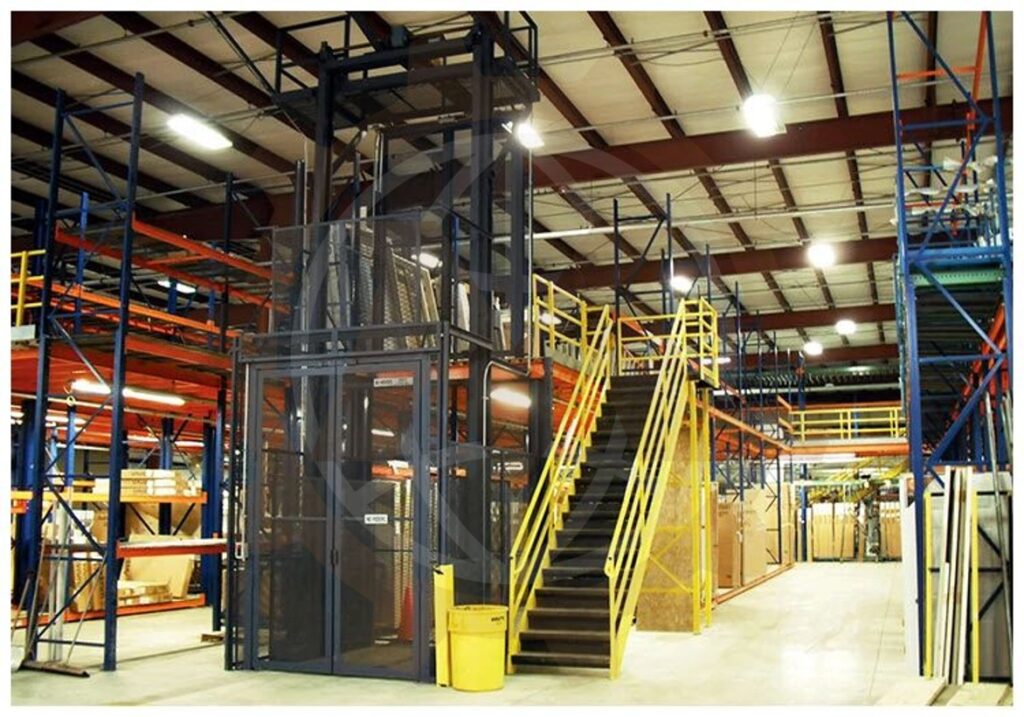
Vertical Reciprocating Conveyors.jpeg
Continuous Vertical Conveyors
A continuous vertical conveyor uses multiple platforms, forks, or product supports moving through a continuous loop. It can achieve higher, steadier throughput than a single-carrier lift, but requires coordinated loading, unloading, pitch, speed, product clearance, and fault recovery. Product flow direction and transfer timing are established early because they define the carrier arrangement and controls.

Continuous Vertical Conveyors
Vertical Pallet Conveyors
Vertical pallet conveyor systems transfer loaded or empty pallets between floor levels or process elevations. Engineering focuses on pallet construction, maximum gross load, load overhang, center of gravity, fork or roller interface, pallet condition, entry orientation, powered transfer, load restraint, and controlled recovery after interruption.
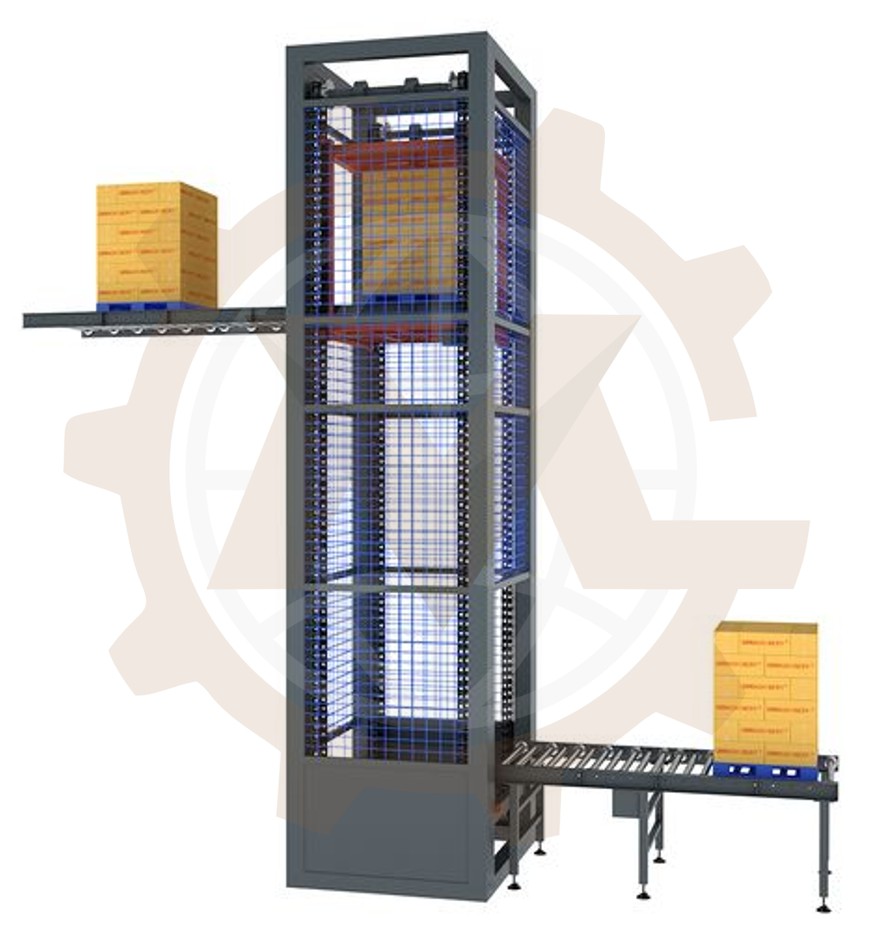
Vertical Pallet Conveyors
Vertical Belt Conveyors
A vertical conveyor belt may use cleats, pockets, sidewalls, opposing belts, or sandwich-belt arrangements to control individual products during elevation change. Belt selection must consider product friction, compression tolerance, release behavior, belt pull, tracking, transitions, and contamination. The phrase can also refer broadly to belt-driven lift mechanisms, so the intended function should be defined in the design basis.
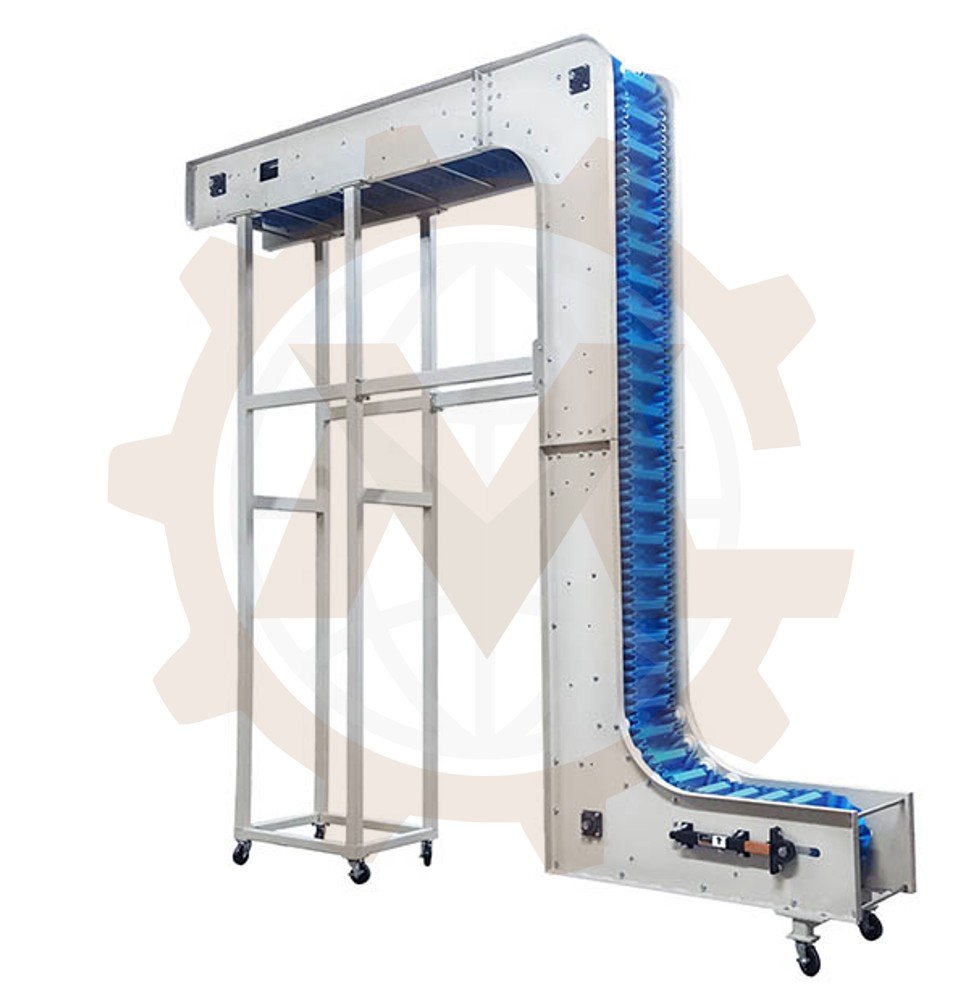
Vertical Belt Conveyors
Vertical Chain and Platform Conveyors
Vertical chain conveyors use one or more synchronized chains to carry platforms, forks, attachments, or product fixtures. Chain selection, sprocket geometry, equalization, guide arrangement, lubrication, polygonal action, fatigue, take-up, and load sharing are critical. Redundant or monitored load paths may be required depending on the risk assessment and governing requirements.

Vertical Chain and Platform Conveyors
Vertical Spiral Conveyors
A vertical spiral conveyor provides continuous elevation change along a helical path. It is useful for cartons, cases, totes, bottles, and packaged products where continuous flow and accumulation are important. Product stability, belt radius, inner-edge loading, speed, elevation, support structure, access, and drive capacity determine feasibility.
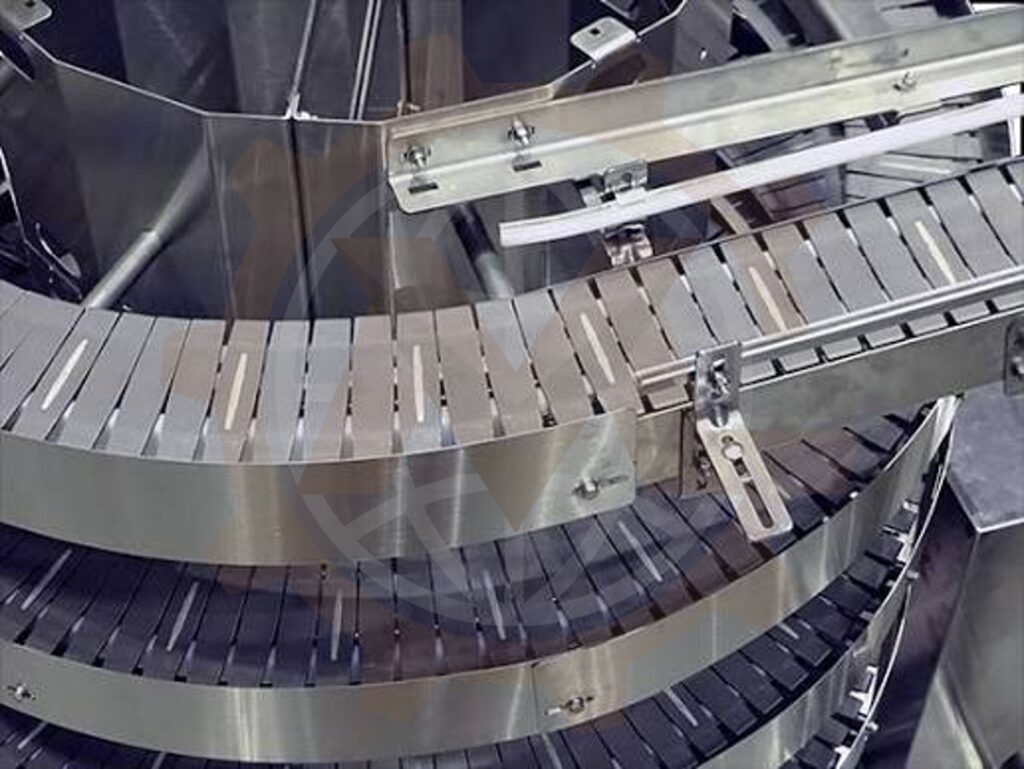
Vertical Spiral Conveyors
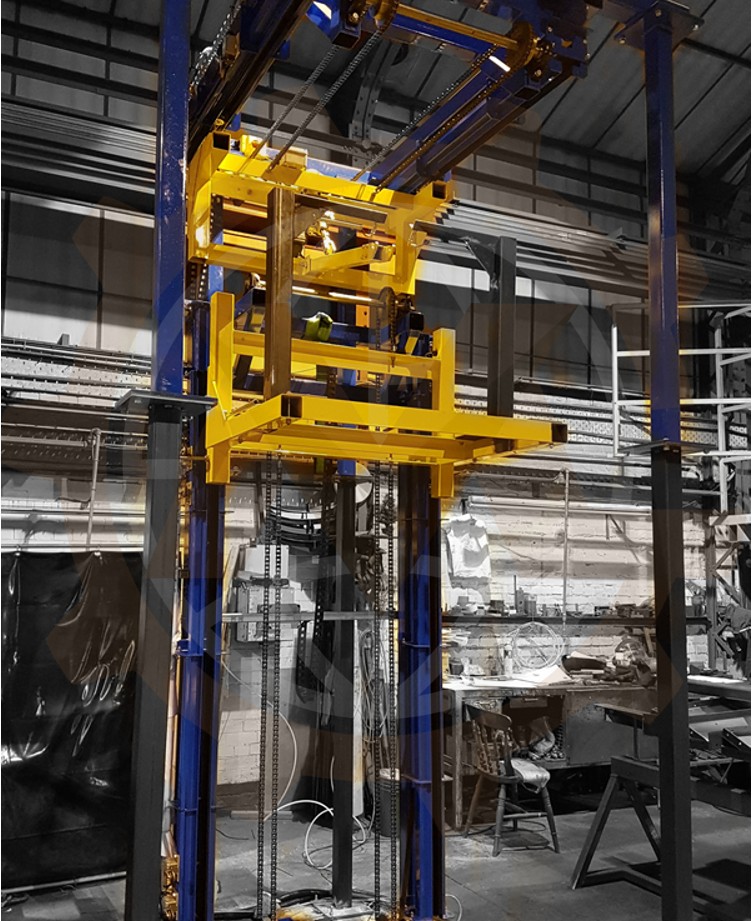
Indexing Lifts and Lift-and-Transfer Units
An indexing lift raises or lowers a conveyor section, nest, fixture, or product to a defined process position. It may interface with roller, chain, belt, pallet, or modular conveyor equipment. Position accuracy, settling time, transfer datum, actuator selection, guidance, mechanical stops, and sequence interlocks are coordinated with the surrounding automation.
Indexing Lifts and Lift-and-Transfer Units
| Configuration |
Best suited to |
Primary design focus |
| Vertical reciprocating conveyor |
Discrete pallets, totes, carts and heavy loads |
Carrier, guides, lifting medium, brake, landings and cycle time |
| Continuous vertical conveyor |
High-frequency cartons, trays and unit loads |
Carrier pitch, synchronized transfers, clearances and recovery |
| Vertical pallet conveyor |
Loaded or empty pallets between levels |
Pallet quality, load stability, transfer rollers/chains and restraint |
| Vertical belt conveyor |
Small products or controlled incline/vertical travel |
Friction, cleats/pockets, tracking, compression and discharge |
| Vertical chain conveyor |
Platforms, fixtures and robust unit-load handling |
Chain load sharing, sprockets, guides, lubrication and fatigue |
| Vertical spiral conveyor |
Continuous packaged-product flow |
Radius, belt pull, product stability, support and footprint |
| Lift-and-transfer unit |
Short-stroke indexing and machine interfaces |
Positioning, actuator, guidance, stops and transfer sequence |
Our Vertical Conveyor Design Process
1. Define the Load and Operating Mission
We establish the minimum and maximum load, dimensions, center of gravity, support points, pallet or tote condition, overhang, orientation, throughput, travel, number of landings, operating hours, starts per hour, dwell time, transfer direction, environment, and future product range. Abnormal but credible conditions—such as a skewed pallet, blocked discharge, or power loss—are recorded rather than left as assumptions.
2. Select the Vertical Transport Architecture
We compare reciprocating, continuous, spiral, belt, chain, and lift-and-transfer concepts against footprint, travel, cycle time, load, accumulation, interfaces, access, maintainability, and project constraints. Concept layouts identify the carrier, mast, drive location, landing elevations, infeed and outfeed direction, guarding envelope, and service zones.
3. Establish the Design Basis and Interfaces
The approved design basis captures load cases, duty, expected life, environmental conditions, applicable site and customer requirements, controls boundary, utility supply, floor or building interfaces, installation approach, and deliverable formats. Datum points and responsibility limits are fixed before detailed design to reduce late-stage integration risk.
4. Perform Engineering Calculations
Calculations address suspended mass, acceleration, dynamic allowance, traction or chain pull, drive torque, motor power, braking energy, shaft and sprocket loads, guide reactions, frame deflection, bearing life, anchor reactions, carrier strength, stopping distance, and cycle time. The most demanding combination may occur during starting, emergency stopping, an offset load, or transfer—not simply at rated static capacity.
5. Develop the 3D Mechanical Design
We model the carrier, guides, lifting elements, shafts, sprockets or pulleys, bearings, drive, brake, counterweight where used, frame, landings, transfer conveyors, guards, doors, sensors, cable routing, supports, and maintenance access. The assembly is reviewed for collision clearance, installation sequence, adjustment, inspection, lubrication, and replacement routes.
6. Produce Manufacturing Documentation
Documentation can include general arrangements, fabrication drawings, machined-part drawings, shaft and sprocket details, carrier and guide assemblies, guarding and door drawings, purchased-component specifications, and a complete BOM. Drawings define critical datums, tolerances, weld requirements, finishes, and assembly notes appropriate to the agreed fabrication scope.
7. Review, Integrate, and Control Revisions
We coordinate design reviews with the client, component suppliers, fabricator, and controls team, then incorporate agreed comments under revision control. Optional support includes supplier-data updates, design-for-manufacture clarification, installation-interface updates, and as-built documentation.
Read more:Conveyor Design Services: https://gmd.engineering/conveyor-design-services/
Vertical Lift Sizing and Cycle-Time Engineering
Rated capacity alone does not define performance. The system must complete the required number of transfers while respecting acceleration, deceleration, landing accuracy, door or gate movement, conveyor transfer time, sensor validation, and control delays. A realistic cycle model separates each phase rather than dividing travel distance by maximum speed.
| Cycle phase |
Engineering questions |
| Load acceptance |
Is the carrier empty, correctly positioned and permissive to receive the product? |
| Infeed transfer |
How long does the pallet or tote take to enter and become fully detected? |
| Secure and verify |
Are gates, restraints, centering devices and load-position sensors satisfied? |
| Vertical travel |
What acceleration, constant-speed distance, deceleration and settling time apply? |
| Landing alignment |
What stopping accuracy and mechanical support are required for transfer? |
| Outfeed transfer |
Is the destination clear, synchronized and able to accept the complete load? |
| Return or next mission |
Does the carrier return empty, serve another level or await demand? |
Throughput is checked for peak demand, not only average production. For multilevel service, traffic logic and destination distribution can dominate capacity. Where one VRC cannot meet the required mission rate, a continuous vertical conveyor, dual lift arrangement, buffer, or revised material-flow strategy may be more suitable.
Roller Conveyor Design Services: https://gmd.engineering/roller-conveyor-design-services/
Load Cases and Mechanical Calculations
- Rated product mass plus carrier, conveyor, fixture, cable, and moving-component mass.
- Offset center of gravity, asymmetric pallet loading, overhang, skew, and uneven support conditions.
- Starting, normal travel, controlled stopping, emergency stopping, and power-loss conditions.
- Lifting-chain, belt, rope, or drive-element tension with dynamic and service factors appropriate to the selected system.
- Motor power, gearbox output torque, starting torque, thermal duty, efficiency, and regeneration or braking demand.
- Brake holding torque, stopping energy, engagement behavior, wear, monitoring, and manual release provisions.
- Drive and idler shaft bending, torsion, deflection, fatigue, keys, splines, locking devices, and connections.
- Sprocket or pulley loads, traction, wrap, tooth engagement, alignment, equalization, and adjustment range.
- Guide-rail and roller reactions during travel, transfer, offset loading, impact, and frame deflection.
- Carrier platform, forks, roller beds, weldments, connections, and local product-contact stresses.
- Mast, bracing, floor plates, building ties, anchors, foundations, seismic or environmental loads when specified.
- Bearing reactions and life, lubrication, sealing, speed, temperature, alignment, and maintenance access.
Carrier, Platform, and Load-Control Design
The carrier establishes the load datum and transfer interface. It may use powered rollers, chain strands, belts, forks, a fixed deck, or a custom nest. The structure must limit deflection so conveyors remain aligned at every landing, while keeping moving mass practical. Replaceable contact parts and accessible fasteners reduce repair time.
Load control can include entry stops, pallet centering, guides, pop-up devices, clamps, anti-rollback features, gates, or containment panels. The design should prevent a product from entering too early, projecting outside the carrier envelope, shifting during travel, or leaving before the destination is confirmed ready.
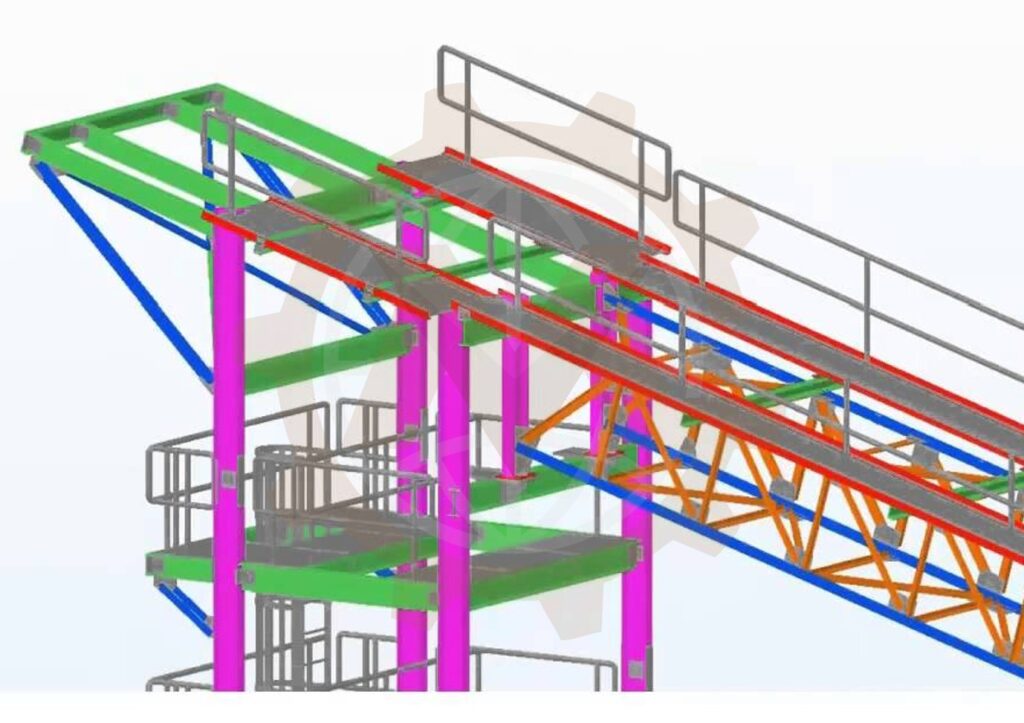
Mast, Guides, and Structural Support
Guide rails and rollers control carrier position under vertical, lateral, and moment loads. Rail straightness, splice alignment, roller preload, adjustment range, wear surfaces, contamination, and lubrication determine travel quality. Guide spacing and frame stiffness are coordinated so local deflection does not create binding or excessive roller load.
The support structure may be free-standing, building-tied, or integrated into a machine frame. Floor capacity, anchor edge distances, slab condition, mezzanine openings, overhead clearance, erection access, and building movement must be verified by the responsible parties. GMD can define equipment reactions and interface loads; building and foundation approval remains with qualified project professionals.
Mast, Guides, and Structural Support
Drive, Brake, and Lifting-Medium Selection
Chain-Driven Systems
Chains provide robust positive drive but require attention to fatigue, lubrication, elongation, sprocket alignment, take-up, equalization, and replacement access. Multiple chains do not automatically share load equally; shaft stiffness, attachment tolerances, carrier guidance, and adjustment influence distribution.
Belt-Driven Systems
Toothed or flat lifting belts can provide quiet operation and low maintenance in suitable applications. Belt strength, termination, pulley diameter, tracking, environmental compatibility, inspection criteria, and replacement method must be verified with the selected manufacturer.
Wire-Rope or Alternative Mechanisms
Wire ropes, rack drives, screws, cylinders, or other mechanisms may be appropriate for specific strokes and duties. Each introduces different inspection, redundancy, buckling, synchronization, leakage, speed, and maintenance considerations. Selection follows the design basis rather than a one-size-fits-all preference.
Braking and Controlled Holding
The drive brake and any supplementary holding or anti-fall device are selected for the actual suspended mass, drive ratio, dynamic condition, stopping duty, and regulatory context. The design defines what happens during normal stop, emergency stop, drive fault, overspeed, lifting-element fault, and manual maintenance—not only during powered operation.

Drive, Brake, and Lifting-Medium Selection
Landing Transfers and Conveyor Interfaces
A vertical conveyor usually succeeds or fails at its interfaces. Roller pitch, chain-strand spacing, belt height, pallet runners, product footprint, direction of travel, conveyor speed, sensor position, and datum tolerances must align across the carrier and every landing. Mechanical stops or support pins may be needed to create repeatable transfer elevation under varying load.
The sequence should verify that the carrier is present, level, supported where required, and permitted to transfer; that the landing is clear; and that doors or gates are in the correct state. For bidirectional systems, product ownership and sensor logic must prevent two loads from being commanded into the same space.
Pallet Conveyor Design Services: https://gmd.engineering/pallet-conveyor-design-services/
Controls, Sensors, and Fault Recovery
- Carrier position sensing, landing confirmation, final limits, and independent overtravel detection.
- Load-present, load-clear, overhang, skew, pallet-position, and carrier-clearance detection.
- Door, gate, guard, restraint, brake, support-pin, and maintenance-access interlocks.
- Encoder or motion feedback, overspeed or unintended-movement detection where required.
- Drive overload, chain or belt monitoring, slack detection, jam detection, and abnormal cycle-time alarms.
- Defined automatic, manual, maintenance, homing, recovery, and evacuation states.
- Controlled response to power loss, communications loss, sensor disagreement, blocked transfers, and incomplete loads.
- Clear restart rules so energy restoration cannot cause unexpected carrier or product movement.
The mechanical design and control philosophy are developed together. A fault should leave the load in a known condition whenever practicable, and recovery should not require personnel to enter a hazard zone without isolation. Diagnostic access, manual-release instructions, and maintenance controls are treated as part of system usability.
Screw Conveyor Design Services: https://gmd.engineering/screw-conveyor-design-services/
Machine Safety and Compliance Considerations
Vertical conveyors combine suspended loads, moving carriers, pinch and shear points, falling-object hazards, floor openings, powered transfers, and multiple access levels. Safeguarding must be based on a documented risk assessment for the complete installation, its country, users, product, and operating modes. Applicable machinery, electrical, structural, fire, guarding, and material-lift requirements should be confirmed by the responsible project team and local authority.
- Fixed and interlocked guarding around the travel path, drive, return path, shafts, chains, belts, pulleys, and transfer hazards.
- Landing doors or gates arranged so people cannot access the shaft or moving carrier during operation.
- Load containment and protection against falling pallets, packages, loose parts, or debris.
- Emergency-stop and protective-device coverage coordinated across all levels and connected equipment.
- Safe stopping, holding, overtravel protection, and prevention of uncontrolled descent or unintended movement.
- Electrical, pneumatic, hydraulic, gravitational, and stored-energy isolation with practical lockout points.
- Safe inspection and maintenance access, including platforms, ladders, lighting, clearance, and component removal routes.
- Validation of safety functions, interlocks, stopping performance, and recovery behavior before production use.
A VRC is generally intended for material movement rather than transporting people. Whether a specific installation is classified as a conveyor, material lift, elevator, or another equipment category depends on its design and local jurisdiction. That classification must be resolved before release; a web description or equipment label does not determine compliance.
Slat Conveyor Design Services: https://gmd.engineering/slat-conveyor-design-services/
Reliability, Inspection, and Maintainability
Vertical systems should be designed for inspection before wear becomes a failure. Chains, belts, ropes, terminations, sprockets, pulleys, brakes, guide rollers, fasteners, sensors, and load-retention devices need visible or measurable inspection criteria. Guards and access panels should be removable without dismantling unrelated equipment, while still preventing unsafe access during operation.
- Centralized or reachable lubrication points and provisions that prevent lubricant from contaminating products.
- Adjustment features for guide rollers, chains, belts, sensors, landings, and conveyor interfaces.
- Replaceable wear strips, rollers, bumpers, guides, and product-contact components.
- Practical routes for removing motors, gearboxes, brakes, shafts, sprockets, carrier parts, and lifting elements.
- Mechanical support or blocking provisions for work beneath or around a raised carrier.
- Inspection windows, access doors, safe platforms, lighting allowances, and defined clearance zones.
- Component identification, lubrication schedules, wear limits, spare-parts data, and controlled drawings.
Applications Across Industry
- Pallet transfer between production floors, mezzanines, storage levels, and automated cells.
- Tote, tray, carton, case, and container movement in warehouses and distribution centers.
- Packaging-line elevation changes, overhead routing, accumulation, and floor-space recovery.
- Automotive, battery, appliance, electronics, and general assembly-line material handling.
- Food, beverage, pharmaceutical, and consumer-goods applications with defined hygiene requirements.
- Machine loading, robotic interfaces, inspection stations, process ovens, cooling, or curing lines.
- Empty-pallet return, palletizing, depalletizing, stretch wrapping, and warehouse interfaces.
- Heavy fixtures, tooling, components, and work-in-process movement between controlled elevations.
Vertical Conveyor Design Documentation and Deliverables
| Deliverable |
Typical content |
| Design basis |
Loads, travel, throughput, duty, environment, assumptions, interfaces and requirements |
| Concept package |
Architecture comparison, layouts, carrier, mast, landings, drive and access zones |
| Calculations |
Load cases, cycle time, drive, brake, lifting medium, shafts, bearings, guides and structure |
| 3D CAD assembly |
Carrier, frame, guides, drive, landings, transfers, guards, sensors and interfaces |
| 2D drawings |
General arrangement, fabrication, machining, shaft, carrier, guard and assembly drawings |
| Bill of materials |
Manufactured parts, drive, brake, bearings, chains/belts, sensors and hardware |
| Exchange formats |
Inventor, STEP, SAT, DXF, PDF, Excel or other agreed formats |
| Review support |
Design review, supplier coordination, manufacturing clarification and revisions |
Why Choose GMD for Vertical Conveyor Engineering?
- More than 10 years of mechanical machine-design experience in conveyors, automation, and industrial equipment.
- Engineering based on real load cases, cycle time, interfaces, environment, fabrication, and maintenance needs.
- Autodesk Inventor as the primary design platform, with common neutral CAD and documentation formats available.
- Practical attention to tolerances, assembly, installation, adjustment, inspection, guarding, and replacement access.
- Flexible support for a complete vertical conveyor or as an extension of an OEM or integrator engineering team.
- Clear design basis, assumptions, exclusions, responsibility boundaries, deliverables, and review milestones.
- Remote collaboration for equipment manufacturers and system integrators serving international markets.
Information Needed to Start Your Project
- Load drawings, dimensions, weight range, center of gravity, support points, overhang, orientation, and condition.
- Required throughput, cycle time, travel, number and elevation of landings, dwell, accumulation, and operating hours.
- Infeed and outfeed conveyor type, direction, elevation, speed, product datum, and upstream/downstream logic.
- Available footprint, pit or mezzanine opening, ceiling height, building interfaces, access, and installation route.
- Temperature, dust, moisture, washdown, corrosion, cleanroom, hazardous-area, or other environmental conditions.
- Preferred components, utilities, controls architecture, customer standards, target market, CAD formats, and schedule.
Vertical Conveyor Design FAQs
What is a vertical reciprocating conveyor?
A vertical reciprocating conveyor is a material-handling machine with a guided carrier that travels back and forth between two or more elevations. It commonly moves pallets, totes, carts, fixtures, or other unit loads and can integrate powered conveyors at each landing.
How is a VRC different from a continuous vertical conveyor?
A VRC moves one carrier through discrete missions and stops at each transfer level. A continuous vertical conveyor circulates multiple carriers or platforms through a loop, supporting repeated loading and unloading. Required throughput, load, footprint, number of levels, and transfer pattern determine which is more suitable.
What information is required to size a vertical conveyor?
Key inputs include load dimensions and weight, center of gravity, travel height, landings, throughput, cycle time, duty, transfer directions, infeed and outfeed equipment, available space, environment, utilities, installation constraints, and applicable project requirements.
How is vertical conveyor capacity calculated?
Capacity is checked using the complete cycle: load acceptance, infeed, verification, acceleration, travel, deceleration, landing alignment, outfeed, and return or next mission. Peak traffic distribution and buffer availability must also be considered, especially for multilevel systems.
Can a vertical conveyor move pallets?
Yes. A vertical pallet conveyor can use rollers, chains, forks, or a platform to support and transfer pallets. The design must account for pallet type and condition, gross load, runners, overhang, orientation, load stability, transfer datum, and restraint during travel.
Can vertical conveyors handle multiple floor levels?
Yes. A reciprocating carrier can serve multiple landings, subject to cycle-time and traffic requirements. The design coordinates landing doors, conveyor interfaces, carrier positioning, routing logic, accumulation, and safe fault recovery at every level.
Is a vertical conveyor the same as an elevator?
Not necessarily. Vertical conveyors are generally designed to move material, while elevators may be governed by different classifications and requirements. The applicable category depends on the equipment design, intended use, installation, and local jurisdiction. Classification should be confirmed early in the project.
What CAD deliverables can GMD provide?
Depending on scope, GMD can provide concept layouts, 3D assemblies, manufacturing and assembly drawings, calculations, bills of materials, and agreed exchange formats such as Autodesk Inventor, STEP, SAT, DXF, PDF, and Excel.
Can GMD redesign or verify an existing vertical conveyor?
Yes, when sufficient data are available. A redesign or verification scope can review load capacity, duty, drive, lifting elements, shafts, guides, carrier, structure, interfaces, access, and known failure modes. The conclusions depend on the accuracy of drawings, measurements, component records, and site information provided.
How long does vertical conveyor design take?
Schedule depends on concept maturity, load range, travel, number of landings, interfaces, calculation depth, documentation level, review cycles, and supplier data. After the design inputs and deliverables are defined, GMD can propose milestones and an engineering schedule.
Plan Your Vertical Conveyor with GMD
A successful vertical conveyor begins with a clear material-flow mission and disciplined interface definition. Share your load data, elevations, required throughput, layout, operating environment, and preferred deliverables. GMD Services will help convert those requirements into a coordinated vertical transport concept and a fabrication-ready mechanical design package.
Contact GMD Services to discuss Vertical Conveyor Design Services for a new automated line, equipment redesign, capacity check, or detailed production documentation.