Custom Curved Tabletop Chain Conveyor Design
GMD Engineering designed a compact curved tabletop chain conveyor to redirect products smoothly between production-line sections. The system combines a flexible sprocket-driven chain, curved guide tracks, adjustable stainless steel side rails, and a geared motor to provide stable and space-efficient product handlin
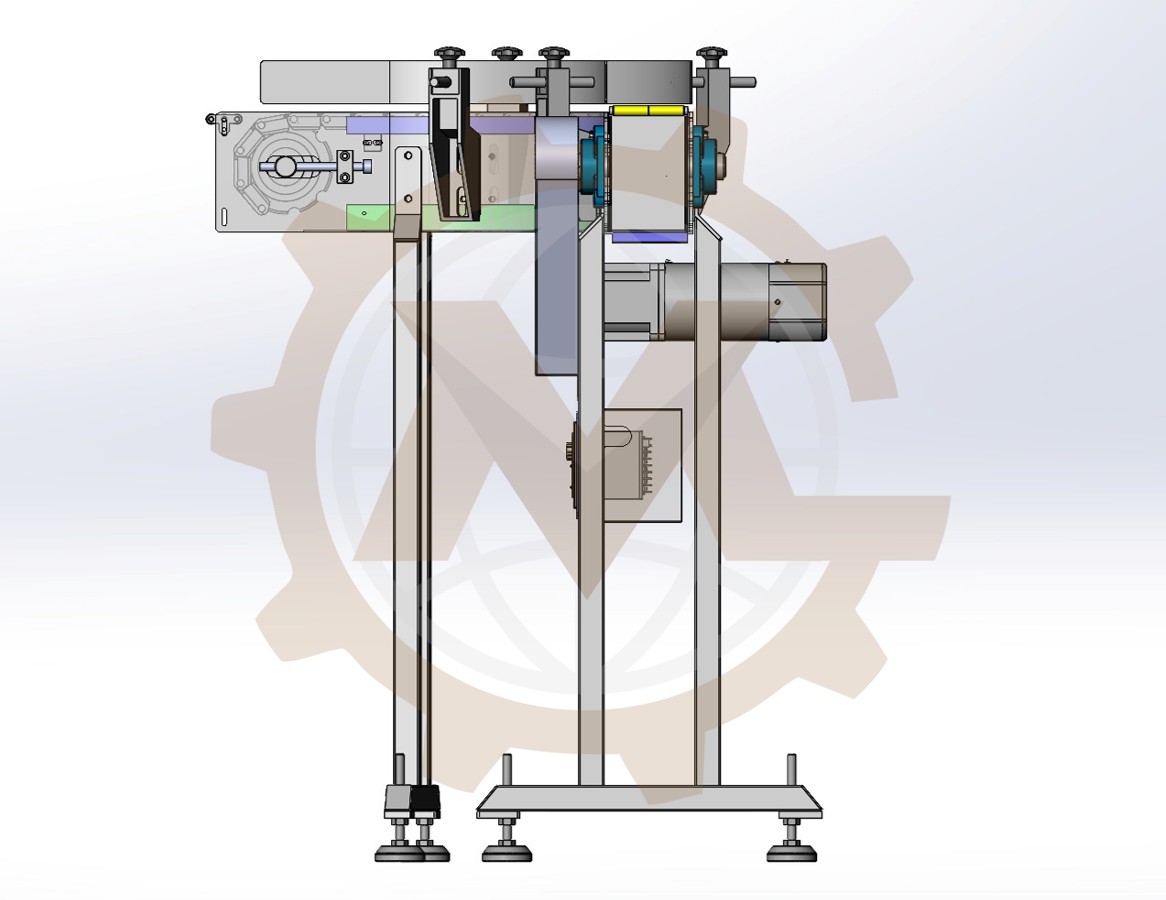
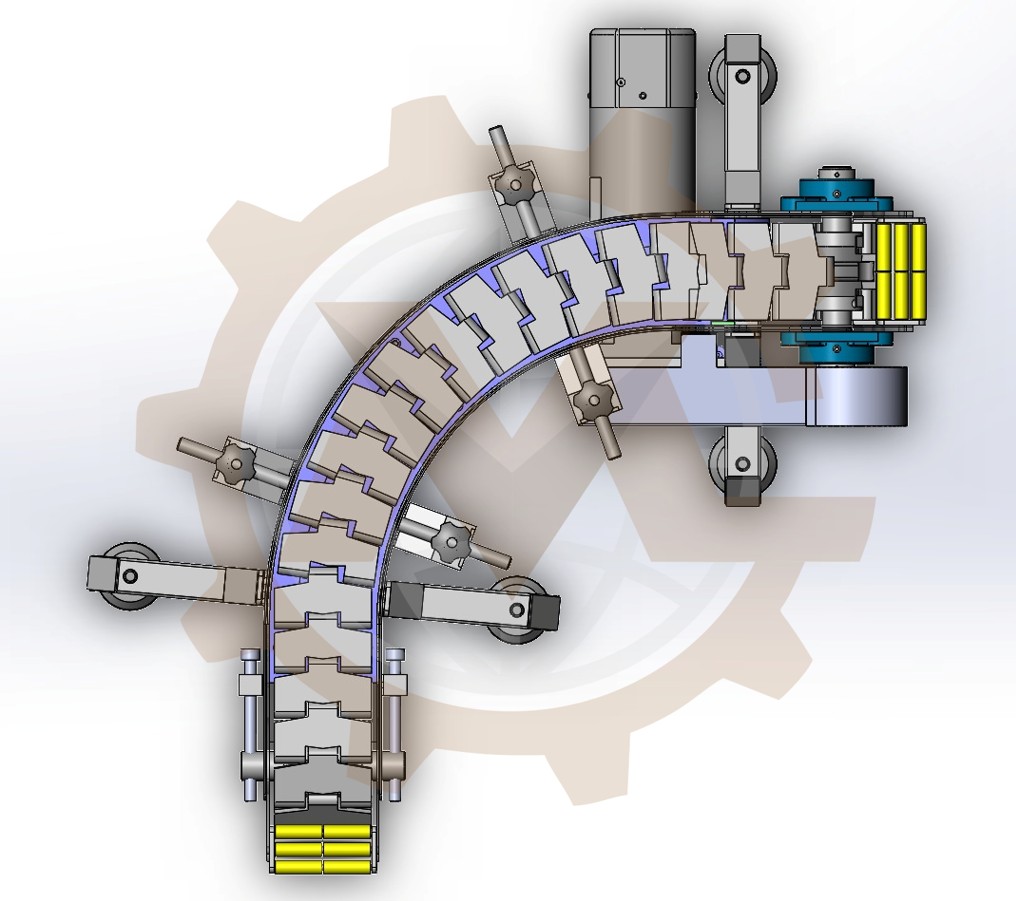
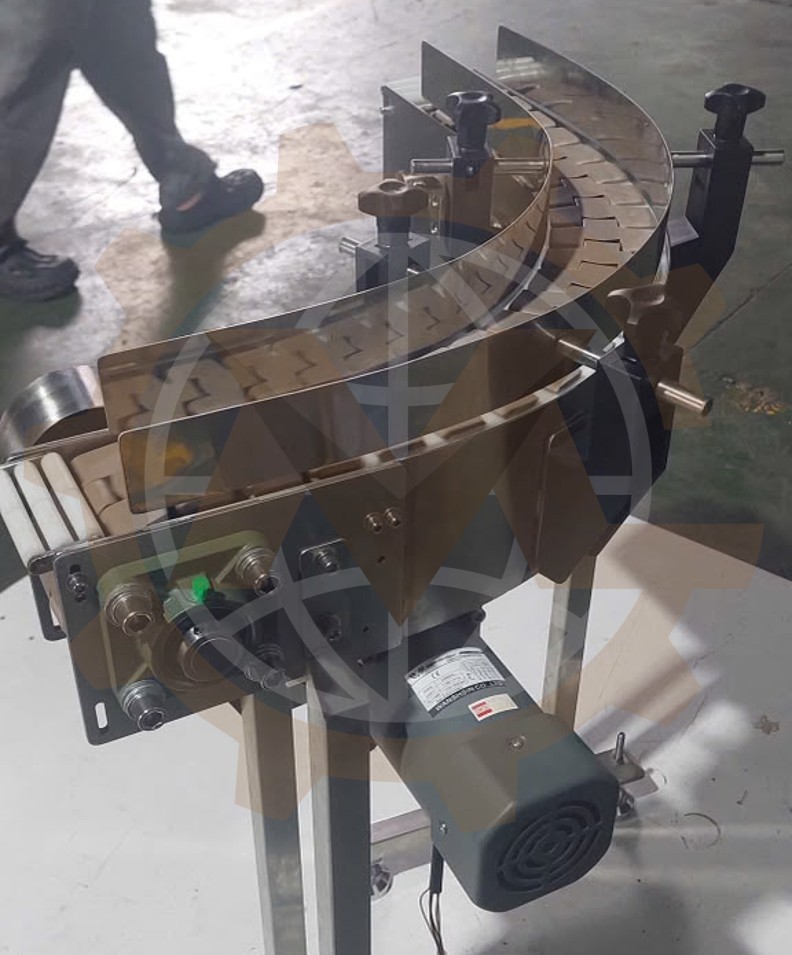
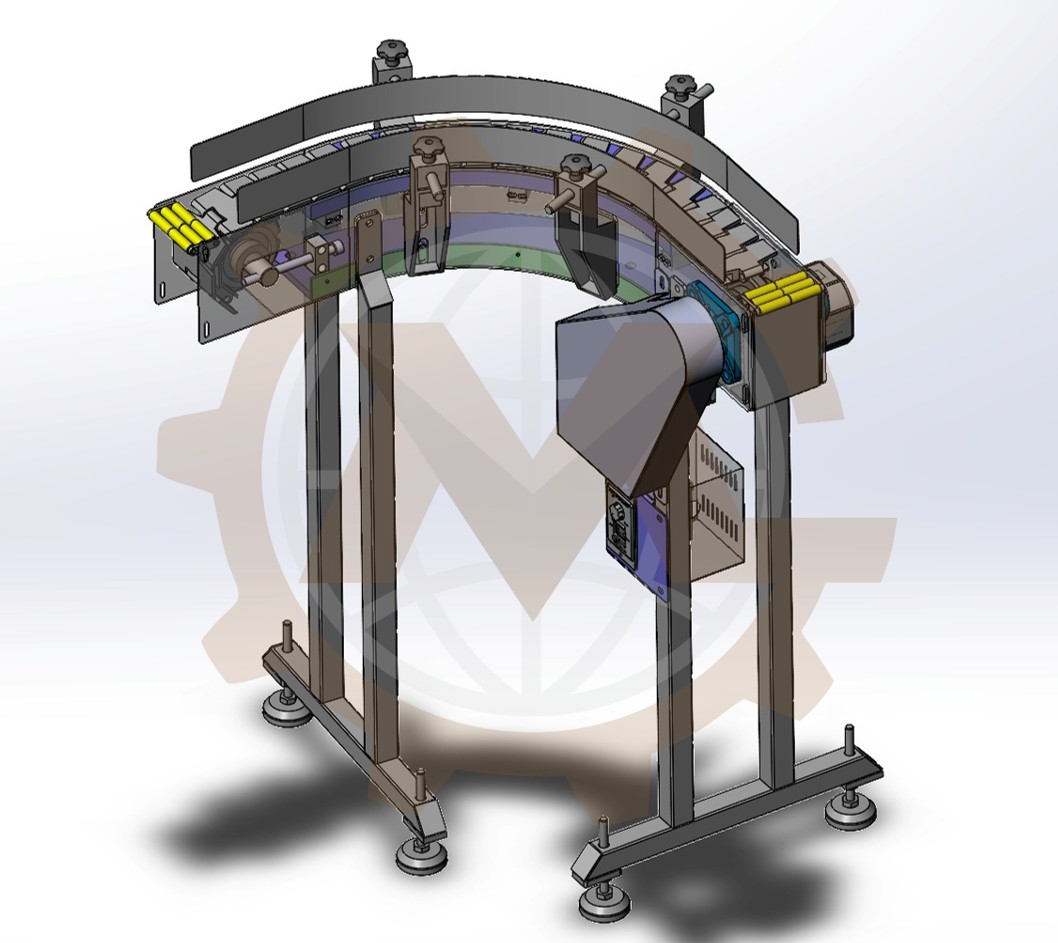
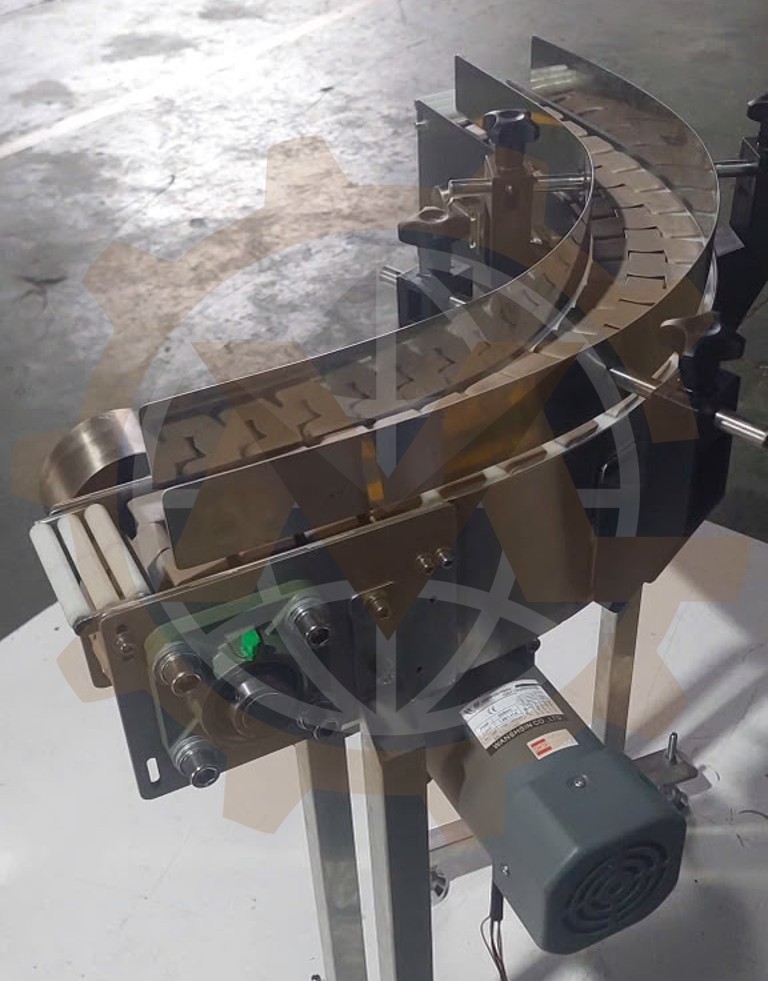
GMD Engineering designed a compact curved tabletop chain conveyor to redirect products between two sections of a production line. The conveyor changes the direction of product flow while maintaining stable, continuous, and controlled transportation.
The system uses a flexible tabletop chain that follows the curved conveyor frame. Adjustable stainless steel side guides keep products within the required path and help prevent them from shifting, rotating, or falling while passing through the curve.
This conveyor configuration provides a practical material-handling solution for production layouts where a straight conveyor cannot connect the upstream and downstream equipment directly.
Compact Conveyor Curve Configuration
The curved conveyor was developed to guide products smoothly around an approximately 90-degree change in direction while using minimal factory floor space.
Instead of installing two straight conveyors with a separate corner-transfer mechanism, the curved chain creates one continuous transportation path. This eliminates the transfer gap that could otherwise cause small or unstable products to become trapped, tilted, or misaligned.
The principal conveyor assemblies include:
- Flexible tabletop chain.
- Curved conveyor frame.
- Inner and outer chain guide tracks.
- Adjustable stainless steel product guides.
- Drive motor and gearbox.
- Drive and return sprocket assemblies.
- Shaft and bearing supports.
- Chain tensioning components.
- Structural support frame.
- Adjustable conveyor mounting points.
The modular design allows the curved conveyor to be integrated with existing straight conveyors, machines, filling systems, packaging equipment, and automatic assembly lines.
Product-Flow Redirection Requirements
The main objective was to develop a reliable conveyor section capable of changing the product transport direction without interrupting production flow.
The conveyor needed to:
- Redirect products around a factory-layout obstruction.
- Connect two conveyor sections positioned at different orientations.
- Maintain continuous product movement through the curve.
- Prevent products from falling off the conveyor.
- Minimize transfer gaps at the inlet and outlet.
- Maintain suitable product orientation.
- Provide adjustable guide width.
- Accommodate different product sizes.
- Operate within a compact installation area.
- Allow convenient access for adjustment and maintenance.
- Integrate easily with upstream and downstream equipment.
The conveyor speed, chain width, curve radius, guide spacing, and motor capacity can be customized according to the product and production requirements.
How the Curved Conveyor Operates
1. Product Entry
Products enter the curved conveyor from an upstream machine or straight conveyor section.
The inlet elevation and chain surface are aligned with the preceding equipment to create a smooth transition. The transfer gap is minimized to prevent small products from becoming trapped between the two conveyor sections.
Adjustable side guides gradually direct each product toward the curved transportation path.
2. Directional Change Through the Curve
As the flexible tabletop chain moves around the curved frame, it carries the products through the required change in direction.
The chain consists of interconnected links that can articulate horizontally. This allows it to follow the conveyor curve while maintaining a relatively continuous supporting surface beneath the product.
Curved wear strips and chain guides support the chain and control its movement through the inner and outer radii.
3. Product Guidance and Stability
Products experience an outward force while moving through a conveyor curve. Without suitable guidance, they may slide outward, rotate, become misaligned, or fall from the conveyor.
The inner and outer guide rails maintain product stability throughout the curved section. Their positions can be adjusted to match different product dimensions.
The guide system includes:
- Stainless steel guide rails.
- Adjustable support rods.
- Locking knobs.
- Guide mounting brackets.
- Multiple adjustment positions.
- Smooth transitions at the conveyor inlet and outlet.
The guide spacing should provide enough clearance for free product movement without allowing excessive lateral movement.
4. Conveyor Discharge
After passing through the curve, products exit in the new direction and continue toward the next machine or conveyor section.
The outlet is aligned with the downstream equipment to provide a smooth product transfer. Guide rails can extend beyond the curved section to stabilize products as they leave the conveyor.
Flexible Tabletop Chain System
The tabletop chain is the main conveying element of the curved conveyor.
Unlike a conventional flat belt, the chain can articulate laterally and follow a curved guide path. Its linked construction also provides positive engagement with the drive sprocket, reducing the possibility of slipping between the motor and conveying surface.
A tabletop chain conveyor offers several advantages:
- Continuous product-supporting surface.
- Ability to follow horizontal curves.
- Positive sprocket-driven movement.
- Compact curve radius.
- Good resistance to lateral movement.
- Replaceable individual chain sections.
- Compatibility with adjustable side guides.
- Easy integration with straight conveyor sections.
The chain material can be selected according to product weight, speed, operating temperature, cleanliness requirements, wear resistance, and environmental conditions.
Read more: Conveyor Design Services: https://gmd.engineering/conveyor-design-services/
Adjustable Stainless Steel Side Guides
The conveyor uses adjustable guide rails on both sides of the chain.
The outer rail prevents products from moving beyond the external curve, while the inner rail controls product position relative to the inside radius.
Hand knobs and adjustable support rods allow the guide width to be changed without modifying the conveyor frame. This makes the system suitable for multiple product sizes within an acceptable adjustment range.
Important guide-rail design considerations include:
- Product width and height.
- Product center of gravity.
- Conveyor speed.
- Curve radius.
- Surface friction.
- Product accumulation.
- Required exit orientation.
- Contact-sensitive product surfaces.
Low-friction guide materials can be added where direct metal-to-product contact is unsuitable.
Drive and Transmission Assembly
The conveyor is powered by an electric gearmotor mounted near one end of the conveyor.
The gearbox reduces motor speed and provides the torque required to move the chain, products, and rotating components. The output shaft drives a sprocket that engages directly with the tabletop chain.
The drive assembly may include:
- Electric motor.
- Reduction gearbox.
- Drive shaft.
- Tabletop chain sprocket.
- Shaft bearings.
- Motor mounting plate.
- Chain guards.
- Speed controller or variable-frequency drive.
Motor and gearbox selection should consider:
- Total conveyor length.
- Curved chain resistance.
- Product weight.
- Product accumulation.
- Required conveyor speed.
- Starting frequency.
- Operating duty cycle.
- Required safety factor.
Curved conveyors generally generate more resistance than equivalent straight conveyors because of friction between the chain and curved guide tracks.
Chain Conveyor Design Services: https://gmd.engineering/chain-conveyor-design-services/
Curved Chain Guide Structure
The chain is supported and guided by a dedicated track through the conveyor curve.
The guide structure controls both the horizontal path and vertical position of the chain. Wear strips reduce direct contact between the moving chain and the structural frame.
The curved guide system must:
- Match the allowable chain-bending radius.
- Prevent chain lift or derailment.
- Support the product load.
- Minimize sliding friction.
- Provide consistent inlet and outlet transitions.
- Allow wear-strip inspection and replacement.
- Maintain sufficient clearance for chain articulation.
Accurate manufacturing and assembly of the curved track are essential for smooth chain movement and reduced component wear.
Conveyor Design Challenges
Controlling Products Around the Curve
Products naturally move toward the outside of the curve during transportation. The outer guide rail must contain this movement without creating excessive friction or damaging the product.
The selected curve radius, conveyor speed, guide geometry, and product center of gravity all affect stability.
Maintaining Product Orientation
Products with a high center of gravity, irregular base, or low surface friction may rotate as they travel through the curve.
Adjustable inner and outer guides help control this behavior. Conveyor speed can also be optimized to reduce unwanted movement.
Roller Conveyor Design Services: https://gmd.engineering/roller-conveyor-design-services/
Minimizing Friction and Chain Wear
The curved chain slides against its guide tracks, generating more friction than a straight conveyor.
Suitable chain material, low-friction wear strips, adequate curve radius, correct tension, and proper alignment help reduce drive load and premature wear.
Preventing Chain Derailment
The chain must remain engaged with the guide track throughout the curve. Inadequate support, incorrect tension, or excessive product load can cause chain lift or unstable movement.
The guide profile and hold-down features are designed to maintain chain control during operation.
Creating Smooth Conveyor Transitions
Large gaps or differences in elevation at the inlet and outlet can destabilize products.
The conveyor end geometry is designed to reduce transfer gaps and align the chain surface with adjacent equipment.
Product and Application Flexibility
Curved tabletop chain conveyors can transport a wide range of products, including:
- Bottles.
- Jars.
- Cans.
- Containers.
- Plastic components.
- Packaged products.
- Cartons.
- Small assembly parts.
- Food and beverage containers.
- Pharmaceutical packages.
- Cosmetic products.
- Automotive components.
The final chain, frame, guide, and drive specifications should be selected according to the actual product and production environment.
Belt Conveyor Design Services: https://gmd.engineering/belt-conveyor-design-services/
Integration with Production Equipment
The curved conveyor can be installed as an independent unit or integrated into a complete material-handling system.
Typical integration applications include:
- Connecting perpendicular conveyor lines.
- Redirecting products around machines.
- Transferring products between assembly stations.
- Feeding packaging machines.
- Connecting filling and labeling equipment.
- Routing products around columns or structural obstacles.
- Returning products toward an operator station.
- Creating compact U-shaped production lines.
- Linking inspection and sorting stations.
The conveyor can also be combined with sensors, product stops, pneumatic gates, counters, and accumulation-control systems.
Conveyor Control Options
Depending on the application, the conveyor can operate continuously or communicate with other equipment through a PLC.
Available control functions may include:
- Start and stop control.
- Adjustable conveyor speed.
- Product presence detection.
- Product counting.
- Accumulation monitoring.
- Upstream and downstream interlocks.
- Jam detection.
- Motor overload protection.
- Emergency stop integration.
- Automatic restart sequence.
- HMI status display.
- Production line synchronization.
A variable-frequency drive can be used when conveyor speed needs to be adjusted for different products or production rates.
Maintenance and Accessibility
The conveyor structure is designed to provide access to the drive, bearings, sprockets, guide tracks, and chain.
Routine maintenance typically includes:
- Inspecting chain wear.
- Checking chain tension.
- Cleaning the chain and guide tracks.
- Inspecting wear strips.
- Checking guide-rail alignment.
- Tightening adjustable brackets.
- Inspecting shaft bearings.
- Monitoring motor and gearbox condition.
- Removing accumulated product debris.
- Confirming inlet and outlet alignment.
Replaceable wear components help extend the service life of the main conveyor structure.
Vertical Conveyor Design Services: https://gmd.engineering/vertical-conveyor-design-services/
Safety Considerations
Although the conveyor operates at relatively low speed, moving chains, sprockets, shafts, and transfer points can create mechanical hazards.
Typical safety provisions include:
- Guards around drive sprockets and rotating shafts.
- Covers over accessible pinch points.
- Emergency stop integration.
- Motor overload protection.
- Secure electrical cable routing.
- Stable conveyor support.
- Lockable electrical isolation.
- Warning labels at hazardous locations.
- Suitable access for maintenance.
- Prevention of unintended machine restart.
The final guarding and control system should be determined through a machine risk assessment and the regulations applicable at the installation location.
Operational Benefits
The completed curved tabletop chain conveyor provides several practical advantages:
- Smooth change in product-flow direction.
- Continuous support through the conveyor curve.
- Compact use of factory floor space.
- Reduced transfer gaps.
- Adjustable guide width.
- Stable product transportation.
- Compatibility with multiple product sizes.
- Positive sprocket-driven chain movement.
- Easy connection to existing conveyor systems.
- Simple speed adjustment.
- Accessible maintenance components.
- Flexible integration into production lines.
Engineering Scope and Deliverables
GMD Engineering’s conveyor design scope can include:
- Conveyor concept development.
- Product-flow analysis.
- Curve radius selection.
- Tabletop chain selection.
- Motor and gearbox sizing.
- Drive sprocket selection.
- Shaft and bearing design.
- Curved guide-track development.
- Adjustable side-guide design.
- Conveyor frame design.
- Inlet and outlet interface design.
- Sensor and control-component mounting.
- Safety guarding design.
- Complete 3D CAD modeling.
- Detailed 2D manufacturing drawings.
- General assembly drawings.
- Bill of Materials preparation.
- Design for manufacturing and assembly.
Custom Curved Conveyor Design Services
GMD Engineering provides custom conveyor design and material-handling engineering services for manufacturers, machine builders, and automation companies worldwide.
Our conveyor design capabilities include:
- Curved tabletop chain conveyors.
- Straight chain conveyors.
- Slat conveyors.
- Modular belt conveyors.
- Flat belt conveyors.
- Roller conveyors.
- Inclined and declined conveyors.
- Vertical conveyor systems.
- Product accumulation conveyors.
- Conveyor transfer mechanisms.
- Product guide systems.
- Custom conveyor frames.
- Conveyor line integration.
- 3D mechanical design.
- 2D manufacturing drawings.
- Bill of Materials development.
Each conveyor is designed according to the product dimensions, weight, stability, required speed, production capacity, available floor space, and surrounding equipment.
Need a Custom Curved Conveyor?
If your production line requires a compact directional change, GMD Engineering can develop a curved conveyor tailored to your product and factory layout.
Contact us to discuss your product dimensions, weight, conveyor speed, required curve angle, available space, and connection points with existing equipment.
Need a Custom Curved Conveyor System?
Contact GMD Engineering to discuss your curved conveyor, tabletop chain conveyor, or complete material-handling system.