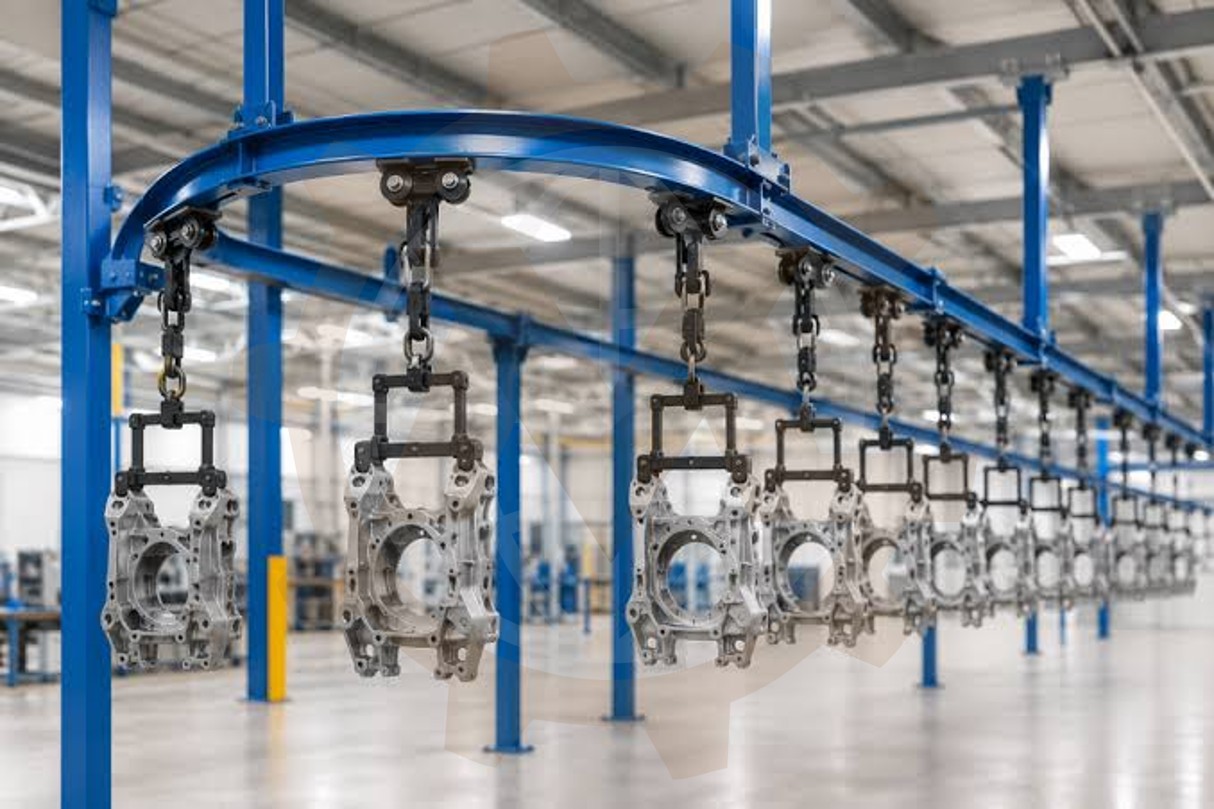
A reliable overhead conveyor must coordinate the track, chain or tow element, trolleys, carriers, attachments, curves, vertical bends, take-up, drive, lubrication, support steel, transfers, stops, switches, guarding, controls, and process interfaces. Our designs are developed around the actual payload, carrier pitch, production rate, route geometry, elevation changes, accumulation strategy, temperature, contamination, duty cycle, maintenance access, and building constraints—creating a system that uses overhead space efficiently while remaining practical to manufacture, install, inspect, and maintain.
Custom Overhead Material Handling for Modern Production
Overhead conveyor systems free valuable floor area, keep workpieces accessible, and route products through assembly, coating, washing, drying, curing, inspection, storage, or packaging processes. Loads can travel above equipment and aisles, rise or descend between process elevations, and arrive at workstations in a controlled orientation. The correct solution depends on whether carriers must move continuously, accumulate independently, stop precisely, switch routes, rotate, or interface with automation.
GMD Services supports OEMs, conveyor manufacturers, automation integrators, fabricators, and industrial end users. The scope can range from a feasibility study or route redesign to a complete manufacturing package for a new custom overhead conveyor. We can also verify chain pull, drive capacity, trolley loading, support reactions, throughput, and critical interfaces in an existing concept when adequate data are available.
What Is an Overhead Conveyor System?
An overhead conveyor suspends or supports products from a track installed above the operating area. Trolleys run inside an enclosed track or on a structural rail, while a chain, cable, friction drive, or manual force moves the carriers. Hangers, hooks, fixtures, flight bars, load bars, or custom frames connect the product to the trolley arrangement.
Unlike floor conveyors, overhead conveyors keep much of the transport mechanism away from floor traffic. This can improve access and material flow, but it transfers loads into roof steel, columns, or dedicated support frames and places moving loads above people and equipment. Track alignment, carrier stability, falling-object prevention, clearance, access, and support design therefore require careful engineering.
Types of Overhead Conveyors We Design
Enclosed-Track Overhead Conveyors
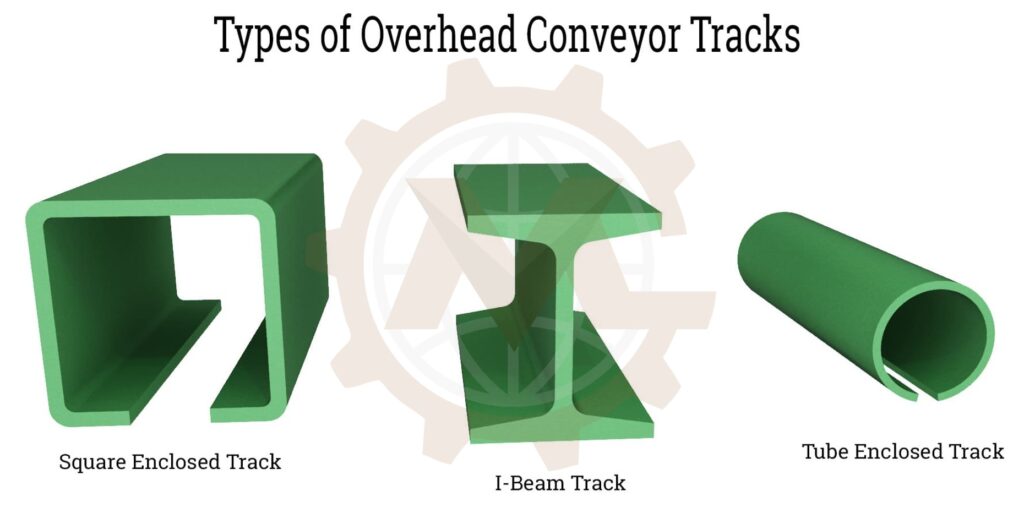
An enclosed-track overhead conveyor places the chain and trolley wheels inside a formed or fabricated track section. The compact profile protects running components and is suitable for light-to-medium unit loads, long routes, curves, and process lines. Track section capacity, trolley spacing, chain pull, heat, contamination, lubrication, and access determine suitability.
Enclosed-Track Overhead Conveyors
I-Beam Monorail Conveyors
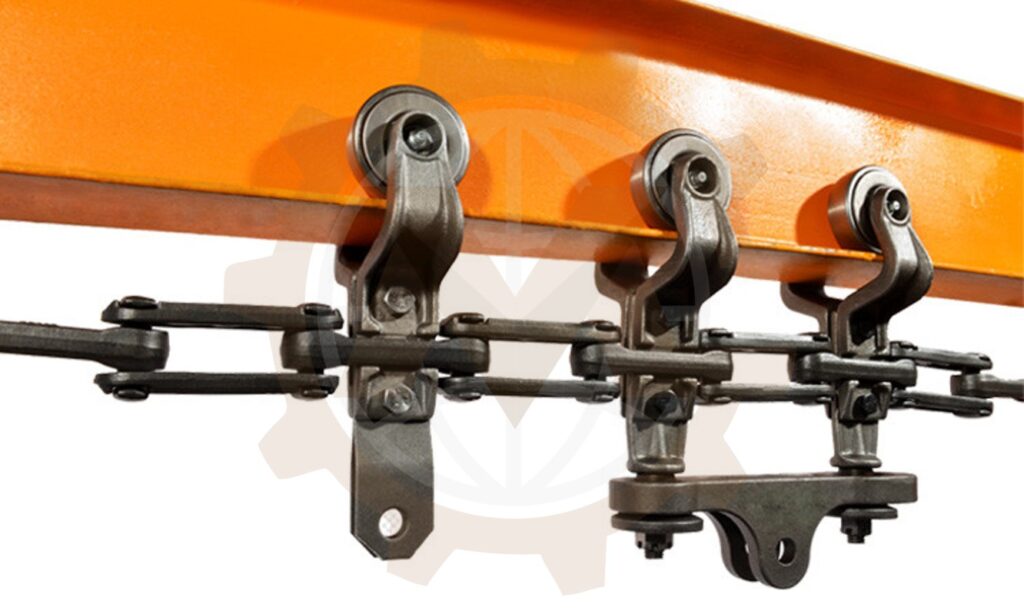
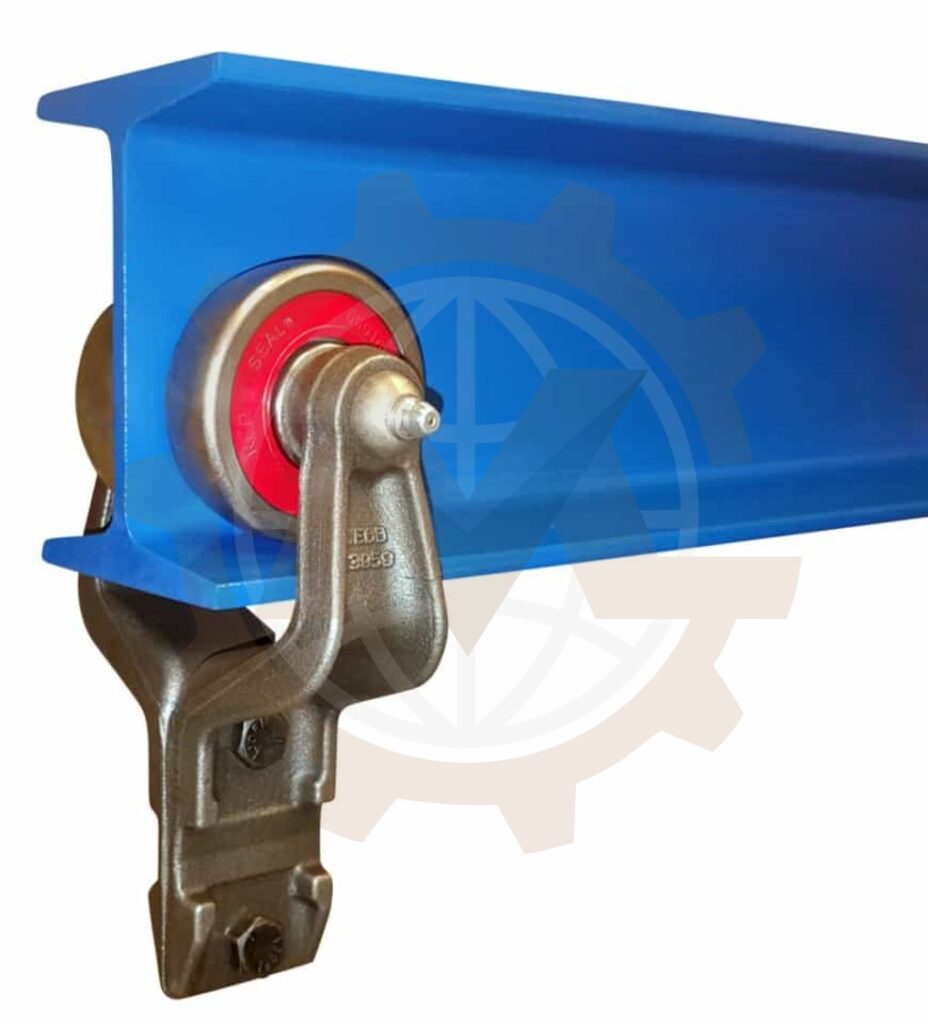
An I-beam overhead monorail conveyor uses trolleys running on the lower flange of a structural beam. It can handle heavier carriers and harsher industrial conditions. Flange bending, beam stress and deflection, trolley wheel loads, curve geometry, joints, hangers, drive-dog engagement, and wear must be coordinated across the complete route.
I-Beam Monorail Conveyors
Overhead Chain Conveyors
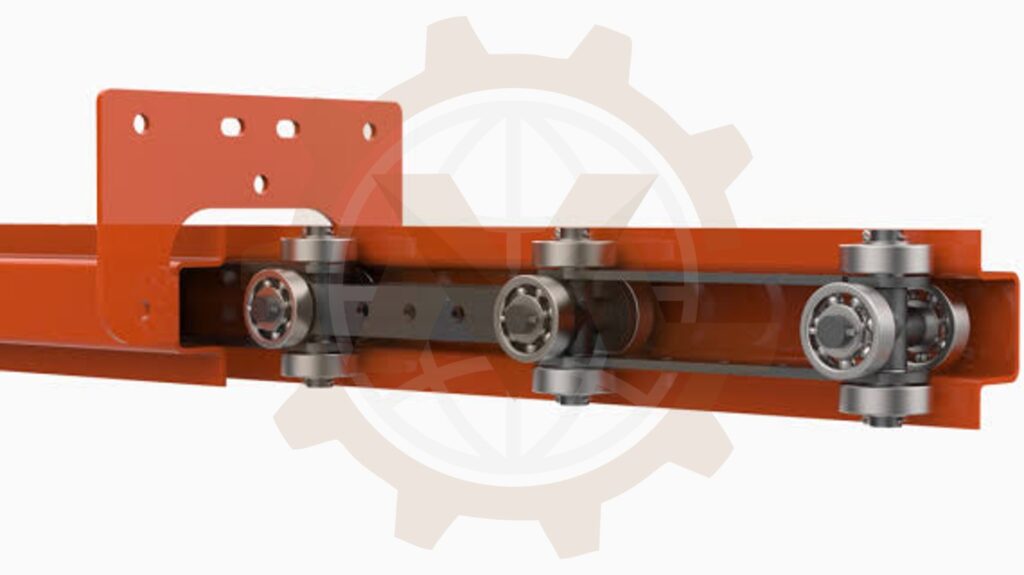
A powered overhead chain conveyor links the trolley or carrier system to a continuously moving chain. It provides predictable carrier pitch and product flow for painting, finishing, assembly, and manufacturing. Chain selection cannot be based on tensile rating alone; articulation, fatigue, allowable working pull, attachments, sprockets, lubrication, temperature, and start-stop duty all influence service life.
Overhead Chain Conveyors
Power-and-Free Conveyor Systems
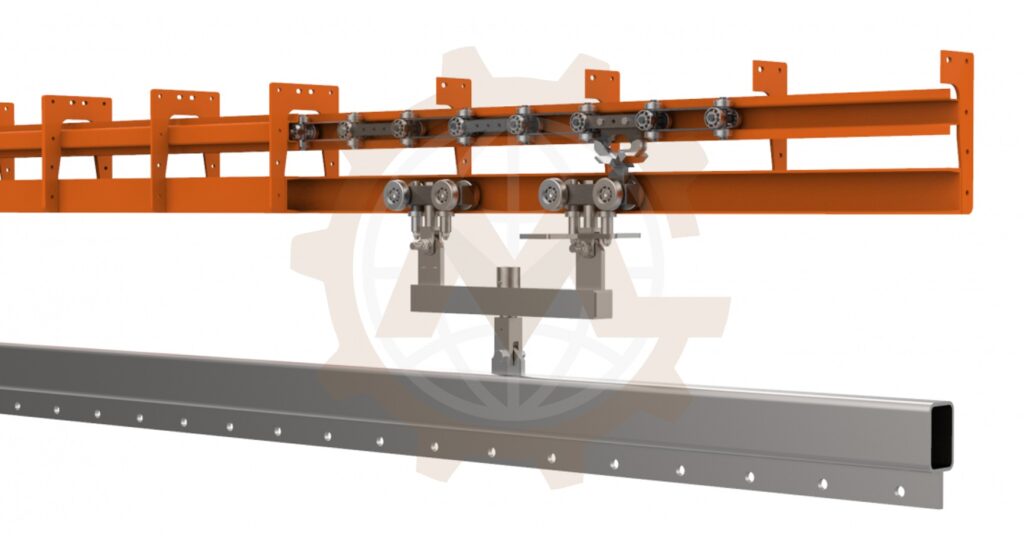
A power-and-free conveyor separates the continuously moving power chain from independently controlled free trolleys. Carriers can accumulate, stop at stations, merge, divert, index, and travel at different process rates. The design must coordinate push dogs, retractable dogs, stops, switches, anti-backup devices, carrier spacing, accumulation pressure, and control logic.
Power-and-Free Conveyor Systems
Overhead Trolley and Monorail Systems
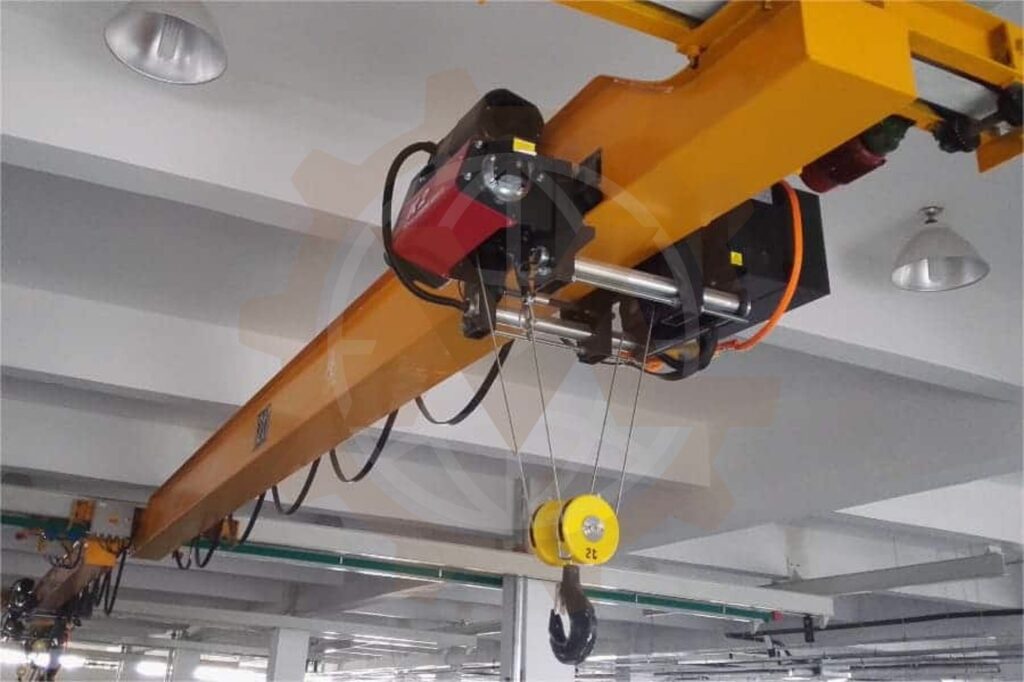
Overhead trolley conveyor systems may be powered, gravity-assisted, or manually moved. Single trolleys suit compact loads; load bars between two or more trolleys support long, heavy, or orientation-sensitive products. Trolley wheel spacing, articulation, load balance, minimum curve radius, vertical bends, and hanger swing are verified for the route.
Overhead Trolley and Monorail Systems
Manual and Gravity Overhead Conveyors
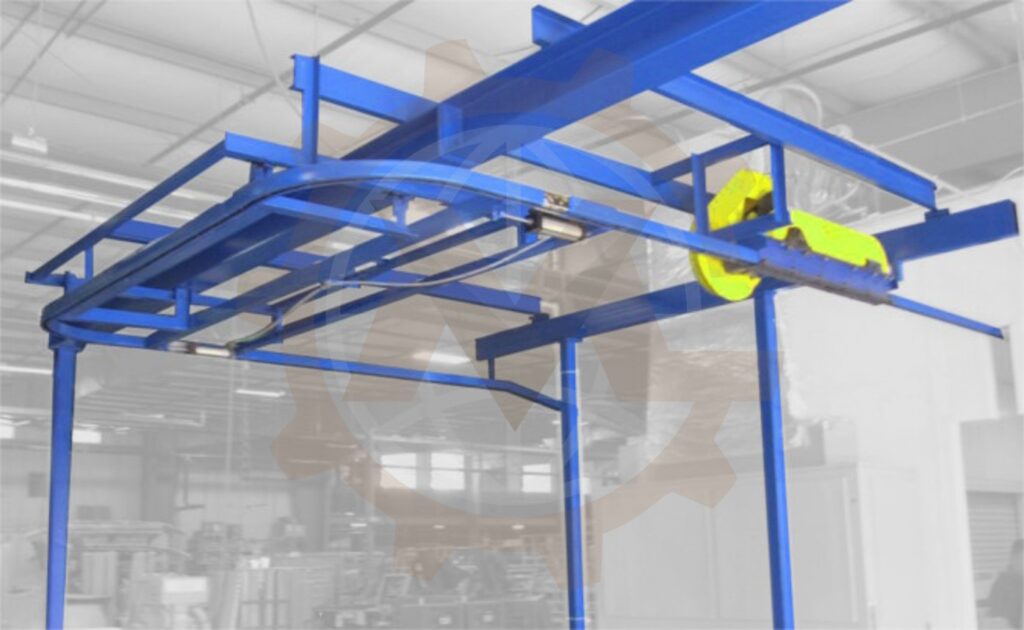
Manual overhead conveyors allow operators to push suspended carriers, while gravity sections use controlled slope. They can offer a simple solution for work cells, garment handling, maintenance areas, or low-throughput operations. Push force, slope, runaway prevention, ergonomic limits, brakes, end stops, and safe handling zones require deliberate design.
Manual and Gravity Overhead Conveyors
Special-Process Overhead Conveyors
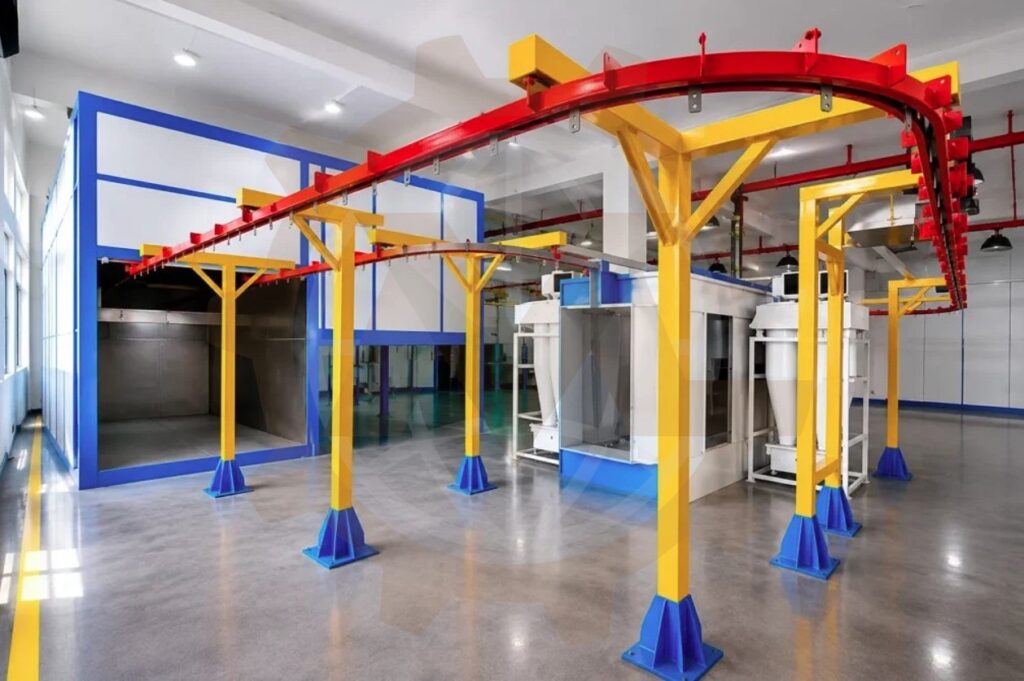
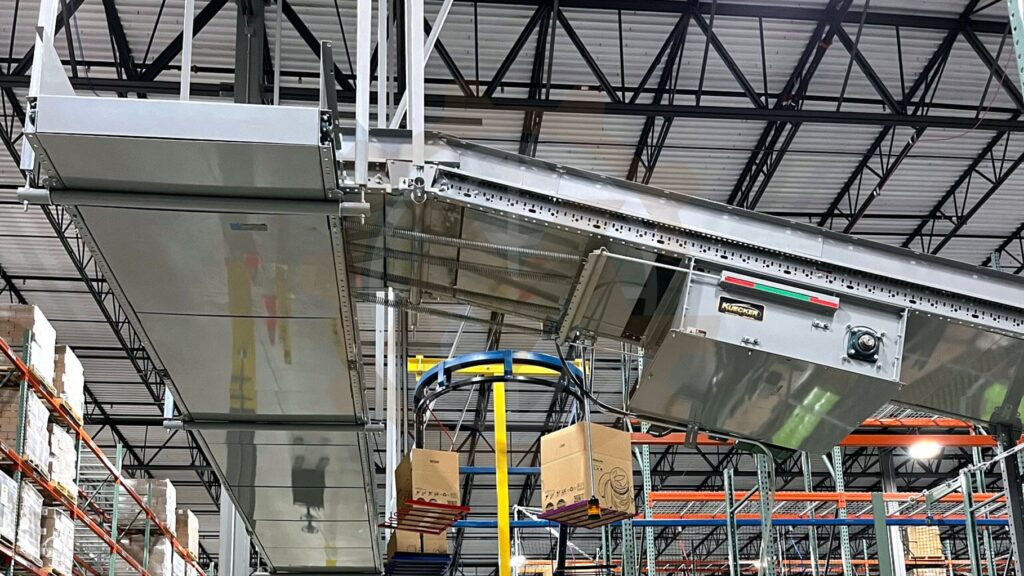
Custom systems can carry products through powder coating, liquid paint, pretreatment, washing, drying, curing ovens, cooling zones, inspection, and assembly. Heat, chemicals, overspray, water, dirt, explosion risk, drainage, product rotation, grounding, and process dwell time affect track, chain, bearings, lubrication, carriers, and controls.
Special-Process Overhead Conveyors
|
System type
|
Typical use
|
Primary design focus
|
|
Enclosed track
|
Light/medium loads, finishing and assembly
|
Track capacity, chain pull, curves, heat and lubrication
|
|
I-beam monorail
|
Heavy loads and harsh industrial duty
|
Beam/flange loads, trolley wheels, joints and supports
|
|
Powered chain conveyor
|
Continuous paced production
|
Chain, pitch, drive, take-up, synchronization and process speed
|
|
Power-and-free
|
Accumulation, routing and variable process times
|
Dogs, stops, switches, carrier logic and congestion
|
|
Manual / gravity
|
Work cells and low-volume handling
|
Push force, slope, ergonomics, braking and runaway control
|
|
Special-process line
|
Paint, wash, oven, cooling and inspection
|
Temperature, chemicals, contamination, dwell and grounding
|
Our Overhead Conveyor Design Process
1. Define the Product and Production Mission
We collect product dimensions, mass, center of gravity, lifting or support points, orientation, surface sensitivity, carrier quantity, pitch, throughput, takt time, accumulation, operating hours, loading and unloading method, process steps, and future variants. Maximum and minimum products are reviewed because both can govern hanger stability, transfer clearances, or station access.
2. Develop the Route and System Architecture
We map load and unload points, workstations, process equipment, elevations, horizontal and vertical curves, switches, accumulation zones, inspection access, and maintenance areas. The concept identifies whether an enclosed track, I-beam, power-and-free, powered monorail, or manual arrangement best fits the required load control and available building envelope.
3. Establish the Design Basis
The design basis records load cases, carrier spacing, target speed, production rate, duty, temperature, environment, allowable swing, interface datums, utility supply, customer requirements, installation constraints, support boundaries, and documentation scope. Assumptions and exclusions are made visible before detailed engineering.
4. Calculate Loads, Pull, Power, and Capacity
We calculate moving load, chain pull, curve and incline resistance, acceleration, accumulation effects, drive torque, motor power, take-up travel, trolley and wheel reactions, track or beam stress, hanger loads, support reactions, and throughput. Starting, stopping, jam, uneven loading, process drag, and credible fault conditions are considered where relevant.
5. Build the Detailed 3D Design
The 3D assembly coordinates track, rails, curves, expansion joints, trolleys, chain, carriers, fixtures, drive, take-up, lubrication, switches, stops, transfers, support steel, guards, sensors, and connected equipment. Product envelopes and carrier sweep paths are checked throughout straight sections, bends, stations, and intersections.
6. Produce Manufacturing Documentation
Deliverables can include general arrangements, track and support layouts, fabrication and machining drawings, trolley and carrier assemblies, drive and take-up drawings, hanger details, component specifications, and a complete BOM. Drawings define critical datums, tolerances, welds, finishes, assembly notes, and installation references appropriate to the agreed scope.
7. Review and Integration Support
We review the design with the client, conveyor-component supplier, fabricator, controls team, and process-equipment provider, then incorporate agreed comments under revision control. Optional support includes supplier-data updates, manufacturing clarification, installation-interface revisions, and as-built documentation.
Belt Conveyor Design Services: https://gmd.engineering/belt-conveyor-design-services/
Route Layout and Carrier Envelope Engineering
The route must provide more than nominal product clearance. The engineering envelope includes the product, carrier, hanger, trolley, expected manufacturing variation, carrier swing, load tilt, thermal movement, track deflection, and safe clearance to steelwork, ducts, lights, sprinklers, platforms, machines, and operators. Horizontal and vertical curves are modeled with swept volumes rather than checked only at their endpoints.
Carrier pitch is coordinated with product length, curves, load and unload stations, process dwell, accumulation, and drive capacity. A short pitch can increase throughput but also raises moving mass, chain pull, congestion risk, and the number of trolleys and fixtures. Long products supported by multiple trolleys require articulation that does not bind in compound curves.
Chain Pull and Drive-Power Calculations
Total conveyor pull is built from the resistances around the complete path. These can include trolley rolling resistance, chain and track friction, vertical elevation, horizontal and vertical curve effects, take-up forces, process equipment contact, seals, brushes, accumulation, acceleration, and environmental factors. Supplier formulas and allowable working pull are applied to the selected chain and trolley system.
- Weight of chain, trolleys, carriers, fixtures, and maximum conveyed products on every route segment.
- Rolling or sliding resistance on straight track, including contamination, lubrication, bearing condition, and temperature.
- Gravity component on rises and descents, including product distribution and partially loaded operating cases.
- Additional resistance through horizontal curves, vertical bends, caterpillar drives, sprockets, switches, and special track.
- Acceleration and deceleration loads for normal starting, frequent indexing, stop-start duty, and controlled stopping.
- Process forces from washers, blast curtains, oven seals, brushes, grounding contacts, tooling, or product manipulation.
- Drive torque, gearbox ratio, motor power, thermal duty, efficiency, service factor, and overload protection.
- Allowable chain pull and required margin at the actual speed, temperature, route, duty, and lubrication condition.
Drive location influences the tension profile around the loop. It should limit the peak pull, maintain controlled chain behavior at critical curves and process zones, and remain accessible for maintenance. Long or heavily loaded systems may require multiple synchronized drives or a revised route, but the control and load-sharing strategy must be engineered rather than assumed.
Roller Conveyor Design Services: https://gmd.engineering/roller-conveyor-design-services/
Track, Curves, and Structural Support
Straight Track and Rail Joints
Track straightness, joint alignment, weld quality, flange condition, and support spacing affect rolling resistance and wheel life. Joints should allow installation and replacement without creating steps that shock the trolley. Critical track datums and allowable mismatch are defined in drawings and installation requirements.
Track, Curves, and Structural Support
Horizontal Curves
Minimum curve radius depends on trolley spacing, chain articulation, product envelope, hanger swing, drive-dog geometry, and selected component limits. Curves increase chain pull and lateral wheel loading. Long carriers or load bars require special attention because trolley chord geometry can shift the product toward surrounding structures.
Vertical Bends and Elevation Changes
Vertical curves control transition into inclines and declines. Radius, trolley wheelbase, carrier clearance, load stability, chain articulation, anti-backup measures, and process orientation are checked together. Sudden slope changes can cause impact, hanger swing, product contact, or poor drive engagement.
Support Steel and Building Interfaces
Track may be supported from roof steel, columns, floor-mounted frames, platforms, or a dedicated gantry. Support calculations include vertical loads, longitudinal chain forces, transverse curve forces, start-stop loads, unbalanced loading, equipment weight, and specified environmental actions. GMD can define conveyor reactions; final approval of the building, roof, foundations, and anchors remains with qualified project professionals.
Chain Conveyor Design Services: https://gmd.engineering/chain-conveyor-design-services/
Trolleys, Load Bars, Hangers, and Fixtures
Trolley selection considers wheel load, bearing type, flange or track geometry, articulation, temperature, contamination, speed, and expected life. Single-trolley carriers can swing freely but may rotate; dual-trolley load bars improve orientation and distribute load but must negotiate curves without binding. Unequal product loading can overload one trolley even when total carrier mass is within rating.
Custom hangers and fixtures establish product orientation and process access. They must support the product during acceleration, vertical travel, manual handling, rotation, washing, air blow-off, and possible contact with process tooling. Positive retention, secondary restraint, poka-yoke loading, drainage, masking, electrical grounding, and quick-change features are added when the application requires them.
Trolleys, Load Bars, Hangers, and Fixtures
Drive, Take-Up, and Lubrication Systems
Drive Arrangements
Common arrangements include caterpillar drives, sprocket drives, friction drives, and application-specific traction units. The drive must engage the chain or trolley system smoothly without excessive impact, tooth interference, or local overload. Mounting stiffness, alignment, adjustment, guarding, torque limiting, and removal access are part of the design.
Take-Up and Chain-Length Control
A take-up accommodates chain wear, manufacturing tolerance, thermal growth, and installation adjustment while maintaining suitable engagement. Screw, spring, pneumatic, hydraulic, or gravity arrangements may be used depending on the system. Available travel, force, guides, limit detection, end-of-travel behavior, access, and safe isolation are defined.
Lubrication and Contamination Management
Lubrication reduces chain-pin, trolley-wheel, and track wear, but excessive lubricant can contaminate products, paint, ovens, or floors. Manual, drip, brush, or automatic lubricators are selected against speed, temperature, chemistry, and cleanliness. Catch pans, shields, access, lubricant compatibility, and fire or process restrictions should be coordinated with the plant.
Pallet Conveyor Design Services: https://gmd.engineering/pallet-conveyor-design-services/
Power-and-Free Accumulation and Routing
Power-and-free systems allow independent carrier control, but each mechanical function must be checked as part of the traffic system. Accumulation zones need sufficient length, positive stopping, anti-backup behavior, controlled pressure, and a release sequence that does not create collisions or overload the power chain.
- Stop locations, carrier pitch, accumulation capacity, minimum release gap, and station cycle time.
- Push-dog engagement and disengagement, retractable-dog timing, and behavior at vertical curves.
- Track switches, merges, diverts, route confirmation, mechanical interlocks, and misroute prevention.
- Carrier identification using RFID, barcodes, encoders, or other tracking methods where required.
- Fast and slow process zones, transfer between drives, synchronization, and speed-change transitions.
- Recovery from blocked carriers, failed stops, sensor disagreement, incomplete routing, and loss of power.
- Prevention of carrier rollback, uncontrolled release, rear-end impact, and excess accumulation force.
Screw Conveyor Design Services: https://gmd.engineering/screw-conveyor-design-services/
Process Integration: Paint, Wash, Oven, and Assembly
A process conveyor is part of the manufacturing operation, not merely transport. Conveyor speed and carrier pitch determine dwell time, while route elevation and product orientation affect drainage, coating coverage, heating, cooling, and operator reach. The design coordinates oven openings, tank clearances, spray zones, exhaust, seals, drip zones, booths, robots, platforms, and manual stations.
High-temperature zones may require special chain, bearings, wheels, lubricants, seals, clearances, and thermal expansion provisions. Coating lines may need reliable electrical grounding and fixtures that maintain contact despite paint buildup. Wash systems require drainage and corrosion-compatible materials. These requirements must be confirmed with the process and component suppliers for the actual chemistry and temperature.
Controls, Sensors, and Production Logic
- Chain-motion, speed, encoder, drive-overload, take-up position, and chain-fault monitoring.
- Carrier-present, carrier-clear, product-loaded, load-orientation, station-ready, and process-permissive sensing.
- Stop, switch, transfer, lift, rotator, door, guard, and fixture interlocks.
- Line speed control, recipe selection, takt coordination, process dwell, and carrier tracking.
- Blocked and starved states, accumulation limits, downstream backup, and controlled restart.
- Manual, automatic, maintenance, jog, setup, homing, and fault-recovery operating modes.
- Defined behavior after power loss, communications loss, drive trip, sensor disagreement, or carrier jam.
Mechanical and controls design must use the same carrier numbering, station datums, traffic assumptions, and fault states. Safe recovery should be possible without exposing personnel to moving overhead loads or stored energy. Sensor access and adjustment should be considered before the track is installed above equipment.
Slat Conveyor Design Services: https://gmd.engineering/slat-conveyor-design-services/
Safety and Risk-Reduction Considerations
Overhead conveyors create falling-object hazards, suspended-load risks, moving chains and trolleys, pinch and shear points, carrier swing, elevated maintenance work, and stored energy in inclined or tensioned sections. Safeguarding must follow a documented risk assessment for the complete installation, applicable jurisdiction, site rules, operating modes, and process hazards.
- Positive product retention and secondary restraint where loss of the load could create unacceptable risk.
- Fixed and interlocked guarding at drives, take-ups, sprockets, chains, switches, transfers, rotating devices, and accessible pinch points.
- Protection beneath or beside routes where people, aisles, machines, or critical equipment could be exposed to falling parts.
- Anti-runback or controlled holding on inclined sections and defined response to drive or power failure.
- Emergency-stop and protective-device coverage coordinated with connected process equipment and all operator stations.
- Electrical, pneumatic, hydraulic, gravitational, tension, thermal, and other stored-energy isolation with practical lockout points.
- Safe access platforms, ladders, lighting, work clearances, inspection zones, and equipment-removal routes.
- Validation of stopping, interlocks, carrier retention, routing, restart, and safety functions before production use.
Maintenance, Inspection, and Reliability
Overhead conveyor maintenance begins with design access. Chains, trolleys, wheels, bearings, track joints, curves, drives, take-ups, switches, stops, fixtures, supports, and lubricators need inspectable locations and measurable wear criteria. Components above booths, tanks, ovens, or machinery may require dedicated access platforms or removable track sections.
- Accessible lubrication points and containment that prevents oil from reaching products, processes, or walkways.
- Adjustment for drive engagement, take-up, switches, stops, sensors, track alignment, and carrier fixtures.
- Inspection windows, removable guards, service platforms, lifting points, and safe component-handling routes.
- Replaceable wear bars, trolley wheels, chain sections, dog components, bumpers, guides, and fixture contacts.
- Defined wear limits for chain elongation, trolley wheels, track flanges, pins, bearings, dogs, and hooks.
- Spare-parts identification, lubrication schedules, inspection intervals, torque data, and controlled drawings.
- Maintenance or test carriers for route checks where the operating system and risk assessment support them.
Where Overhead Conveyor Systems Deliver the Most Value
- Automotive bodies, components, seats, exhausts, axles, wheels, and subassembly lines.
- Powder coating, liquid painting, pretreatment, washing, drying, curing, and cooling systems.
- Doors, windows, cabinets, furniture, appliances, frames, fabrications, and metal products.
- Aerospace, agricultural, off-highway, rail, and heavy industrial component handling.
- Assembly lines, work-in-process buffers, inspection stations, robotic cells, and test areas.
- Warehousing, garment handling, packaging, empty-container return, and overhead storage.
- Food and consumer-product applications where product, hygiene, and material requirements are defined.
- Custom carriers for awkward, long, hot, delicate, or orientation-sensitive products.
Vertical Conveyor Design Services: https://gmd.engineering/vertical-conveyor-design-services/
Overhead Conveyor Engineering Package and CAD Deliverables
|
Deliverable
|
Typical content
|
|
Design basis
|
Products, carriers, route, throughput, duty, environment, assumptions and interfaces
|
|
Concept and layout
|
System type, track route, curves, elevations, stations, accumulation and support zones
|
|
Engineering calculations
|
Chain pull, drive power, trolley/track loads, supports, take-up and throughput checks
|
|
3D CAD assembly
|
Track, trolleys, carriers, drive, take-up, supports, switches, guards and interfaces
|
|
2D drawings
|
General arrangement, fabrication, machining, carrier, track and assembly drawings
|
|
Bill of materials
|
Manufactured parts, track, chain, trolleys, drives, bearings, sensors and hardware
|
|
Exchange formats
|
Inventor, STEP, SAT, DXF, PDF, Excel or other agreed formats
|
|
Review support
|
Design review, supplier coordination, fabrication clarification and controlled revisions
|
Why Partner with GMD for Overhead Conveyor Engineering?
- More than 10 years of mechanical machine-design experience for conveyors, automation, and production equipment.
- Design decisions based on actual products, carrier loading, route geometry, cycle time, process conditions, and fabrication capability.
- Practical attention to tolerances, installation, alignment, access, lubrication, inspection, wear, and component replacement.
- Autodesk Inventor as the primary design platform, with common neutral CAD and documentation formats available.
- Flexible support for a complete custom overhead conveyor or as an extension of an OEM or integrator engineering team.
- Clear definition of assumptions, exclusions, responsibility boundaries, deliverables, and review milestones.
- Remote collaboration for conveyor manufacturers, fabricators, and system integrators serving international markets.
Overhead Conveyor Project Data and Design Inputs
- Product drawings, weight range, center of gravity, support points, orientation, surface limits, and variants.
- Required throughput, takt time, carrier pitch, accumulation, process sequence, dwell time, speed, and operating hours.
- Load/unload method, station locations, route sketch, elevations, curves, floor plan, and available building envelope.
- Temperature, chemicals, wash, paint, dust, corrosion, hazardous-area, cleanliness, and grounding requirements.
- Support structure information, roof or floor constraints, installation route, access, platforms, and maintenance strategy.
- Preferred conveyor components or suppliers, utilities, controls architecture, standards, CAD formats, and schedule.
Overhead Conveyor Design FAQs
What is an overhead conveyor system?
An overhead conveyor transports suspended products or carriers along a track installed above the operating area. Trolleys run inside an enclosed track or on a rail and are moved by a chain, cable, friction drive, gravity, or manual force.
What are the main types of overhead conveyors?
Common types include enclosed-track conveyors, I-beam monorails, powered chain conveyors, power-and-free systems, overhead trolley conveyors, manual conveyors, gravity systems, and special-process lines for painting, washing, drying, or curing.
What is the difference between a monorail and a power-and-free conveyor?
A conventional powered monorail typically moves carriers at a fixed chain pitch and common line speed. A power-and-free conveyor separates the power chain from free trolleys, allowing carriers to stop, accumulate, merge, divert, and move through different process zones independently.
How is overhead conveyor chain pull calculated?
Chain pull is calculated from the moving chain, trolley, carrier, fixture, and product loads plus rolling friction, elevation, curves, acceleration, process drag, take-up effects, and other route resistance. Results are checked against the selected chain system’s allowable working pull and drive capability under the actual duty and environment.
How much weight can an overhead conveyor handle?
Capacity depends on the track or beam, trolley wheel loads, number and spacing of trolleys, chain, attachments, carrier, drive, supports, route geometry, duty, and safety requirements. A total load figure alone is insufficient; eccentricity and the load on each trolley and support must be checked.
Can an overhead conveyor include accumulation?
Yes. Power-and-free systems are commonly used for controlled accumulation. Simpler powered systems may use other buffering arrangements, but carrier contact, chain load, stopping, release, rollback, and congestion must be evaluated for the selected technology.
Are overhead conveyors suitable for paint and powder-coating lines?
Yes, when the conveyor is designed for the process temperature, chemicals, overspray, grounding, product orientation, dwell time, lubrication, cleaning, and oven or booth interfaces. Component compatibility should be verified with the selected suppliers.
What maintenance do overhead conveyors require?
Typical work includes inspection and lubrication of chains, trolleys, bearings, track, drives, take-ups, switches, stops, supports, and fixtures; checking chain elongation and wheel or track wear; correcting alignment; and replacing worn components according to defined criteria.
Can GMD redesign an existing overhead conveyor?
Yes, when sufficient drawings, measurements, component data, loading, route, duty, and operating history are available. The scope can review chain pull, drive capacity, track and trolley loading, supports, throughput, access, and known failure points.
What engineering files can GMD provide?
Depending on the agreed scope, GMD can provide design-basis documents, concept layouts, calculations, 3D assemblies, fabrication and machining drawings, assembly drawings, bills of materials, and common CAD exchange formats.
Start Your Overhead Conveyor Project
The best overhead conveyor design starts with a clear product-flow mission, accurate carrier loads, and an early understanding of the process and building interfaces. Share your product data, route, production rate, environment, support constraints, and required deliverables. GMD Services will help convert those inputs into a coordinated system concept and a manufacturing-ready mechanical design package.
Contact GMD Services to discuss Overhead Conveyor Design Services for a new production line, paint or finishing system, assembly conveyor, equipment redesign, capacity verification, or detailed manufacturing documentation.