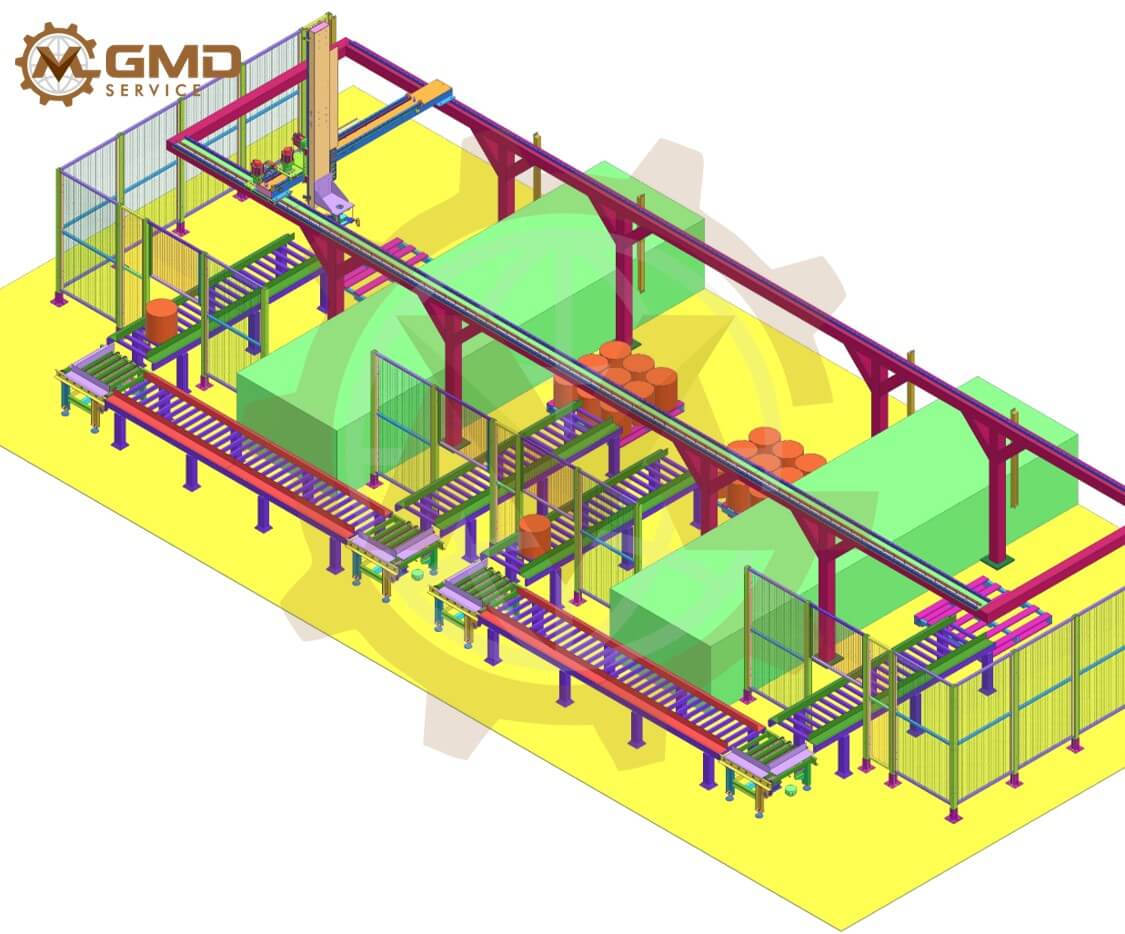
What is a Pick and Place System?
Modern manufacturing demands higher productivity, greater accuracy, and increased flexibility while reducing labor costs and repetitive manual operations. Pick and place systems have become one of the most widely used automation solutions across industries, enabling manufacturers to automate product handling, assembly, packaging, sorting, palletizing, and machine tending with exceptional speed and consistency.
At Global Machine Design Services (GMD), we provide professional Pick and Place System Design Services for manufacturers, automation companies, and machine builders worldwide. Our engineering team develops custom pick and place systems that combine robotic automation, precision mechanical design, conveyors, fixtures, end-of-arm tooling (EOAT), and safety systems into complete production-ready solutions. Every project is tailored to meet your production goals, product characteristics, and factory layout. Whether you require a high-speed robotic pick and place system, a vision-guided inspection and handling cell, a conveyor-based transfer system, or a fully customized automation solution, GMD delivers comprehensive engineering documentation including 3D CAD assemblies, manufacturing drawings, BOMs, layout drawings, and installation-ready design packages. Our objective is to help you build reliable, efficient, and scalable automation systems that improve productivity while supporting long-term manufacturing growth.
A Pick and Place System is an automated material handling solution designed to pick up a product from one location and accurately place it at another location without manual intervention. Depending on the application, a pick and place system may use industrial robots, Cartesian gantries, SCARA robots, Delta robots, collaborative robots (cobots), servo-driven linear modules, or custom mechanical mechanisms to transfer products quickly, safely, and consistently throughout the manufacturing process. Today, pick and place automation systems are used across nearly every manufacturing industry. From loading components onto assembly lines and packaging finished products to machine tending, palletizing, sorting, inspection, and material transfer, these systems eliminate repetitive manual handling while significantly improving production speed, positioning accuracy, and product consistency. However, a successful pick and place system is far more than a robot equipped with a gripper. It is a complete engineering solution where every mechanical and automation component must work together seamlessly. The robot or actuator, end-of-arm tooling (EOAT), conveyor system, fixtures, sensors, structural frame, safety equipment, and control system all contribute to the overall performance of the automation cell. Even the smallest design decisions—such as product orientation, conveyor height, gripper weight, or fixture accessibility—can have a direct impact on cycle time, reliability, and long-term operating costs. At Global Machine Design Services (GMD), we approach every pick and place project from a system engineering perspective. Rather than designing individual components independently, we optimize the complete production process to ensure that every subsystem functions as part of one integrated automation solution. This holistic approach helps manufacturers achieve higher productivity while simplifying installation, maintenance, and future expansion. A typical automated pick and place system may include the following components:
- Industrial robot, Delta robot, SCARA robot, Cartesian gantry, or servo linear module
- End-of-arm tooling (vacuum grippers, mechanical grippers, magnetic grippers, or custom EOAT)
- Product fixtures and locating mechanisms
- Belt, roller, or chain conveyor systems
- Vision inspection and camera systems
- Sensors and detection devices
- Pneumatic or servo-driven actuators
- Structural steel frame and machine base
- Safety guarding, fencing, and interlocked access doors
- Electrical cabinet, PLC, HMI, and communication hardware
- Cable management and utility routing
- Operator loading and unloading stations
Each of these components must be engineered to work together efficiently. For example, selecting a high-speed Delta robot alone will not improve productivity if the conveyor cannot accurately present products, the gripper cannot securely handle different part geometries, or the structural frame allows excessive vibration during operation. Likewise, a vision system capable of locating randomly oriented products will only deliver consistent results when integrated with an appropriately designed mechanical handling system. One of the most important objectives of pick and place system design is optimizing the relationship between robot motion and material flow. Engineers must carefully evaluate factors such as product spacing, conveyor speed, acceleration profiles, gripping forces, payload capacity, reach limitations, and product orientation before determining the most suitable automation concept. By solving these challenges during the engineering phase, manufacturers can reduce commissioning time, improve equipment reliability, and avoid costly design changes after fabrication. Modern pick and place systems are also expected to be flexible enough to support changing production requirements. Manufacturers frequently introduce new product sizes, packaging formats, or production volumes throughout the life of an automation system. As a result, today’s engineering approach focuses on modular and scalable designs that allow future upgrades without requiring complete machine replacement. Flexible fixture concepts, adjustable tooling, modular conveyor layouts, and expandable machine structures all contribute to a longer equipment lifecycle and a higher return on investment. Another growing trend is the integration of vision-guided pick and place systems. Machine vision allows robots to identify the position, orientation, and quality of products before handling them, making it possible to automate applications that previously required manual intervention. Vision technology is particularly valuable in random bin picking, packaging, electronic assembly, food processing, and quality inspection, where product positions cannot always be controlled precisely. Ultimately, the success of a pick and place automation project depends on much more than selecting the right robot. It requires a carefully engineered mechanical system that integrates automation, material handling, structural design, and production planning into one reliable manufacturing solution. At Global Machine Design Services (GMD), our engineers specialize in designing complete pick and place systems that are practical to manufacture, easy to maintain, and optimized for real industrial environments. From concept development and 3D CAD modeling to manufacturing drawings and engineering documentation, we help manufacturers, machine builders, and automation companies transform production challenges into reliable, high-performance automation solutions.
Why Pick and Place Automation Is Essential in Modern Manufacturing
As manufacturers face increasing pressure to improve productivity, maintain consistent quality, and reduce operating costs, automation has become a strategic investment rather than a competitive advantage. Among the many automation technologies available today, pick and place systems are one of the most versatile and cost-effective solutions because they can be applied to virtually every stage of the manufacturing process—from raw material handling to final packaging.
Manual handling operations often appear simple, but they introduce several hidden challenges. Repetitive movements can lead to operator fatigue, inconsistent cycle times, product damage, ergonomic risks, and increased labor costs. As production volumes increase, these issues become even more significant, making it difficult to maintain efficiency while meeting delivery schedules.
A properly engineered pick and place automation system eliminates these limitations by performing repetitive handling tasks with consistent speed, accuracy, and reliability. Whether transferring components between conveyors, loading CNC machines, assembling products, or placing packaged goods into cartons, automated handling systems can operate continuously while maintaining repeatable performance throughout every production cycle.
Increase Productivity
One of the primary reasons manufacturers invest in automated pick and place systems is to increase production throughput.
Unlike manual operations, automated systems maintain consistent cycle times regardless of shift length or production volume. Once optimized, the system performs the same sequence repeatedly with minimal variation, allowing manufacturers to achieve predictable output and better production planning.
Higher productivity is achieved through:
- Continuous operation
- Faster product transfer
- Reduced idle time
- Optimized robot motion
- Improved material flow
- Shorter production cycles
Rather than simply moving products faster, a well-designed system removes unnecessary movements and synchronizes every station to maximize overall line efficiency.
Improve Product Quality and Repeatability
Consistent product handling is essential in industries where positioning accuracy directly affects product quality.
Human operators naturally introduce small variations during repetitive work. While these differences may be acceptable for certain applications, industries such as electronics, medical devices, automotive, and precision assembly require far greater repeatability.
Automated pick and place systems provide:
- Accurate positioning
- Repeatable product orientation
- Consistent gripping force
- Stable placement accuracy
- Reduced product damage
This consistency improves downstream manufacturing processes while reducing scrap and rework.
Reduce Labor Costs
Many pick and place applications involve repetitive, physically demanding tasks that provide little added value but consume significant labor resources.
Automating these operations allows manufacturers to reassign employees to higher-value activities such as equipment supervision, quality control, maintenance, and process improvement.
Instead of replacing people, automation often helps companies address labor shortages while increasing overall production capacity.
Enhance Workplace Safety
Material handling can expose operators to repetitive strain injuries, awkward lifting positions, and hazardous production environments.
A properly designed robotic handling system minimizes operator exposure to:
- Heavy lifting
- Hot components
- Sharp materials
- Hazardous machinery
- Repetitive motion injuries
- High-speed production equipment
Safety features such as guarding, light curtains, interlocked access doors, and laser scanners further improve workplace protection while allowing efficient machine operation.
Increase Manufacturing Flexibility
Modern manufacturing rarely produces a single product indefinitely. Product dimensions, packaging styles, and customer requirements change frequently, requiring production equipment to adapt quickly.
For this reason, modern pick and place systems are increasingly designed with flexibility in mind.
Engineering features may include:
- Adjustable fixtures
- Quick-change tooling
- Recipe-based product changeovers
- Modular conveyor layouts
- Expandable machine structures
- Flexible robot programming interfaces
These capabilities allow manufacturers to introduce new products with minimal equipment modifications, protecting their automation investment over the long term.
Support Smart Manufacturing
Pick and place systems are becoming an important part of Industry 4.0 initiatives.
Modern automation equipment can communicate with production management systems, collect operational data, and support predictive maintenance strategies through integrated sensors and control systems.
Depending on the application, automated systems can provide:
- Production data collection
- Cycle time monitoring
- Machine status reporting
- Product traceability
- Quality monitoring
- Performance analytics
This information enables manufacturers to make data-driven decisions that improve operational efficiency and reduce downtime.
Why Engineering Matters More Than Equipment Selection
Many automation projects begin by selecting an industrial robot or linear motion system. However, the overall success of a pick and place solution depends far more on the quality of its engineering than on the hardware itself.
A high-performance robot cannot compensate for:
- Poor product presentation
- Inefficient conveyor layouts
- Inadequate fixture design
- Excessive structural vibration
- Difficult maintenance access
- Poor cable routing
- Inefficient material flow
- Unsafe operator interaction
These issues are mechanical engineering challenges—not robot selection problems.
At Global Machine Design Services (GMD), we focus on designing the complete pick and place system rather than individual pieces of equipment. By considering every aspect of the manufacturing process during the engineering phase, we help clients reduce commissioning risks, simplify installation, improve equipment reliability, and achieve a faster return on investment.
Every engineering decision—from the robot base structure to the gripper design, conveyor positioning, maintenance clearance, and safety layout—is made with one objective in mind: creating a pick and place system that delivers reliable performance in real industrial production environments for many years to come.
Our Pick and Place System Design Services
At Global Machine Design Services (GMD), we provide complete Pick and Place System Design Services that transform production requirements into reliable, production-ready automation solutions. Rather than supplying standard machines, we engineer custom systems tailored to your products, production targets, available floor space, and manufacturing processes.
Our engineering approach combines mechanical design, motion systems, robotics, conveyor integration, tooling, and safety into one optimized solution. Every project is developed with a strong focus on manufacturability, maintainability, operational efficiency, and future scalability.
Custom Pick and Place System Design
No two manufacturing processes are exactly alike. Product geometry, weight, orientation, production speed, and handling requirements all influence how a pick and place system should be engineered.
Our engineers develop custom solutions based on your specific production objectives, ensuring that every component works together efficiently.
We evaluate factors such as:
- Product dimensions and weight
- Required cycle time
- Positioning accuracy
- Production capacity
- Factory layout
- Available installation space
- Future expansion requirements
By designing around your actual production process instead of adapting a standard machine, we help maximize automation efficiency while reducing unnecessary complexity.
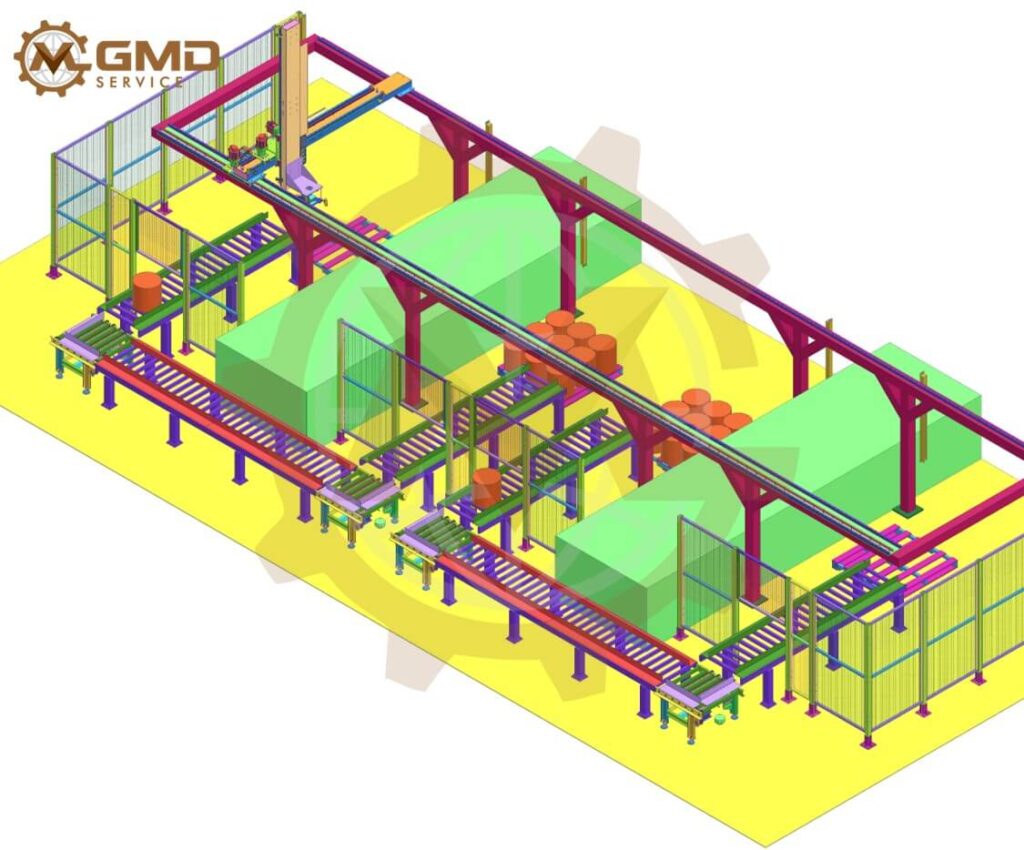
Custom Pick and Place System Design
Robotic Pick and Place Systems
Industrial robots provide exceptional flexibility for applications involving multiple product types or complex handling paths.
We design robotic pick and place systems using various robot technologies, including:
- 6-axis industrial robots
- SCARA robots
- Delta robots
- Collaborative robots (Cobots)
- Cartesian robots
- Gantry robot systems
Robot selection is based on payload, reach, speed, repeatability, and workspace requirements rather than brand preference alone. This vendor-neutral approach ensures that each solution is technically and economically optimized for your application.
High-Speed Pick and Place Automation
Many industries require extremely fast handling systems capable of transferring hundreds of products every minute.
For these applications, we optimize every aspect of the machine, including:
- Product spacing
- Robot acceleration profiles
- Conveyor synchronization
- Gripper weight reduction
- Motion efficiency
- Mechanical rigidity
Our engineering objective is not simply to achieve maximum speed but to maintain consistent performance while protecting product quality and minimizing mechanical wear.
Vision-Guided Pick and Place Systems
Not every product arrives in a perfectly controlled position. Vision systems allow automation equipment to identify product location and orientation before handling.
We design pick and place systems prepared for integration with machine vision technologies for applications such as:
- Random product orientation
- Bin picking
- Product identification
- Barcode recognition
- Quality inspection
- Orientation correction
By incorporating vision requirements during the mechanical design stage, we help ensure adequate camera positioning, lighting access, and robot reach for reliable operation.
Conveyor Integration
Efficient product transportation is just as important as the picking operation itself.
Our engineers design conveyor systems that integrate seamlessly with automated handling equipment, creating smooth product flow throughout the production line.
Depending on the application, conveyor solutions may include:
- Belt conveyors
- Roller conveyors
- Chain conveyors
- Timing belt conveyors
- Indexing conveyors
- Accumulation conveyors
- Pallet transfer systems
Proper conveyor integration minimizes waiting time between cycles while maintaining accurate product positioning.
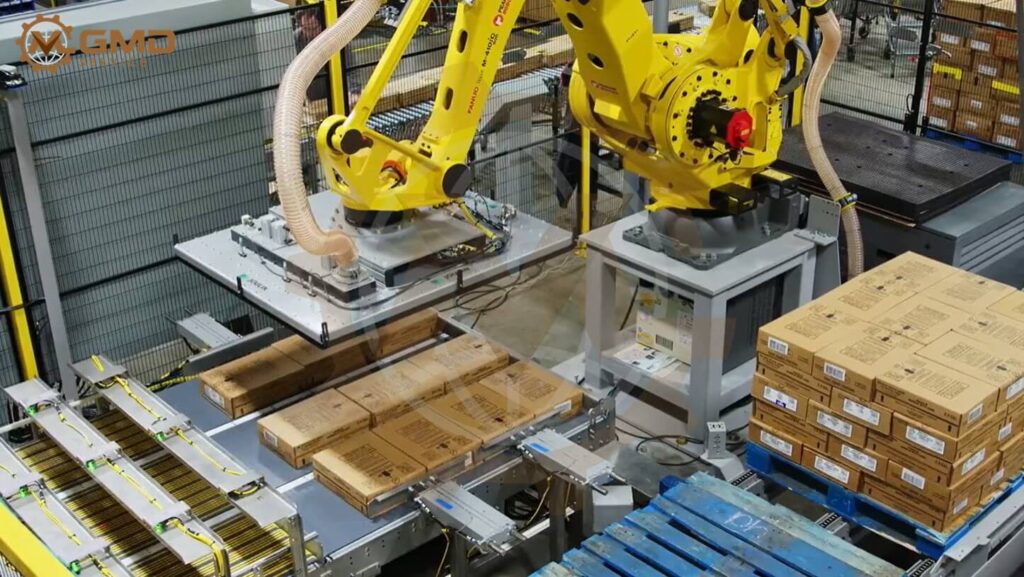
Conveyor Integration
End-of-Arm Tooling (EOAT) Design
The gripper is the interface between the automation system and your product. Selecting the appropriate gripping method is essential for maintaining speed, accuracy, and product quality.
We design custom EOAT solutions including:
- Vacuum grippers
- Mechanical grippers
- Servo grippers
- Magnetic grippers
- Soft-contact grippers
- Multi-product tooling
- Quick-change EOAT systems
Each design considers payload, gripping force, product material, center of gravity, and maintenance requirements to ensure long-term reliability.
Product Fixtures and Positioning Systems
Accurate product positioning is fundamental to successful automation.
Our fixture designs provide repeatable location of workpieces while supporting fast loading and unloading operations.
Typical solutions include:
- Precision locating nests
- Pneumatic fixtures
- Manual fixtures
- Adjustable fixtures
- Modular fixture systems
- Quick-change fixtures
Well-designed fixtures reduce positioning errors, improve downstream accuracy, and simplify product changeovers.

Product Fixtures and Positioning Systems
Mechanical Structure Design
Every pick and place system relies on a rigid mechanical structure that supports moving equipment while maintaining positioning accuracy.
We engineer:
- Machine frames
- Welded steel structures
- Aluminum profile systems
- Robot pedestals
- Gantry frames
- Maintenance platforms
- Protective covers
Structural rigidity, manufacturability, transportation, and future maintenance are considered throughout the design process to ensure long-term equipment performance.
Safety System Integration
Operator safety is integrated into every stage of our engineering process.
Our mechanical designs accommodate:
- Safety fencing
- Machine guarding
- Interlocked access doors
- Light curtain locations
- Area laser scanners
- Emergency stop stations
- Safe maintenance access
Rather than treating safety as an afterthought, we incorporate protective measures into the initial layout so they support both productivity and compliance with applicable industrial safety requirements.
Production-Ready Engineering Documentation
A successful automation project requires documentation that can be manufactured with confidence.
Every project can include:
- Complete 3D CAD assemblies
- Manufacturing drawings
- Assembly drawings
- General Arrangement (GA) drawings
- Bill of Materials (BOM)
- Purchased parts lists
- Installation drawings
- PDF documentation packages
Our engineering documentation provides fabrication teams, procurement departments, and automation integrators with the information required to manufacture, assemble, and commission the system efficiently.
At GMD, our goal is not simply to design a machine that works—we engineer pick and place systems that are practical to manufacture, easy to maintain, scalable for future production requirements, and capable of delivering reliable performance throughout years of industrial operation.
Custom Machine Design Services: https://gmd.engineering/custom-machine-design-services/
Types of Pick and Place Systems We Design
Every manufacturing process has unique handling requirements, making it impossible for a single automation solution to fit every application. Product dimensions, payload, cycle time, positioning accuracy, available floor space, and production volume all influence the most suitable pick and place solution.
At Global Machine Design Services (GMD), we design custom pick and place systems that are engineered around your production process rather than adapting your process to a standard machine. Our engineering team evaluates the complete manufacturing workflow to recommend the most efficient automation concept for your application.
Robotic Pick and Place Systems
Industrial robots provide outstanding flexibility for applications involving multiple product types, complex handling paths, or frequent product changes.
Our robotic pick and place systems are commonly used for:
- Machine tending
- Product transfer
- Packaging
- Assembly
- Bin picking
- Quality inspection
- End-of-line automation
Depending on the application, we design systems utilizing:
- 6-Axis Industrial Robots
- SCARA Robots
- Delta Robots
- Cartesian Robots
- Gantry Systems
- Collaborative Robots (Cobots)
Robot selection is based on payload capacity, reach, speed, repeatability, and workspace requirements to achieve the optimal balance between performance and investment cost.

Robotic Pick and Place Systems
Cartesian Pick and Place Systems
For applications requiring high positional accuracy and linear movement, Cartesian automation systems are often the most practical solution.
Unlike articulated robots, Cartesian systems operate on fixed X, Y, and Z axes, making them ideal for repetitive product transfer operations.
Typical applications include:
- Precision assembly
- Electronics manufacturing
- Medical device production
- CNC loading
- Packaging equipment
- Laboratory automation
Advantages include:
- Excellent positioning accuracy
- Simple mechanical structure
- High rigidity
- Lower maintenance
- Easy integration with conveyors

Cartesian Pick and Place Systems
Delta Robot Pick and Place Systems
Delta robots are specifically designed for ultra-high-speed product handling.
These systems excel in industries where hundreds of products must be picked every minute without sacrificing accuracy.
Common applications include:
- Food packaging
- Pharmaceutical handling
- Consumer goods
- Electronics
- Small component sorting
Our engineering team develops complete Delta robot workstations, including conveyor synchronization, product tracking, vision integration, and lightweight tooling to maximize throughput.

Delta Robot Pick and Place Systems
SCARA Pick and Place Systems
SCARA robots are widely used where fast horizontal movement and excellent repeatability are required.
Typical applications include:
- Electronic assembly
- PCB handling
- Component insertion
- Precision packaging
- Medical equipment manufacturing
Their compact footprint makes them particularly suitable for installations where factory space is limited.

SCARA Pick and Place Systems
Gantry Pick and Place Systems
Large products often exceed the reach or payload capabilities of conventional industrial robots.
For these applications, gantry systems provide excellent coverage over large work areas while maintaining high positioning accuracy.
Typical applications include:
- Sheet metal handling
- Glass handling
- Wood processing
- Heavy component transfer
- Warehouse automation
Our engineers design gantry structures that balance rigidity, motion performance, and ease of maintenance for demanding industrial environments.

Gantry Pick and Place Systems
Vision-Guided Pick and Place Systems
Many production environments require robots to identify products that are randomly positioned or differently oriented.
Vision-guided automation combines cameras with intelligent software to locate products before initiating the picking sequence.
Applications include:
- Random bin picking
- Product orientation
- Defect identification
- Barcode reading
- Package verification
- Sorting operations
When designing these systems, we ensure sufficient space for camera mounting, lighting equipment, maintenance access, and robot movement to achieve reliable long-term performance.

Vision-Guided Pick and Place Systems
Conveyor-Based Pick and Place Systems
In high-volume production lines, products are continuously transported between workstations.
Conveyor-based pick and place systems synchronize robotic movement with conveyor motion, allowing products to be transferred without interrupting production flow.
Typical conveyor configurations include:
- Belt conveyors
- Timing belt conveyors
- Roller conveyors
- Chain conveyors
- Indexing conveyors
- Pallet transfer conveyors
Our layouts are optimized to reduce idle time while maintaining accurate product positioning throughout the automation process.

Conveyor-Based Pick and Place Systems
Vacuum Pick and Place Systems
Vacuum gripping technology is widely used for handling products with flat or smooth surfaces.
Applications include:
- Sheet metal
- Plastic components
- Glass panels
- Cartons
- Flexible packaging
- Electronic products
During engineering, we evaluate:
- Product weight
- Surface characteristics
- Vacuum safety factor
- Cup arrangement
- Air consumption
- Redundant gripping requirements
This ensures secure handling while minimizing product damage.
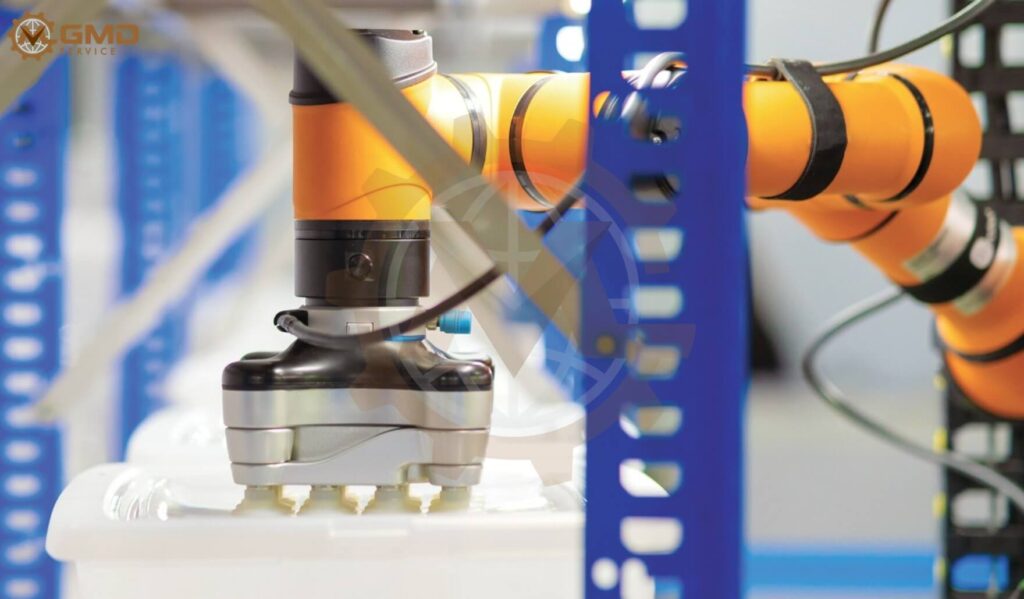
Vacuum Pick and Place Systems
Multi-Station Pick and Place Systems
Complex manufacturing processes often require products to move through multiple workstations before completion.
Our multi-station systems integrate several automation processes into one coordinated production line, such as:
- Product feeding
- Inspection
- Assembly
- Testing
- Packaging
- Sorting
- Final transfer
By coordinating every station during the design phase, we reduce bottlenecks and improve overall production efficiency.
Fully Customized Pick and Place Automation Systems
Some manufacturing processes cannot be solved using standard automation equipment.
For these projects, GMD develops fully customized pick and place systems based entirely on your production objectives.
Our engineering scope may include:
- Custom structural frames
- Servo-driven motion systems
- Pneumatic mechanisms
- Conveyor integration
- EOAT development
- Product fixtures
- Vision system preparation
- Safety guarding
- Maintenance platforms
Every system is engineered to meet your required cycle time, positioning accuracy, available floor space, and long-term production goals.
Rather than delivering a standalone machine, we develop a complete automation solution that integrates seamlessly into your manufacturing environment. By combining practical mechanical engineering expertise with modern automation principles, GMD helps manufacturers implement reliable, scalable, and production-ready pick and place systems that continue delivering value throughout the equipment lifecycle.

Fully Customized Pick and Place Automation Systems
Our Engineering Design Process
At Global Machine Design Services (GMD), every pick and place system is developed using a structured engineering methodology that minimizes project risks, improves manufacturing efficiency, and shortens implementation time. Our process focuses on understanding your production requirements first, then designing an automation solution that is practical to manufacture, simple to maintain, and capable of delivering reliable long-term performance.
By validating critical engineering decisions before fabrication begins, we help our clients reduce commissioning delays, avoid unnecessary design revisions, and achieve a faster return on investment.
1. Requirement Analysis
Every successful automation project begins with a thorough understanding of the manufacturing process.
During the initial engineering stage, we evaluate:
- Product dimensions and weight
- Production capacity
- Required cycle time
- Positioning accuracy
- Existing production equipment
- Factory layout
- Available installation space
- Product flow
- Operator interaction
- Future production expansion
This information allows our engineers to determine the most suitable automation concept before detailed design work begins.
2. Automation Concept Development
Based on the project requirements, our engineering team develops the overall machine concept and determines how products will move through the automation system.
During this stage we define:
- Pick locations
- Place locations
- Product orientation
- Robot or actuator selection
- Conveyor arrangement
- EOAT concept
- Fixture concept
- Safety layout
- Maintenance access
- Utility routing
Evaluating multiple concepts early helps identify the most efficient and cost-effective solution before investing in detailed engineering.
3. Mechanical System Design
Once the concept is approved, we create a complete 3D CAD model of the entire pick and place system.
The assembly typically includes:
- Machine frame
- Robot or gantry
- EOAT
- Fixtures
- Conveyors
- Linear motion systems
- Pneumatic assemblies
- Structural supports
- Safety guarding
- Access doors
- Maintenance platforms
Developing the complete system in 3D enables our engineers to verify component interfaces and identify potential issues before manufacturing begins
4. Engineering Validation
Before releasing drawings for production, we review every major aspect of the system to ensure reliable operation.
Typical engineering checks include:
- Reach analysis
- Collision detection
- Payload verification
- Conveyor synchronization
- Maintenance accessibility
- Product clearance
- Structural rigidity
- Assembly sequence
- Manufacturing feasibility
- Serviceability
Resolving these issues during the design stage significantly reduces installation risks and improves commissioning efficiency.
5. Production Documentation
After the design has been finalized, we prepare complete engineering documentation for fabrication and assembly.
Typical deliverables include:
- Complete 3D CAD assemblies
- Individual part models
- Manufacturing drawings
- Assembly drawings
- General Arrangement (GA)
- Bill of Materials (BOM)
- Purchased Parts List
- Installation drawings
- PDF documentation package
Our documentation provides manufacturers and automation integrators with everything required to move confidently into procurement, fabrication, and commissioning.
Industries We Serve
Pick and place automation is used across almost every manufacturing sector because virtually every production process involves transferring products from one location to another.
Our engineering services support customers in a wide range of industries.
Automotive Manufacturing
Automotive production requires fast, repeatable handling of components throughout assembly and inspection processes.
Applications include:
- Component transfer
- Machine tending
- Assembly automation
- Vision inspection
- Packaging
Electronics Manufacturing
Electronic products require precise positioning and gentle handling.
Typical applications include:
- PCB handling
- Component placement
- Connector assembly
- Product testing
- Packaging automation
Food and Beverage
Food manufacturers require hygienic automation capable of operating at very high speeds.
Typical systems include:
- Product sorting
- Packaging
- Carton loading
- Tray handling
- Case packing
Pharmaceutical and Medical Devices
Medical manufacturing demands exceptional repeatability and traceability.
Applications include:
- Product handling
- Kit assembly
- Packaging
- Inspection
- Label verification
Consumer Products
High-volume consumer goods manufacturing benefits from flexible automation capable of handling multiple product variants.
Applications include:
- Assembly
- Packaging
- Sorting
- Pick and pack
- End-of-line handling
Logistics and Warehousing
Warehouse automation increasingly relies on intelligent pick and place systems to improve order fulfillment.
Applications include:
- Parcel handling
- Tote transfer
- Order sorting
- Product induction
- Automated material movement
Metal Fabrication
Industrial automation improves safety and productivity when handling heavy or repetitive metal components.
Typical applications include:
- Sheet metal transfer
- Laser machine loading
- Press tending
- Welding preparation
- Finished part handling
Plastics and Injection Molding
Automation systems reduce cycle times by automatically removing molded parts and transferring them to downstream processes.
Applications include:
- Part removal
- Trim handling
- Inspection
- Packaging
- Assembly preparation
Why Manufacturers Choose GMD
Choosing the right engineering partner is just as important as selecting the right automation technology.
Manufacturers work with GMD because we focus on developing practical engineering solutions rather than simply creating CAD models. Every design is developed with fabrication, installation, maintenance, and long-term production performance in mind.
Our engineering team combines extensive experience in mechanical design, industrial automation, conveyor systems, lifting equipment, robotic cells, and manufacturing documentation to deliver solutions that can be confidently manufactured and integrated into real production environments.
Whether your project involves a simple conveyor transfer system or a complex multi-robot pick and place automation line, our objective remains the same: deliver a robust engineering package that reduces project risk, supports efficient manufacturing, and provides long-term value for your business.
Engineering Deliverables
Every Pick and Place System Design project delivered by Global Machine Design Services (GMD) includes comprehensive engineering documentation that enables manufacturers, machine builders, and automation integrators to move efficiently from design to fabrication, assembly, installation, and commissioning.
Our deliverables are structured to support the entire manufacturing process while reducing engineering uncertainty and minimizing production delays.
3D CAD Assembly
Every project begins with a fully detailed 3D assembly that represents the complete automation system.
The assembly may include:
- Machine frame
- Robot or gantry system
- End-of-arm tooling (EOAT)
- Product fixtures
- Conveyor systems
- Safety guarding
- Structural supports
- Maintenance platforms
- Purchased components
- Pneumatic assemblies
Developing the entire system in 3D allows design issues to be identified before manufacturing begins, reducing costly revisions during fabrication.
Detailed Part Models
Each manufactured component is created as an individual CAD model with appropriate material definitions and manufacturing features.
Typical parts include:
- Structural members
- Sheet metal components
- Machined parts
- Mounting brackets
- Fixture components
- Robot adapters
- Conveyor parts
- Guarding components
Manufacturing Drawings
Production-ready drawings are prepared according to industry-standard engineering practices.
Typical drawing packages include:
- Part drawings
- Assembly drawings
- Weldment drawings
- Section views
- Detail views
- Exploded assemblies
- Dimensioning
- Material specifications
- Welding symbols
- Surface finish requirements
These drawings provide fabrication teams with clear manufacturing instructions while minimizing interpretation errors.
General Arrangement (GA) Drawings
General Arrangement drawings provide an overview of the complete automation system and are particularly useful during installation planning.
Typical information includes:
- Overall dimensions
- Equipment footprint
- Robot location
- Conveyor layout
- Operator stations
- Safety fencing
- Maintenance clearance
- Utility connection locations
GA drawings help ensure that the equipment integrates efficiently into the customer’s production facility.
Bill of Materials (BOM)
Every project includes a structured Bill of Materials to simplify procurement and inventory management.
The BOM may contain:
- Manufactured parts
- Standard hardware
- Bearings
- Pneumatic components
- Sensors
- Motors
- Gearboxes
- Purchased assemblies
- Fasteners
Well-organized BOMs reduce purchasing errors and improve manufacturing efficiency.
Engineering Documentation Package
Depending on project requirements, additional documentation can include:
- PDF drawing package
- STEP files
- DXF files
- Assembly instructions
- Installation drawings
- Exploded views
- Purchased Parts List
- Revision documentation
Our engineering packages are designed to support fabrication teams, purchasing departments, machine builders, and system integrators throughout the entire project lifecycle.
Frequently Asked Questions
1. What is a pick and place system?
A pick and place system is an automated machine designed to pick products from one location and accurately place them in another. These systems are commonly used for assembly, packaging, machine tending, palletizing, inspection, and material handling applications.
2. What industries use pick and place automation?
Pick and place automation is widely used in automotive, electronics, food and beverage, pharmaceutical, medical devices, consumer goods, logistics, plastics, metal fabrication, and general manufacturing industries.
3. Can you design custom pick and place machines?
Yes. Every system is custom engineered based on your products, production capacity, factory layout, cycle time, and automation requirements rather than using a standard machine design.
4. What robot types can be used in a pick and place system?
Depending on the application, we design systems using:
- 6-axis industrial robots
- SCARA robots
- Delta robots
- Cartesian robots
- Gantry systems
- Collaborative robots (Cobots)
The final selection depends on payload, speed, reach, repeatability, and workspace requirements.
5. Do you provide vision-guided pick and place system design?
Yes. We design mechanical systems prepared for integration with machine vision technologies, including camera mounting, lighting access, product presentation, and robot reach optimization. Vision-guided systems are commonly used for random part picking, orientation correction, inspection, and product tracking.
6. Can your systems integrate with conveyors?
Absolutely. Conveyor integration is one of our core engineering capabilities. We design belt conveyors, roller conveyors, chain conveyors, indexing conveyors, pallet transfer systems, and other material handling equipment that operate seamlessly with automated pick and place systems.
7. Do you design custom grippers (EOAT)?
Yes. We develop custom End-of-Arm Tooling (EOAT) for vacuum handling, mechanical gripping, magnetic handling, soft-contact gripping, and multi-product applications. Every gripper is designed according to product geometry, payload, cycle time, and reliability requirements.
8. What software do you use?
Our primary design platform is Autodesk Inventor. We can also provide neutral file formats such as STEP, DWG, DXF, and PDF to ensure compatibility with your engineering, procurement, and manufacturing processes.
9. Can you improve an existing pick and place system?
Yes. In addition to new machine development, we can redesign and optimize existing automation systems by improving layouts, fixtures, conveyors, grippers, structural components, and overall production efficiency.
10. Can GMD collaborate with our engineering team?
Yes. We regularly work alongside robot programmers, PLC engineers, electrical designers, system integrators, and in-house engineering departments. Our mechanical engineering deliverables are prepared to integrate smoothly with multidisciplinary automation projects.
Ready to Automate Your Production?
Whether you are planning a new production line, upgrading an existing manufacturing process, or developing a high-speed automated handling system, Global Machine Design Services (GMD) is ready to support your project with professional engineering expertise.
Our team specializes in designing reliable, production-ready pick and place systems that improve productivity, reduce engineering risks, and simplify manufacturing. From concept development and 3D CAD design to complete manufacturing documentation, we provide practical engineering solutions tailored to your specific production requirements.
Contact GMD today to discuss your automation goals and discover how a custom pick and place system can improve the efficiency, flexibility, and long-term performance of your manufacturing operation.
Conclusion
A well-designed pick and place system is far more than an automated transfer mechanism—it is a critical component of modern manufacturing that directly influences productivity, product quality, labor efficiency, and operational reliability.
Successful automation requires careful integration of robots, conveyors, fixtures, grippers, safety systems, structural design, and material flow into one cohesive production solution. Every engineering decision, from equipment layout to end-of-arm tooling, contributes to the overall performance and long-term value of the system.
At Global Machine Design Services (GMD), we combine extensive experience in mechanical engineering, industrial automation, robotic systems, and manufacturing design to deliver custom pick and place solutions that are practical to build, easy to maintain, and optimized for real-world production environments. Whether your application involves robotic handling, vision-guided automation, assembly, packaging, machine tending, or material transfer, we provide complete engineering services that help transform your automation concept into a reliable, scalable, and production-ready system.