
Automatic VFFS Packaging Machine for Granular Products
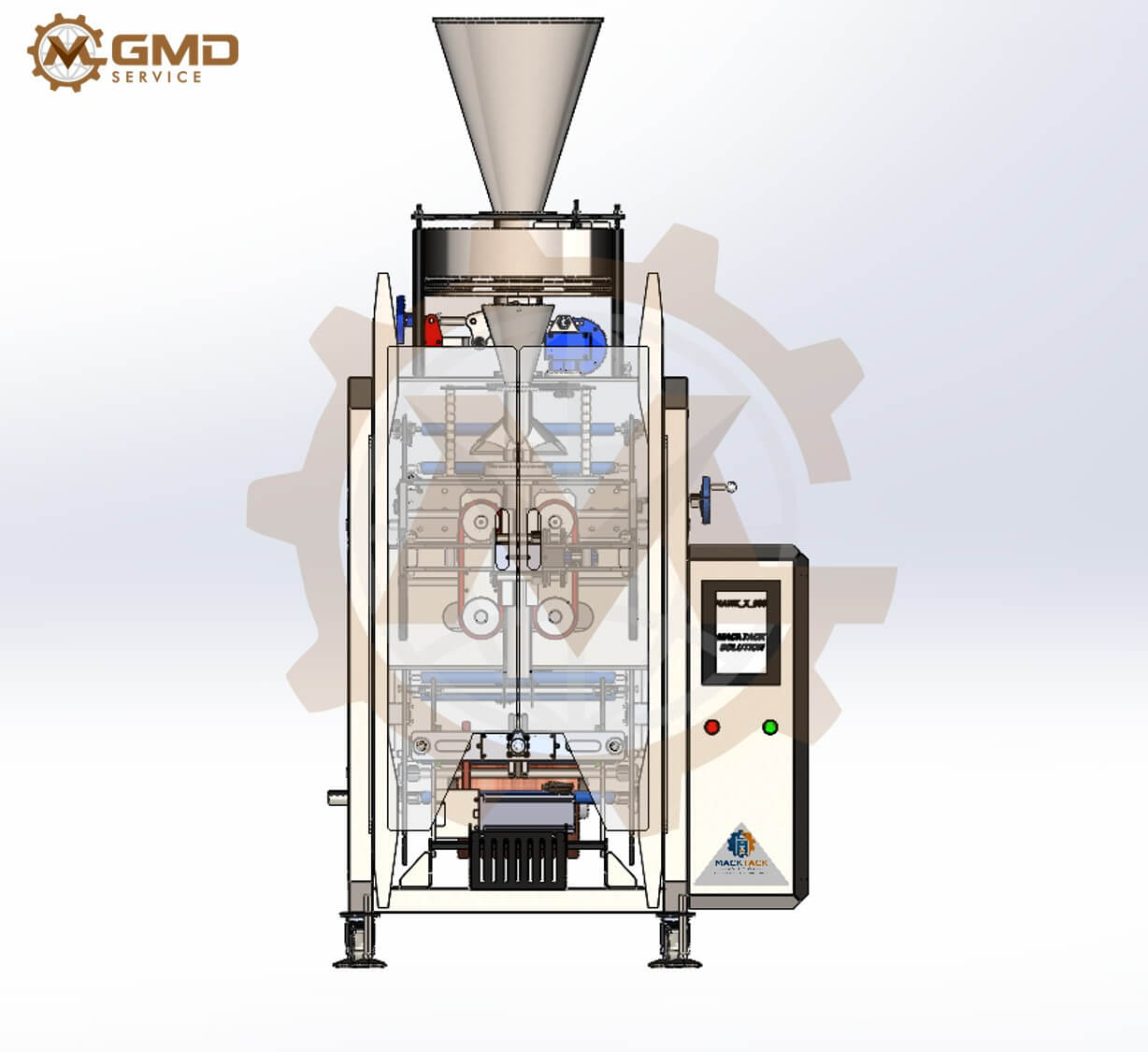
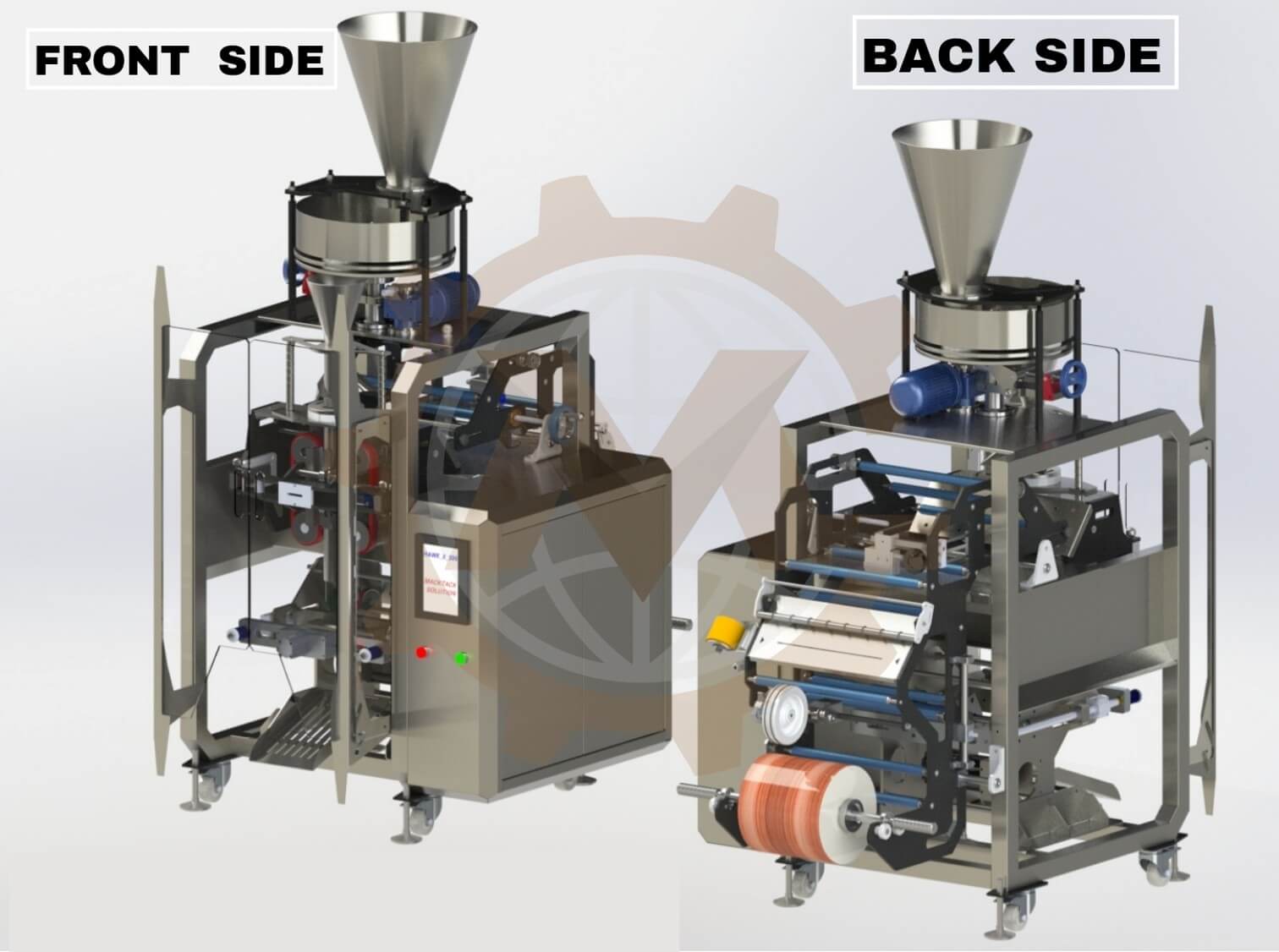
This automatic vertical form-fill-seal packaging machine integrates rotary cup dosing, roll-film feeding, bag forming, granular product filling, heat sealing, cutting and finished-package discharge into one continuous packaging process.






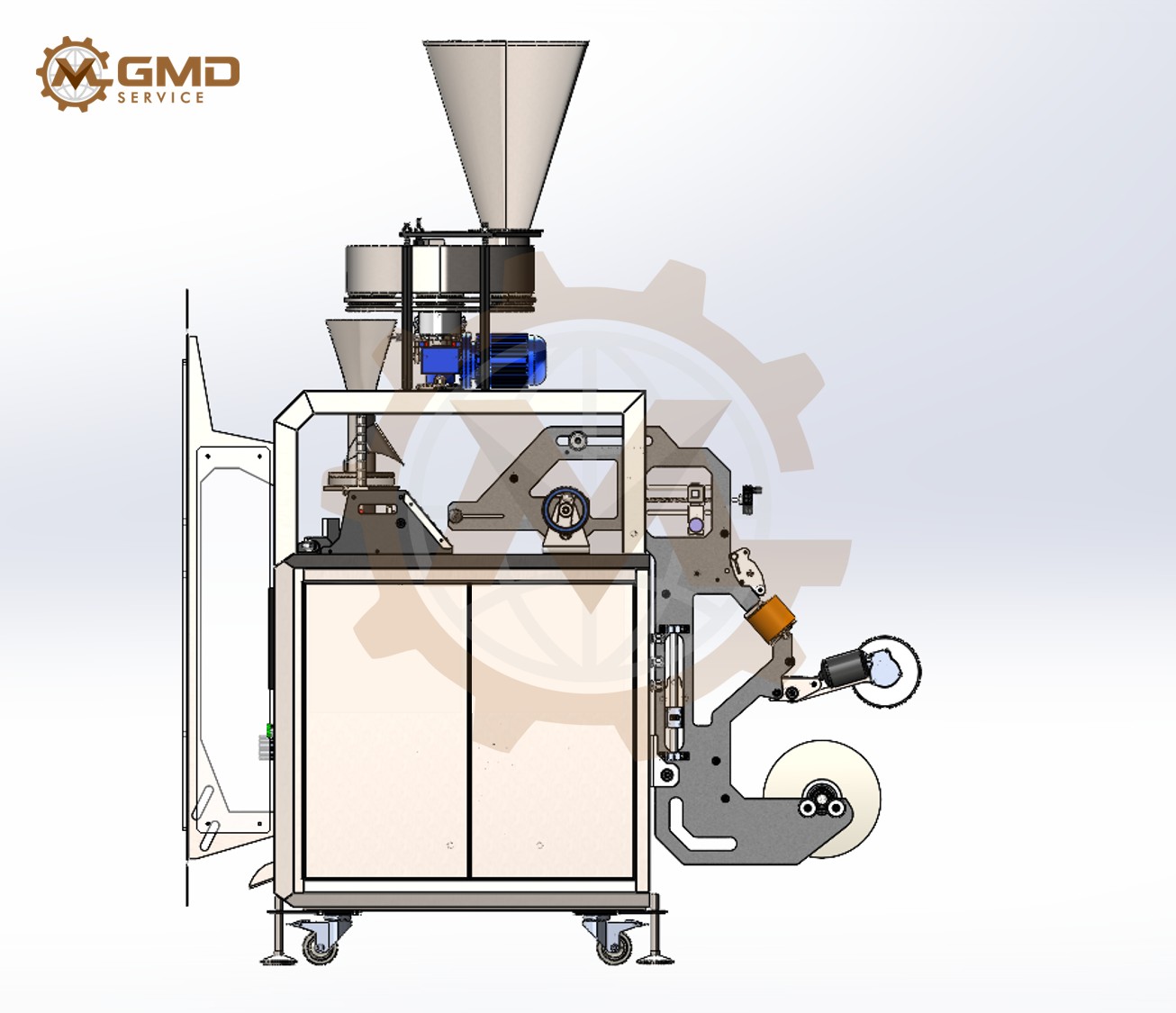
Automatic VFFS Packaging Machine Project Overview
GMD Engineering developed an automatic vertical form-fill-seal packaging machine for packaging granular products into individual sealed bags.
The machine integrates the complete packaging process into one compact system, including product storage, volumetric dosing, packaging-film feeding, bag forming, product filling, heat sealing, bag cutting and finished-package discharge.
Granular products are initially stored inside a large hopper installed at the top of the machine. A four-position rotary cup dosing system measures and transfers a predefined quantity of product to the filling funnel.
At the same time, packaging film is unwound from a roll, guided through a series of rollers and formed into a tubular bag around the forming collar. The product is then discharged into the newly formed bag. The machine seals the bag using heated sealing jaws, cuts it to the required length and guides the completed package onto the discharge chute.
This integrated solution provides a repeatable and efficient packaging process for small granular products while reducing manual product handling and packaging operations.
Objectives of the VFFS Packaging Machine Project
The main objective was to design a compact automatic packaging machine capable of forming bags directly from roll film and packaging a controlled quantity of granular product.
The machine was developed to:
- Store granular products in a large-capacity hopper.
- Measure a repeatable product quantity for each package.
- Transfer the measured product into the filling funnel.
- Unwind packaging film from a roll.
- Guide and tension the film during operation.
- Form flat film into a tubular bag.
- Pull the packaging film downward at a controlled speed.
- Seal the longitudinal edge of the film.
- Create the bottom and top seals of each bag.
- Fill the formed bag with the measured product.
- Cut individual packages to the required length.
- Discharge completed packages through an inclined chute.
- Coordinate all mechanisms within one automatic operating cycle.
Engineering Challenges
Designing an automatic packaging machine requires accurate coordination between the product-dosing system and the film-handling mechanisms.
If the dosing and bag-forming cycles are not correctly synchronized, the product may be released before the bag is ready, become trapped inside the sealing area or cause inconsistent package weights.
Several key engineering challenges had to be considered.
Consistent Product Dosing
The machine must deliver a controlled quantity of granular product during every cycle. Variations in filling volume may affect the weight, appearance and quality of the final package.
Stable Film Feeding
Flexible packaging film can wrinkle, drift sideways or lose tension while being pulled from the roll. The film path, guide rollers and pulling mechanisms must maintain stable movement throughout the cycle.
Accurate Bag Formation
The flat film must wrap smoothly around the forming collar and filling tube to create a uniform tubular bag. Incorrect forming geometry can cause wrinkles, poor edge alignment and unreliable sealing.
Coordinated Product Filling
The product should only be released after the bottom seal has been completed and the bag is correctly positioned. The filling sequence must also finish before the upper sealing jaws close.
Reliable Heat Sealing
The sealing temperature, pressure and contact time must be suitable for the selected packaging material. Insufficient heat can create weak seals, while excessive heat may damage or deform the film.
Accurate Bag Length and Cutting
The film-pulling system must advance a consistent distance for each packaging cycle. The cutting mechanism must then separate the finished bag without damaging the adjacent seal.
Machine Configuration
The machine consists of several coordinated mechanical and control systems.
1. Product Storage Hopper
A large hopper is installed at the top of the machine to store the granular product before packaging.
The hopper uses inclined internal surfaces to guide the product toward the dosing system. Its capacity can be selected according to the required production time, product density and frequency of manual or automatic refilling.
The hopper outlet supplies product to the four-position rotary cup dosing system located below it.
2. Four-Position Rotary Cup Dosing System
The rotary dosing unit contains four volumetric cups arranged around an indexing rotary table.
As the table rotates, each cup moves sequentially through the filling, transfer and discharge positions. At the filling position, granular product from the main hopper enters an empty dosing cup.
The volume of each cup determines the approximate quantity of product supplied to each bag. Interchangeable or adjustable cups may be used when different filling quantities are required.
When a filled cup reaches the discharge position, its contents are released into the product-guiding funnel.
The four-position arrangement enables the dosing process to continue in a repetitive indexed cycle while maintaining a compact machine structure.
3. Product-Guiding Funnel
The product-guiding funnel is positioned below the rotary cup dosing system.
Its purpose is to receive the measured quantity of granular product and direct it into the vertical filling tube. The funnel geometry helps prevent product loss and ensures that the granules travel toward the center of the formed bag.
The internal surfaces should be smooth and appropriately inclined to reduce product accumulation or blockage.
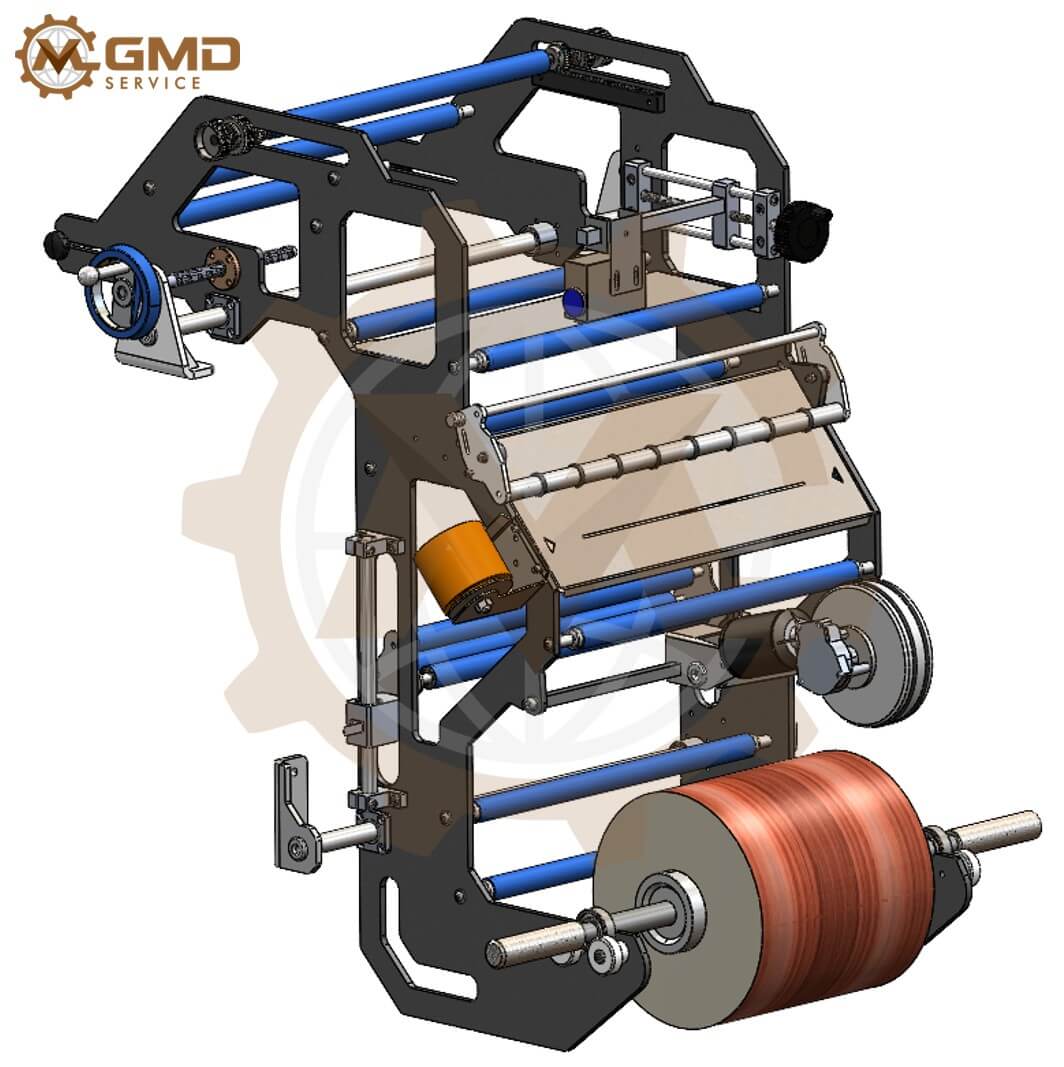
4. Packaging-Film Roll Holder
The packaging material is supplied as a continuous roll of flexible film mounted on the machine.
The film roll holder supports the roll and allows it to unwind during machine operation. The assembly may include mechanical adjustment features to align the roll with the bag-forming system.
The holder must allow convenient roll replacement while maintaining sufficient rigidity during high-speed film movement.
5. Film Guide and Tension Rollers
After leaving the film roll, the packaging material passes through a series of guide rollers.
These rollers establish the correct film path and help maintain stable tension before the film reaches the forming section. Proper roller alignment is important for preventing wrinkles, lateral film movement and uneven bag formation.
Depending on the film characteristics, the system may also include:
- An adjustable tension roller.
- A dancer roller mechanism.
- A film-edge guiding system.
- A brake or controlled unwinding mechanism.
- Registration-mark sensors for printed film.
6. Bag Forming Collar and Filling Tube
The flat packaging film enters a specially designed forming collar.
As the film passes over the forming collar, it wraps around the vertical filling tube and changes from a flat sheet into a tubular shape. The two longitudinal edges of the film overlap or meet along the vertical sealing area.
The forming collar is one of the most important components of a VFFS packaging machine. Its geometry must be designed according to the film width, bag dimensions, film properties and filling-tube diameter.
A correctly designed forming collar enables the film to move smoothly without excessive stretching or wrinkling.
7. Side Film-Pulling Belt Assemblies
Two belt assemblies are positioned on opposite sides of the vertical forming tube.
These belts press against the film and move downward simultaneously to pull the tubular packaging material through the machine. The synchronized belt movement controls the feeding speed and the length of film supplied for each bag.
The belt pressure must be sufficient to move the film without causing slipping, stretching or surface damage.
Servo or stepper motor control can be used to achieve repeatable bag length and coordinate the film movement with the sealing and cutting mechanisms.
8. Longitudinal Heat-Sealing Unit
Once the film has wrapped around the forming tube, its vertical edges must be joined to create a closed tubular structure.
A longitudinal heat-sealing unit applies controlled heat and pressure along the overlapping film edges. Depending on the selected film, the sealing system may operate continuously or intermittently.
The sealing temperature must be adjusted to suit the packaging material and production speed.
9. Horizontal Heat-Sealing and Cutting Unit
A pair of horizontal sealing jaws is installed below the filling tube.
The jaws close across the tubular film to create the horizontal seals that form the bottom of the next bag and the top of the filled bag.
After the product has been discharged into the prepared bag, the film advances to the required length. The jaws close again to seal the top of the filled package.
An integrated cutting blade separates the completed bag from the continuous film tube. Depending on the design, sealing and cutting may be completed during the same jaw-closing movement.
10. Finished-Package Discharge Chute
After sealing and cutting, the completed package falls onto an inclined discharge chute.
The chute guides the bag away from the sealing area and toward a collection bin, inspection station, checkweigher or downstream conveyor.
The chute angle and surface finish are selected to allow the package to move smoothly without becoming trapped.
Automatic Operating Process
Step 1: Supplying the Granular Product
The operator or an upstream feeding system supplies granular product to the main storage hopper.
The product moves downward under gravity and fills the dosing cup located at the loading position of the rotary table.
Step 2: Volumetric Product Dosing
The four-position rotary table indexes by one step.
A filled measuring cup moves toward the discharge position while another empty cup enters the hopper-filling position. This indexed sequence allows the machine to prepare the next product dose while the current packaging cycle is taking place.
Step 3: Unwinding the Packaging Film
The packaging film is pulled from the roll and passes through the guide and tension rollers.
The roller arrangement maintains the required film path and helps keep the material centered before it reaches the forming collar.
Step 4: Forming the Tubular Bag
The flat film moves across the forming collar and wraps around the vertical filling tube.
The longitudinal edges are aligned and joined by the vertical heat-sealing mechanism, creating a continuous film tube.
Step 5: Creating the Bottom Seal
Before the product is released, the horizontal sealing jaws close across the film tube.
This creates the bottom seal of the new bag and ensures that the measured product can be retained inside it.
Step 6: Filling the Product
When the bag is ready, the rotary dosing table moves the filled cup to the discharge position.
The measured quantity of product is released into the guiding funnel and travels downward through the filling tube into the formed bag.
The filling sequence is timed to ensure that the sealing jaws are open and the product does not enter the sealing area.
Step 7: Pulling the Film to the Required Bag Length
After filling, the two side belt assemblies pull the film downward.
The control system advances the film by a programmed distance corresponding to the required bag length. If printed packaging film is used, a registration-mark sensor can be integrated to maintain alignment between the printed design and cutting position.
Step 8: Heat-Sealing the Bag Opening
The horizontal jaws close again after the filled bag reaches the correct position.
This operation seals the upper opening of the filled bag. At the same time, the same seal may form the bottom edge of the next bag, allowing the packaging cycle to continue efficiently.
Step 9: Cutting the Finished Bag
A cutting blade separates the sealed package from the continuous film tube.
The blade position is coordinated with the horizontal seal so that the finished package retains a complete seal while the next bag remains closed at its lower end.
Step 10: Discharging the Completed Package
The finished bag falls onto the discharge chute and moves away from the packaging area.
It can then be collected manually or transferred to an additional process such as:
- Checkweighing.
- Metal detection.
- Labeling.
- Date-code inspection.
- Carton packing.
- Case packing.
- Final product collection.
Control and Synchronization
The machine’s control system coordinates the dosing table, film-pulling belts, sealing jaws, cutting mechanism and product discharge sequence.
The control logic ensures that:
- The dosing cup reaches the correct discharge position.
- A bottom seal is present before filling begins.
- The product is completely discharged before the sealing jaws close.
- The film advances by the correct distance.
- The sealing temperature remains within the required range.
- The cutting mechanism operates only after sealing.
- The next cycle begins only after the previous package has been discharged.
Sensors can monitor film presence, product level, rotary table position, sealing-jaw position and bag discharge.
An HMI can allow operators to adjust production parameters such as:
- Bag length.
- Film-pulling speed.
- Dosing cycle.
- Sealing temperature.
- Sealing time.
- Production speed.
- Manual operating functions.
- Alarm limits.
Key Machine Features
Integrated Form-Fill-Seal Process
The machine forms bags from continuous roll film, fills the product, seals the bag and cuts the finished package within one automatic cycle.
Four-Position Rotary Cup Dosing
The rotary cup system provides a compact and repeatable volumetric dosing method for granular products.
Controlled Film Guidance
Multiple rollers guide the film from the roll to the forming collar while maintaining stable movement and tension.
Synchronized Film-Pulling Belts
Two side belt assemblies pull the film downward evenly and control the final bag length.
Adjustable Heat-Sealing Parameters
Sealing temperature and cycle time can be adjusted to suit different heat-sealable packaging materials.
Integrated Cutting Mechanism
The completed package is automatically separated from the continuous film tube after sealing.
Compact Vertical Design
The vertical machine architecture uses gravity for product transfer and reduces the required factory floor area.
Flexible Production Settings
Bag length, dosing volume and sealing parameters can be adjusted to support different packaging requirements.
Benefits of the Automatic Packaging Machine
The automatic VFFS machine provides several production benefits:
- Reduced manual packaging work.
- Continuous bag production from roll film.
- Repeatable product dosing.
- Consistent bag dimensions.
- Reliable longitudinal and horizontal sealing.
- Reduced product handling.
- Improved packaging productivity.
- Compact machine footprint.
- Faster product changeover.
- Reduced packaging-material waste.
- Easier integration with downstream equipment.
- Improved process control and production monitoring.
Suitable Product Applications
This machine concept can be adapted for packaging many types of free-flowing granular products, including:
- Plastic pellets.
- Seeds.
- Nuts.
- Beans.
- Rice and grains.
- Sugar.
- Salt.
- Small confectionery products.
- Desiccant granules.
- Fertilizer granules.
- Small plastic components.
- Small industrial parts.
The product-contact materials and machine construction must be selected according to the product type, hygiene requirements and operating environment.
Optional Machine Enhancements
Depending on production requirements, the packaging machine can be equipped with additional features such as:
- Automatic product-level control.
- Vibratory product feeding.
- Adjustable volumetric dosing cups.
- Servo-controlled film feeding.
- Printed-film registration sensors.
- Date-code printing.
- Batch-code printing.
- Bag-presence detection.
- Product-in-seal detection.
- Automatic film tracking.
- Stainless-steel product-contact parts.
- Checkweigher integration.
- Metal detector integration.
- Reject handling.
- Outfeed conveyor.
- Remote production monitoring.
Machine Safety Considerations
The final machine must be supported by a risk assessment and an appropriate safety control system.
Potential machine-safety provisions include:
- Guards around the rotary dosing mechanism.
- Covers around film-pulling belts and rollers.
- Protection around heated sealing surfaces.
- Interlocked access doors.
- Emergency-stop devices.
- Temperature monitoring.
- Overtemperature protection.
- Film-jam detection.
- Product-blockage detection.
- Safe manual and maintenance modes.
- Warning labels for hot surfaces and moving mechanisms.
The sealing jaws, cutting blade and film-pulling mechanisms should not be accessible during automatic operation.
GMD Engineering’s Scope of Work
For similar packaging automation projects, GMD Engineering can provide:
- Packaging machine concept development.
- Complete 3D mechanical design.
- Product-dosing mechanism design.
- Rotary cup dosing system design.
- Film roll and roller-path design.
- Bag forming-collar integration.
- Film-pulling mechanism design.
- Heat-sealing unit integration.
- Cutting mechanism design.
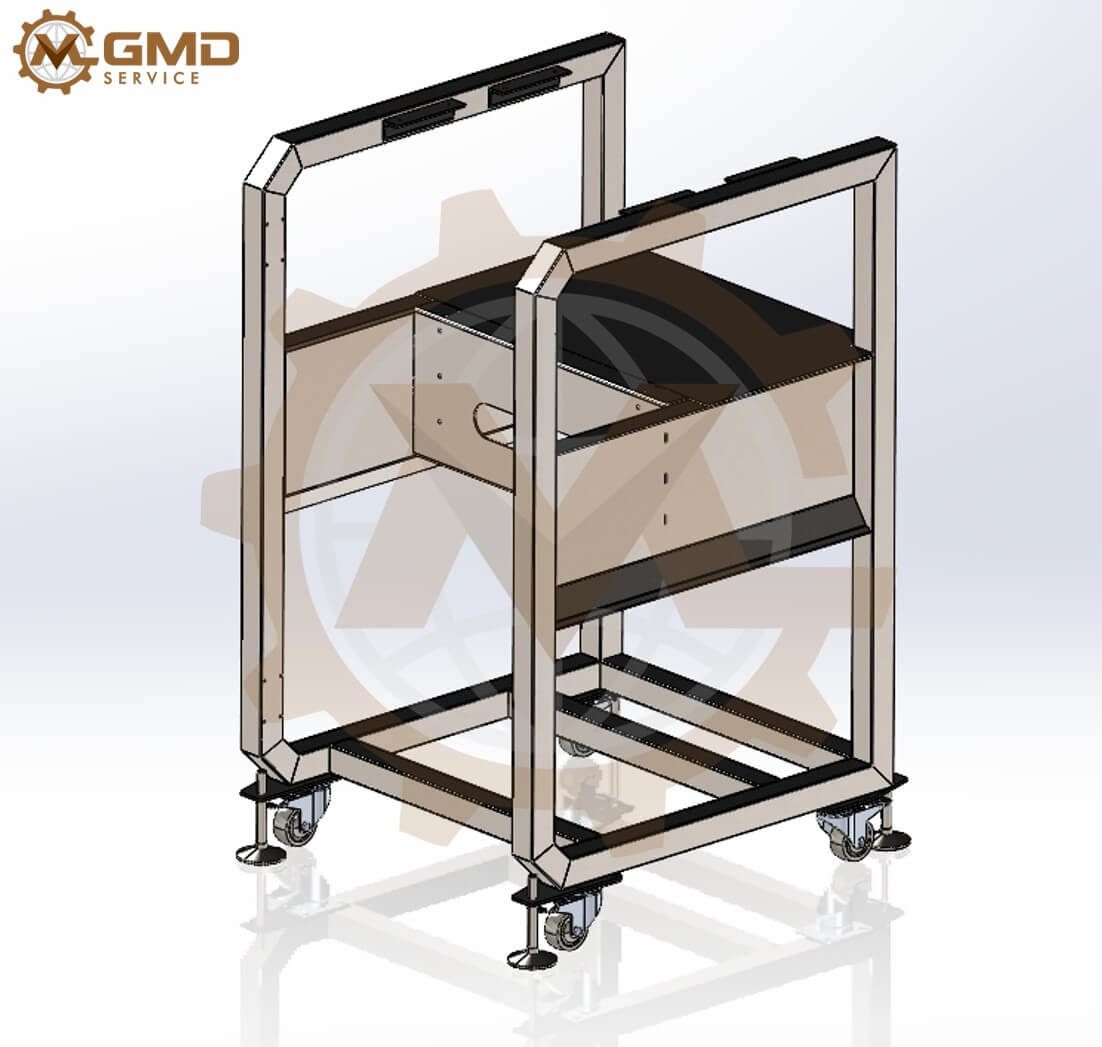
- Machine frame and enclosure design.
- Pneumatic system design.
- Electrical and control-system support.
- Safety guarding design.
- Detailed manufacturing drawings.
- Bill of Materials preparation.
- Assembly documentation.
- Design optimization and engineering support.
Conclusion
The automatic vertical form-fill-seal packaging machine integrates product dosing, film forming, filling, heat sealing, bag cutting and package discharge into one coordinated system.
Granular products are stored in the upper hopper and measured by a four-position rotary cup dosing unit. Packaging film is pulled from a roll, guided through multiple rollers and wrapped around a forming collar to create a tubular bag.
After the bottom seal is created, the measured product is released through the filling funnel and vertical tube. The film is pulled downward to the programmed bag length before the horizontal sealing jaws close, seal the package opening and cut the finished bag. The completed product is then discharged through the inclined chute.
This machine concept provides a compact and practical packaging solution for granular products while improving process repeatability, packaging speed and product consistency.
Looking for a Custom Packaging Machine?
GMD Engineering provides custom machine design and industrial automation engineering services for packaging equipment, dosing systems, bag-forming mechanisms and complete production lines.
Our engineering team can develop a packaging machine based on your product characteristics, filling quantity, bag dimensions, packaging material, required cycle time and factory environment.
Contact GMD Engineering to discuss your custom packaging machine project