
Automatic Sealing Press Machine Design – Case Study
GMD Engineering designed an automatic sealing press machine featuring a circular infeed conveyor, pneumatic product transfer, a step-by-step indexing mechanism, two simultaneous sealing positions, profile pressing, and automatic discharge through an inclined conveyor.
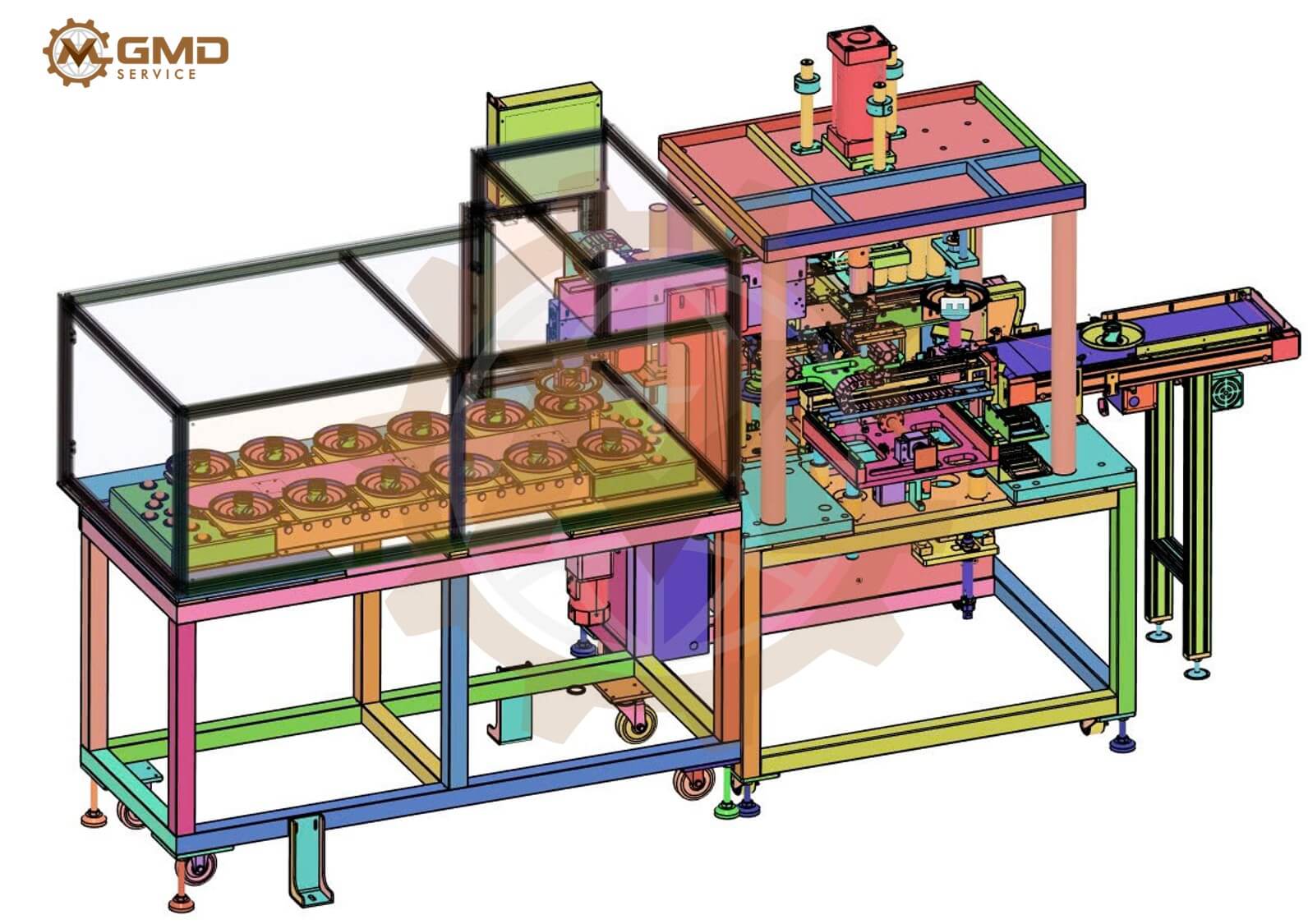
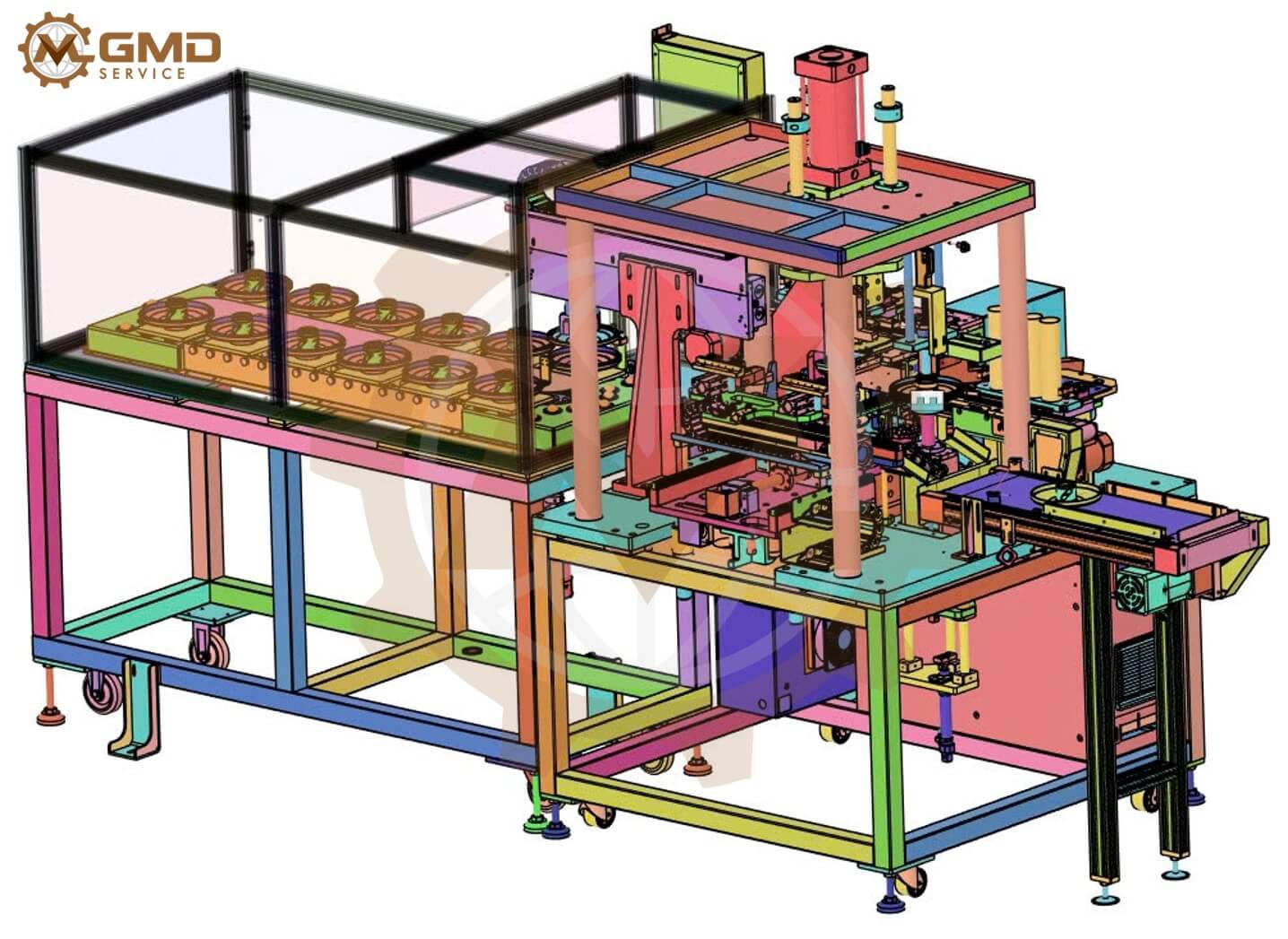
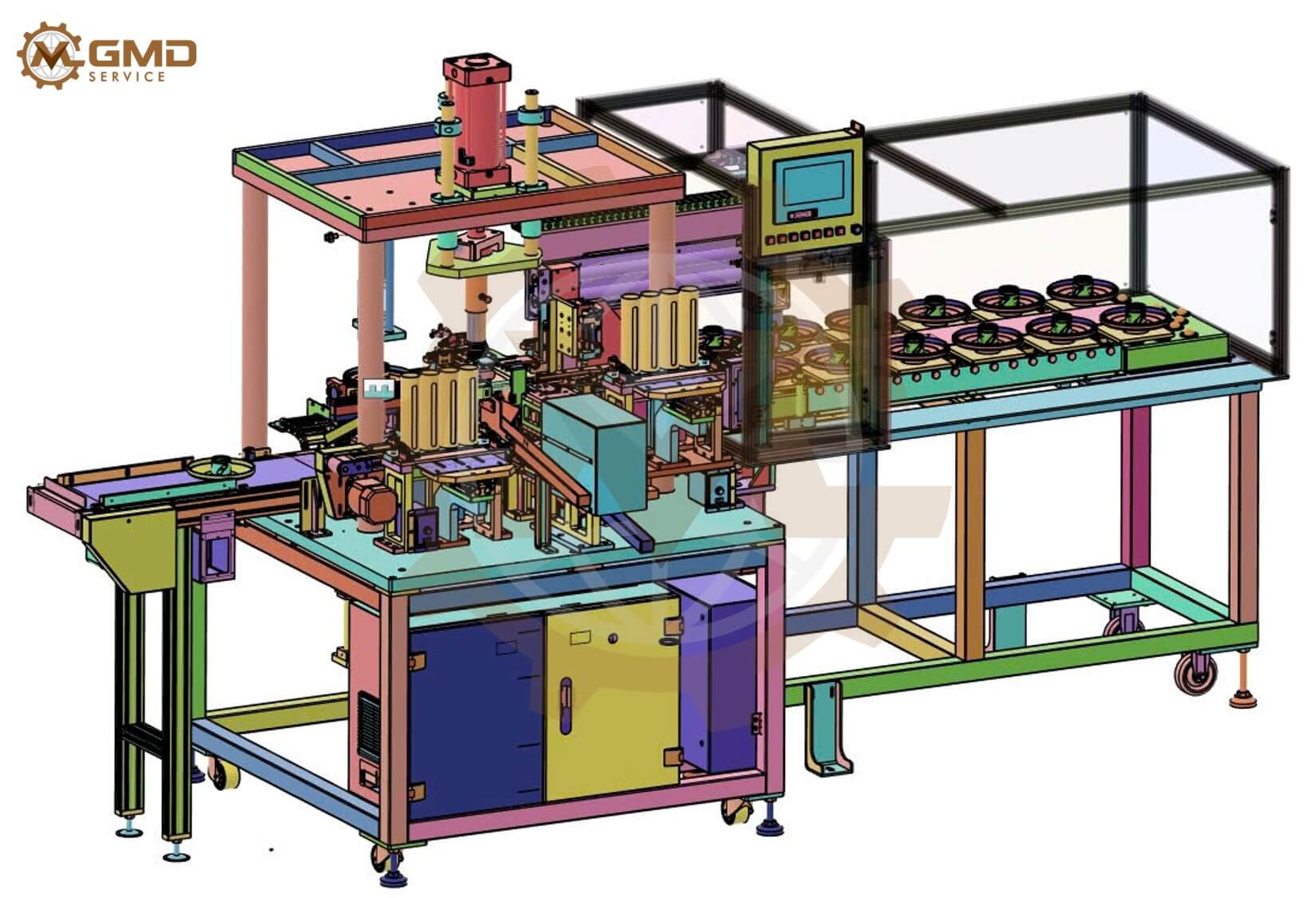
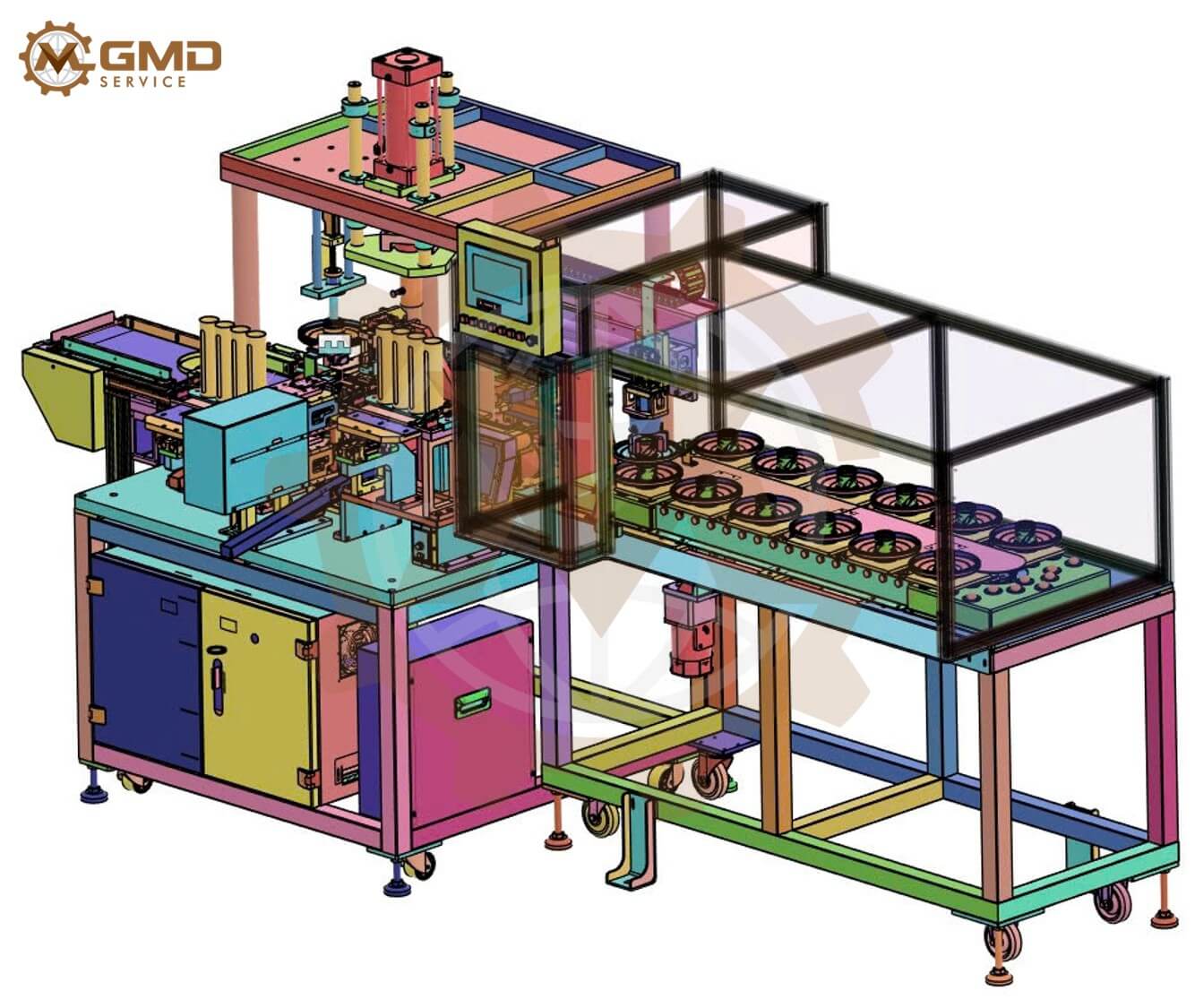
GMD Engineering designed an automatic sealing press machine to improve the consistency, productivity, and safety of a product assembly process. The machine receives products manually, automatically transfers them through two sealing positions, presses the sealing component according to the required profile, and discharges the completed products onto an inclined conveyor.
The system combines a circular infeed conveyor, pneumatic transfer cylinders, a step-by-step indexing mechanism, synchronized sealing stations, and an automatic lifting and unloading unit.
Its compact layout allows several operations to be integrated into one automated machine while maintaining convenient access for operators, maintenance, and production adjustments.
Objectives of the Automated Sealing Press Machine Project
The primary objective of this project was to develop a reliable automated machine capable of transferring and processing products through multiple sealing operations with consistent positioning.
The machine was designed to:
- Allow operators to load products safely and conveniently.
- Automatically transfer products from the loading area to the sealing process.
- Process two sealing positions within the same operating cycle.
- Maintain accurate product positioning during pressing.
- Press the sealing component according to the required product profile.
- Automatically unload completed products.
- Reduce manual handling and operator dependency.
- Improve production consistency and cycle time.
- Provide suitable guarding around the moving mechanisms.
Automatic Sealing Press Machine Working Process
1. Manual Product Loading and Circular Conveyor Transfer
The operator places the products onto the designated fixtures of the circular conveyor.
The conveyor continuously or intermittently rotates the products from the manual loading position toward the pneumatic transfer station. Multiple fixtures are arranged around the conveyor, allowing the operator to load new products while other products are being transferred into the automatic sealing process.
This configuration creates a practical buffer between manual loading and machine processing, helping maintain a stable production flow.
2. Pneumatic Transfer to the Indexing Mechanism
When a product reaches the transfer position, a pneumatic cylinder moves it from the circular conveyor into the step-by-step indexing mechanism.
The transfer system guides the product accurately between the two sections of the machine. Mechanical guides and dedicated product fixtures help maintain the correct orientation during movement.
Sensors can be used to confirm:
- Product presence at the transfer station.
- Correct position of the receiving fixture.
- Extended and retracted positions of the transfer cylinder.
- Successful completion of the transfer cycle.
The next machine cycle begins only after all required positioning conditions have been confirmed.
3. Step-by-Step Movement Through Two Sealing Positions
After entering the processing section, the product is moved through the machine by a pneumatic indexing mechanism.
The indexing cylinder advances the fixtures by one position during each cycle. This mechanism allows the machine to operate at two sealing positions simultaneously.
While one product is being processed at the first sealing position, another product can be processed at the second position. This synchronized operation improves machine productivity compared with a single-station sequential process.
The indexing system also ensures that every product stops at a repeatable position beneath the corresponding working unit.
4. Profile Pressing and Product Discharge
After the sealing operations have been completed, the product reaches the final pressing and unloading station.
A pneumatic lifting cylinder raises the product from its lower fixture and positions it against the upper tooling. The pressing mechanism then applies force along the required profile to ensure that the sealing component is properly seated and follows the geometry of the product.
Once the pressing operation is complete, the lifting unit moves downward and places the finished product onto an inclined discharge conveyor.
The product then travels automatically out of the machine and can be collected by an operator or transferred to the next production process.
Main Machine Components
The automatic sealing press machine consists of the following main assemblies:
Circular Infeed Conveyor
The circular conveyor stores and transports multiple products between the operator loading position and the pneumatic transfer station. Its rotary arrangement provides an efficient loading buffer while keeping the machine footprint compact.
Product Fixtures and Positioning System
Dedicated fixtures locate and support the products throughout the process. The fixtures help control product orientation and improve the repeatability of each sealing and pressing operation.
Pneumatic Transfer Unit
The transfer unit moves products from the circular conveyor into the automatic indexing section. Linear guides and pneumatic cylinders provide controlled and repeatable product movement.
Pneumatic Indexing Mechanism
The indexing mechanism advances the products through the working stations in fixed steps. It coordinates the movement of multiple fixtures and enables simultaneous operation at two sealing positions.
Dual Sealing Stations
Two sealing positions operate during the same machine cycle. This arrangement increases throughput while maintaining sufficient processing time at each station.
The tooling at each position can be designed according to the geometry, material, and assembly requirements of the sealing component.
Lifting and Profile Pressing Unit
The final pressing unit raises the product and applies a controlled force along its required profile. This ensures that the sealing component is correctly positioned and uniformly pressed onto the product.
Inclined Discharge Conveyor
After processing, the finished product is lowered onto an inclined conveyor. The conveyor automatically moves the product away from the machine and provides a convenient collection point for the operator.
Machine Frame and Safety Guarding
The machine is built on a rigid structural frame that supports the transfer, indexing, and pressing mechanisms.
Transparent safety guarding separates the operator from the moving machine components while maintaining visibility of the production process. Access doors can be equipped with safety interlocks to prevent machine operation when the guarded area is open.
Key Engineering Challenges
Accurate Transfer Between Different Mechanisms
The product must be transferred accurately from the circular conveyor into the indexing fixture. Any positioning error at this stage could affect the downstream sealing operations.
To address this requirement, the transfer mechanism uses controlled pneumatic motion, dedicated guiding features, and repeatable product location points.
Synchronization of Two Sealing Positions
Because two products are processed simultaneously, the machine sequence must coordinate the indexing movement, sealing operations, cylinder positions, and safety conditions.
The operating sequence is designed so that indexing can occur only after both sealing stations have completed their respective cycles.
Consistent Profile Pressing
The final sealing component must follow the required product profile without becoming displaced or unevenly pressed.
Dedicated pressing tooling supports the product geometry and distributes the pressing force across the required area. Cylinder stroke, pressing force, and tooling position can be adjusted according to the product requirements.
Reliable Product Discharge
After pressing, the finished product must be removed without interfering with the next indexing cycle. The lifting mechanism lowers the product directly onto the inclined conveyor, allowing gravity and conveyor movement to transport it away from the machine.
Automation and Control Concept
The machine can be controlled by a PLC that coordinates the conveyor, pneumatic cylinders, sensors, and sealing stations.
The control sequence includes:
- Detecting a product at the transfer position.
- Confirming that the receiving fixture is available.
- Transferring the product into the indexing mechanism.
- Moving all fixtures forward by one step.
- Confirming that the products are correctly positioned.
- Activating both sealing stations.
- Performing the final lifting and profile pressing operation.
- Lowering the completed product onto the discharge conveyor.
- Confirming that all cylinders have returned to their safe positions.
- Starting the next production cycle.
The machine can also be equipped with an HMI for production control, manual operation, alarm display, cycle counters, parameter adjustment, and maintenance diagnostics.
Safety Considerations
The sealing press machine incorporates several safety measures to reduce the risks associated with moving cylinders, indexing fixtures, and pressing mechanisms.
Typical safety features include:
- Transparent guarding around the automatic working area.
- Safety-interlocked access doors.
- Emergency stop push buttons.
- Cylinder position sensors.
- Product presence sensors.
- Pressure monitoring for the pneumatic system.
- Two-hand control or protected loading zones where required.
- Controlled machine restart after an emergency stop.
- Mechanical stops and guided tooling at the pressing stations.
- Fault detection and alarm notification through the HMI.
The final safety configuration should be determined by a machine risk assessment and the applicable safety standards for the installation location.
Project Results
The completed machine concept integrates manual loading, automatic product transfer, dual-station sealing, profile pressing, and product discharge into one coordinated production system.
The proposed design provides several operational benefits:
- Reduced manual product handling.
- Improved positioning repeatability.
- Simultaneous operation at two sealing positions.
- More consistent sealing quality.
- Shorter production cycle time.
- Automatic discharge of finished products.
- Improved operator protection.
- Compact and accessible machine layout.
- Easy integration into an existing production line.
- Flexible tooling for future product variants.
Engineering Services Provided
The engineering scope for this project included:
- Machine concept development.
- Mechanical system design.
- 3D CAD modeling.
- Circular conveyor design.
- Pneumatic transfer mechanism design.
- Step-by-step indexing mechanism design.
- Sealing and profile pressing tooling design.
- Product fixture development.
- Discharge conveyor integration.
- Machine frame and safety guarding design.
- Pneumatic component integration.
- Design for manufacturing and assembly.
- Preparation of detailed manufacturing drawings.
- Bill of Materials preparation.
Custom Automated Machine Design Services
At GMD Engineering, we provide custom machine design and industrial automation engineering services for manufacturers, machine builders, and engineering companies worldwide.
Our capabilities include:
- Assembly machine design.
- Automatic pressing machine design.
- Sealing and gasket assembly machines.
- Pneumatic automation systems.
- Indexing and transfer mechanisms.
- Conveyor and product handling systems.
- Custom fixtures and tooling.
- Robotic handling systems.
- Production line design.
- 3D mechanical design and 2D manufacturing drawings.
- Bill of Materials development.
- FEA and motion simulation.
We develop practical machine designs based on the customer’s product geometry, manufacturing process, production capacity, available factory space, and safety requirements.
Looking for an Automatic Sealing Machine Design Partner?
If you are developing a sealing, pressing, assembly, or product handling machine, GMD Engineering can support your project from the initial concept through detailed mechanical design and manufacturing documentation.
Contact us to discuss your product, required cycle time, sealing process, automation level, and production requirements.
Need a Custom Sealing Press Machine?
Contact GMD Engineering to discuss your automatic sealing, pressing, assembly, or product handling machine project.
Related Portfolios
Explore similar engineering portfolios and industrial solutions.

Automatic Medical Tube Cap Assembly and Welding Machine
GMD Engineering developed an automatic medical tube cap...
View Portfolio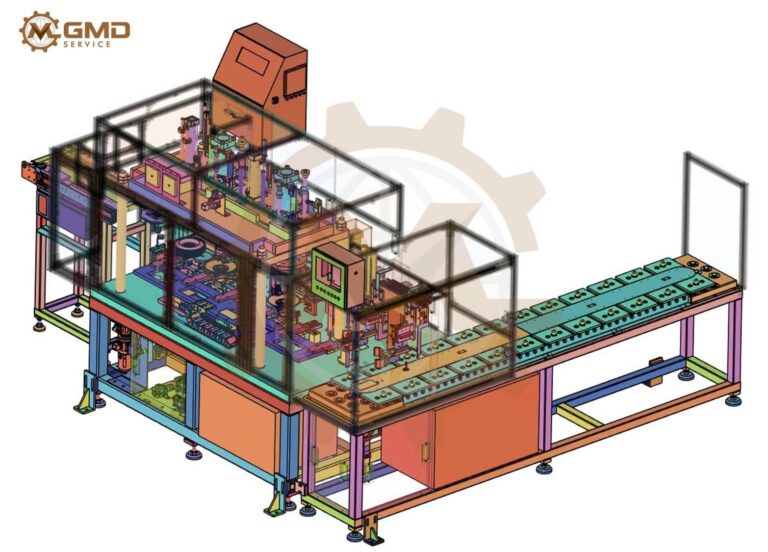
Automatic Bearing Press-Fit and Assembly Machine with Runout Inspection
Discover an automatic bearing press-fit and assembly machine...
View Portfolio
Automatic Connector Terminal Insertion and Dual Housing Assembly Machine Design
Custom automatic connector assembly machine designed for a...
View Portfolio