
Vision-Guided Robotic Palletizing System
A flexible robotic handling system designed for automated goods movement, sorting, and positioning across production, packaging, and warehouse areas.
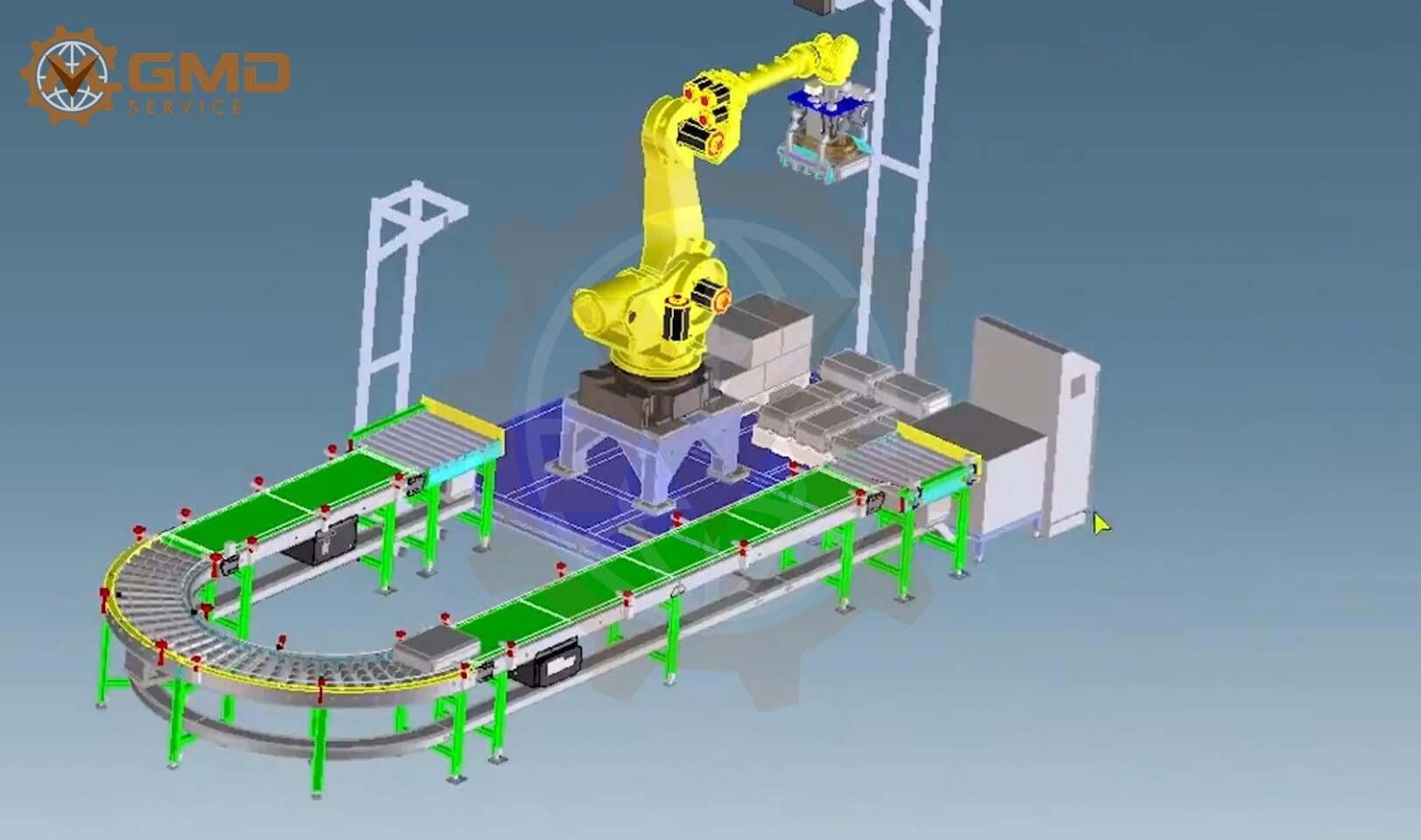


Modern manufacturing requires palletizing systems that are not only fast but also capable of adapting to product variations. This project demonstrates a fully automated robotic palletizing system that combines a U-shaped conveyor, 2D vision, 3D vision, and an industrial robot to achieve high positioning accuracy while reducing manual labor.
The entire system was designed in Autodesk Inventor 2024, allowing complete verification of machine layout, robot reach, conveyor synchronization, and palletizing sequence before manufacturing.
Project Overview
This automatic palletizing solution is designed for factories handling bagged products such as:
- Food
- Animal feed
- Fertilizer
- Chemicals
- Cement
- Powder products
- Granules
Instead of relying on fixed robot coordinates, the system uses machine vision to continuously update product and pallet positions, ensuring consistent stacking accuracy even when bags deform or shift during transport.
System Components
The complete system consists of:
- Industrial Robot
- U-shaped Conveyor System
- 2D Vision Camera
- 3D Vision Camera
- Automatic Pallet Station
- Safety Fence
- PLC Control System
- HMI Operator Panel
- Forklift Loading Area
Working Principle
Step 1 – Bag Transportation
Filled bags enter the U-shaped conveyor system, which continuously transports products toward the robot picking station.
The conveyor layout maximizes floor space utilization while maintaining smooth product flow and ensuring sufficient buffer capacity for continuous operation.
Step 2 – 2D Vision Inspection
When a bag reaches the robot pickup position, a 2D camera captures:
- Bag outline
- Position
- Rotation angle
- Center point
The vision system calculates the exact pick coordinates and sends them to the robot controller.
This eliminates positioning errors caused by conveyor movement or inconsistent bag placement.
Step 3 – Robotic Bag Picking
The industrial robot receives the coordinates from the vision system and moves to the calculated position.
The gripper securely picks the bag and transfers it toward the palletizing station.
Because every pick location is vision-guided, no mechanical positioning fixtures are required.
Step 4 – 3D Camera Measures Pallet
Before placing each bag, a 3D vision camera scans the pallet.
The camera determines:
- Current pallet height
- Existing bag positions
- Surface profile
- Placement availability
This allows the robot to compensate for height variations caused by compressed or uneven bags.
Step 5 – Intelligent Palletizing
Using information from the 3D camera, the robot calculates the optimal placement position.
Each new bag is positioned accurately according to the stacking pattern while maintaining pallet stability.
The robot continuously adapts to:
- Uneven layers
- Bag deformation
- Height differences
- Position offsets
This results in a stable and uniform pallet.
Step 6 – Full Pallet Removal
After the pallet reaches its programmed capacity:
- Robot stops palletizing
- Operator removes the full pallet using a forklift
- Empty pallet is placed into the station
- Production resumes automatically
This minimizes production downtime and keeps the palletizing process continuous.
Key Features
✓ Vision-guided robotic picking
✓ Automatic bag position detection
✓ Automatic pallet height measurement
✓ Adaptive palletizing algorithm
✓ U-shaped conveyor layout
✓ High pallet stability
✓ Reduced manual labor
✓ Continuous production flow
✓ Flexible for different bag sizes
✓ Easy integration into existing production lines
Engineering Challenges
Designing a vision-guided palletizing system involves several engineering challenges:
- Synchronizing conveyor movement with robot operation
- Achieving accurate robot pick positions from moving products
- Compensating for bag deformation
- Maintaining pallet stability across multiple layers
- Updating robot coordinates in real time using 3D vision
- Preventing robot collisions with stacked products
- Optimizing cycle time without sacrificing accuracy
All these factors were validated during the virtual machine simulation stage before manufacturing.
Software Used
- Autodesk Inventor 2024
- Motion Simulation
- Robot Reach Verification
- Collision Detection
- Mechanical Design
- Assembly Design
- Manufacturing Drawings
Benefits
Compared with manual palletizing, this solution provides:
- Higher throughput
- Improved stacking accuracy
- Better pallet quality
- Reduced labor costs
- Improved workplace safety
- Lower product damage
- Increased production consistency
- Easy adaptation to different bag dimensions
Applications
This robotic palletizing solution is suitable for:
- Food factories
- Flour mills
- Animal feed plants
- Fertilizer production
- Chemical factories
- Cement plants
- Packaging facilities
- Logistics warehouses
Looking for a Custom Robotic Palletizing Solution?
At GMD Service, we specialize in designing complete industrial automation systems, including robotic palletizers, conveyor systems, machine vision integration, and custom mechanical solutions.
Our engineering services include:
- Custom machine design
- Conveyor system design
- Robot cell design
- Vision system integration
- 3D mechanical design
- Motion simulation
- Manufacturing drawings
- BOM generation
- Factory automation solutions
Related Portfolios
Explore similar engineering portfolios and industrial solutions.
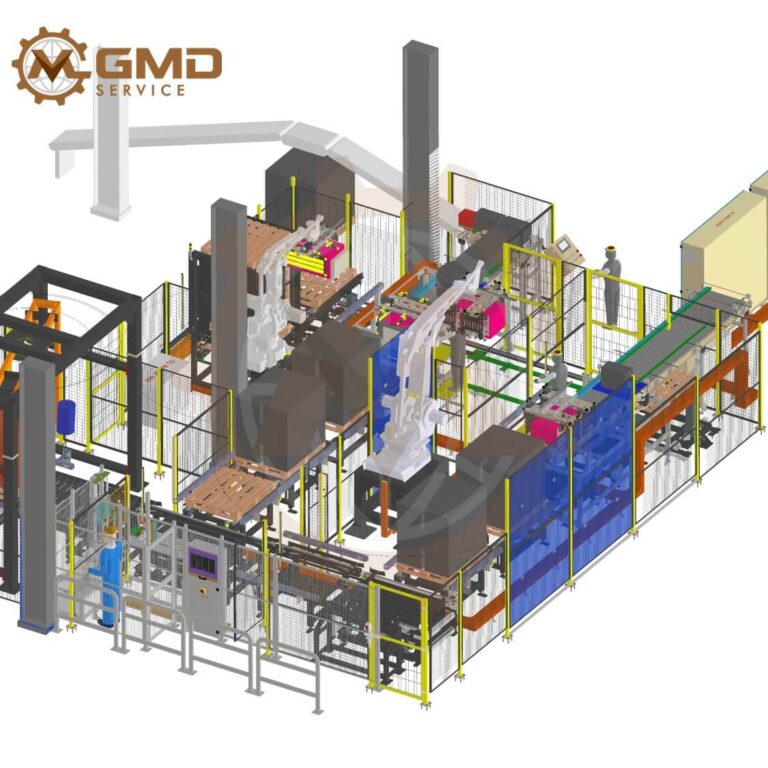
Automated Box Palletizing and Pallet Stretch Wrapping System
An integrated automation system for arranging, packing, and...
View Portfolio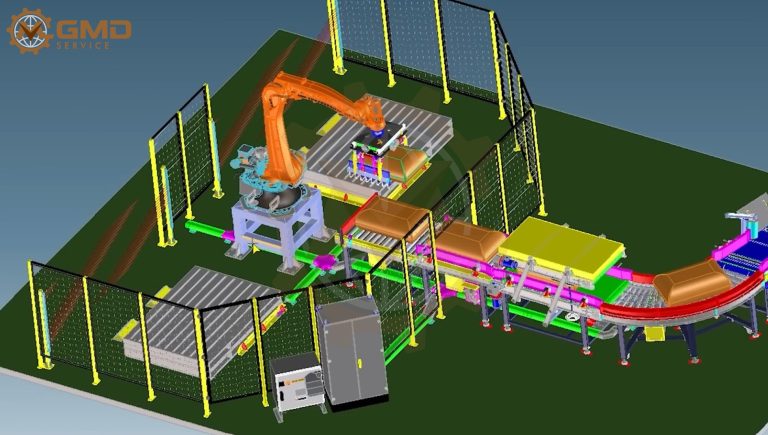
Automatic Bag Handling Robot System | Case Study | Inventor 2024
A robotic bag handling solution developed to automate...
View Portfolio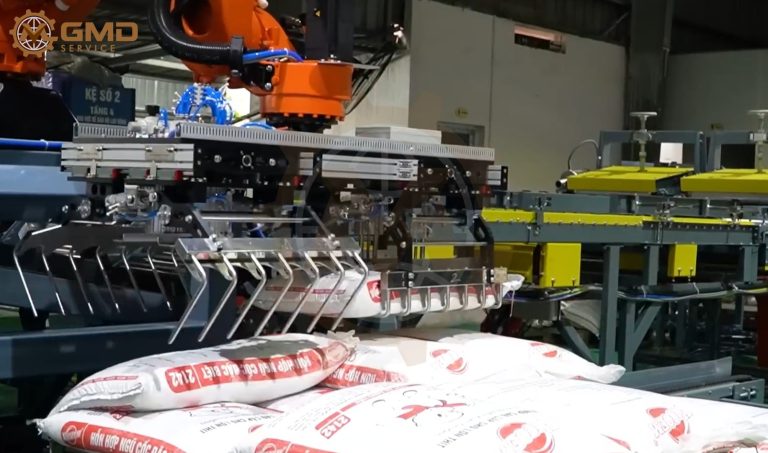
Automated Robotic Bag Palletizing System – GMD Engineering
An automated robotic palletizing system engineered to pick,...
View Portfolio