
Automated Box Palletizing and Pallet Stretch Wrapping System
An integrated automation system for arranging, packing, and palletizing carton box products, ensuring consistent output and efficient end-of-line operation.



Overview
As production capacity increases, manufacturers require highly automated end-of-line solutions capable of handling product palletizing, pallet transportation, and stretch wrapping without manual intervention.
This project showcases a fully automated Box Palletizing and Pallet Stretch Wrapping System developed for a Vietnamese customer. The entire production flow—from empty pallet distribution to robotic palletizing and pallet wrapping—is integrated into one intelligent automation system.
The mechanical design, layout verification, collision analysis, and motion simulation were completed using Autodesk Inventor 2024, ensuring smooth system operation before manufacturing.
Project Information
| Item | Details |
| Project | Automated Box Palletizing and Pallet Stretch Wrapping System |
| Industry | Packaging Automation |
| Customer | Vietnam |
| Software | Autodesk Inventor 2024 |
| Design Year | 2024 |
Project Objectives
The primary objective of this project was to develop a completely automated end-of-line packaging solution capable of:
- Automatically supplying empty pallets
- Separating carton flow
- Orienting cartons correctly
- Robotic palletizing
- Automatic pallet transportation
- Stretch wrapping completed pallets
- Preparing finished pallets for forklift pickup
The entire system operates automatically with minimal operator involvement.
System Layout
The system consists of the following major equipment:
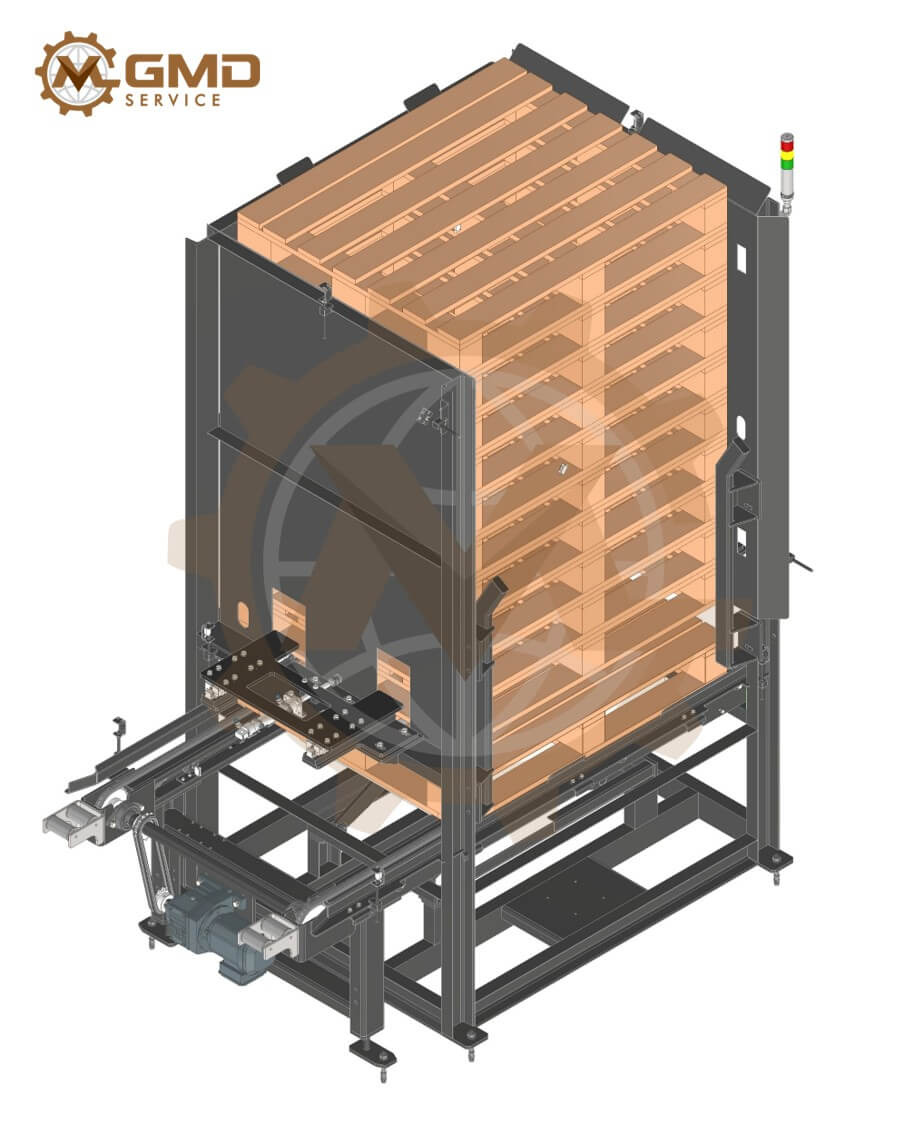
- Empty Pallet Distribution Station
- Automatic Pallet Conveyor
- Dual-Level Conveyor System
- Intermediate Carton Conveyor
- Carton Separation Conveyor
- 90° Carton Turning Conveyor
- Industrial Robot Palletizer
- Pallet Transfer Conveyor
- Pallet Merging Conveyor
- Automatic Stretch Wrapping Machine
- Finished Pallet Conveyor
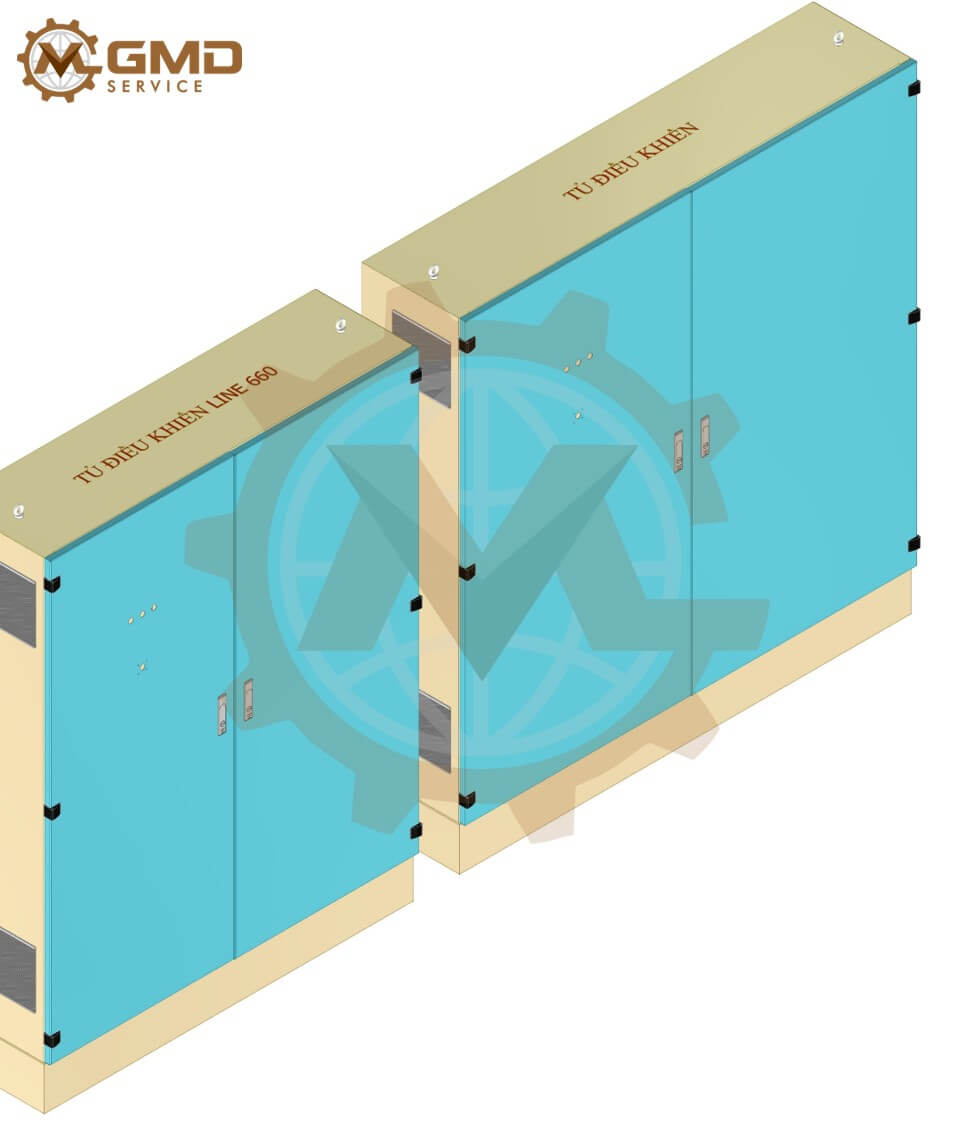
- PLC Control System
- HMI Operator Interface
- Safety Fencing
Dual-Level Conveyor Design
One of the key design features of this project is the dual-level conveyor architecture.
Lower Conveyor (Level 1)
The lower conveyor is dedicated to empty pallet transportation.
Forklift operators load empty pallets into the automatic pallet distribution station.
The conveyor system automatically transfers each pallet to the robot palletizing station without interrupting carton flow.
Upper Conveyor (Level 2)
The upper conveyor transports finished carton products from the upstream production line.
This dual-level arrangement allows pallets and cartons to travel independently while minimizing factory floor space.
The design significantly improves system efficiency and simplifies maintenance.
Working Principle
Step 1 – Cartons Arrive from Previous Production Line
Finished carton boxes are transferred from the upstream production process onto an intermediate conveyor.
The conveyor maintains continuous product flow while providing sufficient accumulation capacity.
Step 2 – Carton Separation and Orientation
The cartons are automatically divided into two conveyor lanes.
Each carton is then rotated by 90 degrees to achieve the required orientation before robotic handling.
Proper product orientation ensures consistent gripping performance and stable pallet patterns.
Step 3 – Robotic Palletizing
The industrial robot picks each carton from the conveyor and places it onto the pallet.
The robot follows predefined palletizing patterns while maintaining accurate positioning throughout every layer.
The pallet continues building until reaching the programmed:
- Number of cartons
- Number of layers
- Maximum pallet height
The palletizing pattern can easily be modified for different carton sizes and customer requirements.
Step 4 – Full Pallet Transfer
Once the pallet is complete, it automatically exits the robot station.
The pallet is transferred onto a pallet merging conveyor before entering the stretch wrapping area.
Meanwhile, a new empty pallet is automatically delivered to the robot, allowing palletizing to continue without interruption.
Step 5 – Automatic Stretch Wrapping
The completed pallet enters the automatic stretch wrapping machine.
The wrapper applies stretch film around the entire pallet load, securing cartons during storage and transportation.
Proper wrapping improves:
- Load stability
- Product protection
- Transportation safety
- Warehouse handling
Step 6 – Finished Pallet Discharge
After wrapping, the pallet moves to the finished goods conveyor.
The pallet waits in the discharge area until a forklift operator removes it for delivery to the next production stage or warehouse.
No manual handling is required during the palletizing and wrapping process.
Automatic Pallet Distribution
The empty pallet handling process is fully automated.
Forklift operators simply load stacks of empty pallets into the pallet dispenser.
The system automatically:
- Separates individual pallets
- Transfers pallets to robot stations
- Synchronizes pallet supply with robot operation
- Eliminates manual pallet loading
This significantly reduces operator workload and improves production continuity.
Key Features
- Fully automated palletizing process
- Automatic empty pallet distribution
- Dual-level conveyor system
- Automatic carton separation
- 90° carton orientation
- High-speed industrial robot
- Continuous pallet supply
- Automatic pallet transfer
- Automatic stretch wrapping
- Finished pallet discharge
- Modular machine design
- Flexible palletizing patterns
- Easy integration into existing production lines
Engineering Challenges
Developing a fully automated palletizing line requires careful consideration of multiple engineering factors, including:
- Synchronization between pallet conveyors and carton conveyors
- Continuous robot operation without waiting for pallets
- Collision-free robot movements
- Stable palletizing patterns
- Conveyor buffering
- Product orientation accuracy
- Stretch wrapper integration
- Forklift accessibility
- Factory layout optimization
All these challenges were addressed during the digital design stage using Autodesk Inventor 2024.
Design Software
The entire project was designed using:
- Autodesk Inventor 2024
- 3D Mechanical Design
- Assembly Design
- Motion Simulation
- Robot Reach Verification
- Collision Detection
- Manufacturing Drawings
- BOM Generation
Customer Benefits
This automated solution provides numerous advantages over manual palletizing operations.
Increased Productivity
Continuous robotic operation enables significantly higher throughput compared to manual handling.
Reduced Labor Costs
Only forklift operators are required to replenish empty pallets and remove finished loads.
Improved Product Quality
Consistent robotic palletizing creates stable, uniform pallet loads.
Enhanced Workplace Safety
Employees are no longer required to manually lift heavy cartons.
Better Floor Space Utilization
The dual-level conveyor design optimizes available factory space.
Flexible Production
The palletizing program can easily accommodate different carton dimensions and pallet patterns.
Typical Applications
This system is ideal for:
- Food & Beverage
- Consumer Goods
- Beverage Packaging
- Home Appliances
- Electronics
- Pharmaceutical Packaging
- Logistics Centers
- Distribution Warehouses
- FMCG Manufacturing
- Industrial Packaging Lines
Why Choose GMD Service?
At GMD Service, we specialize in designing complete industrial automation systems tailored to each customer’s production requirements.
Our expertise includes:
- Robotic Palletizing Systems
- Conveyor System Design
- End-of-Line Automation
- Packaging Machine Design
- Custom Industrial Machinery
- Mechanical Engineering
- Factory Layout Design
- Motion Simulation
- Manufacturing Drawings
- BOM Generation
- Autodesk Inventor Design Services
Every project is developed with a strong focus on productivity, reliability, maintainability, and future scalability.
Looking for a Custom Automation Solution?
Whether you need a robotic palletizing system, conveyor automation, packaging equipment, or a complete end-of-line solution, GMD Service can help transform your concept into a reliable production system.
Contact us today to discuss your next industrial automation project
Related Portfolios
Explore similar engineering portfolios and industrial solutions.

Vision-Guided Robotic Palletizing System
A flexible robotic handling system designed for automated...
View Portfolio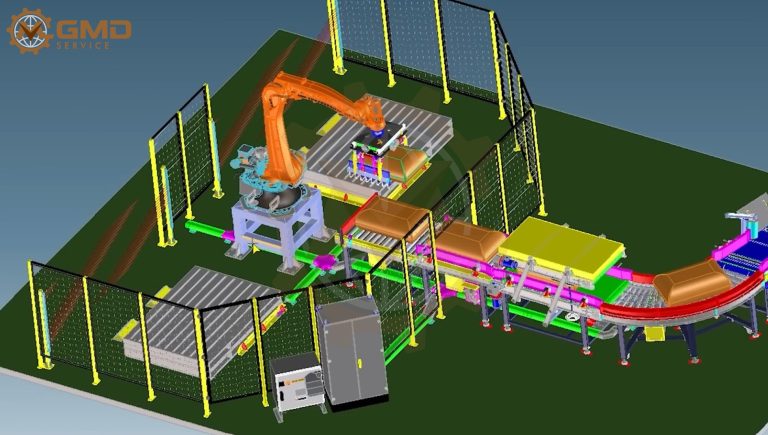
Automatic Bag Handling Robot System | Case Study | Inventor 2024
A robotic bag handling solution developed to automate...
View Portfolio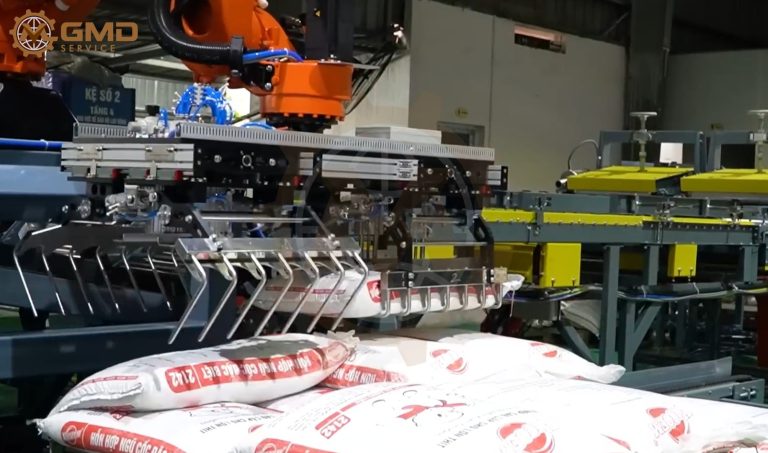
Automated Robotic Bag Palletizing System – GMD Engineering
An automated robotic palletizing system engineered to pick,...
View Portfolio